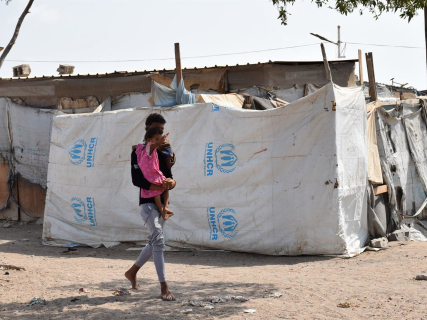

The International Organization for Migration (IOM) warned this Wednesday that the number of people forced to flee their homes in Yemen due to the conflict has surpassed the threshold of 200,000, in an emergency that is advancing at an "alarming" rate and for which there are barely any economic resources available.
In a statement, the IOM specified that "a total of 201,217 people have been forced to leave their homes in Yemen since the fighting began," in which Houthi rebel militias are facing the internationally recognized government forces and the coalition led by Saudi Arabia.
The province of Taiz is the hardest hit, with 114,708 displaced, more than half of the total. Following are Lahj, with 42,264; Aden, with 20,814; Abyan, with 9,030, and Hodeidah, with 8,244. Alongside these five governorates, the areas of Hadramaut, Shabwa, Marib, Al Mahra, and Ad Dali have also been impacted.
The agency added that, in addition to internal displacement, more than 3,700 people who have left their homes have attempted to escape by sea to Djibouti.
The IOM has insisted that "the speed of this crisis is alarming." Of the more than 201,200 displaced by the war in Yemen, 197,755 (more than 98%) have left their homes since September 1. Since that date, the increase has been very rapid: the IOM recorded 76,000 displaced in mid-September, 145,000 at the end of the month, and 201,217 after the first week of October. Now, the organization expects "that displacement will continue to increase in the coming days."
"People are fleeing to save their lives and cannot find any safe place to go," said the Director General of the Organization, Amy Pope, who emphasized that these people "need shelter, food, and security today" and that, although the agency's teams "are on the ground (...), funds are lacking."
For this reason, she has called on donors "to act now, because every day of delay costs lives." "Yemen must not become a forgotten crisis," she stated, reminding that "the world has the means to help (and) must use them now."
"Every day, our teams encounter families who have lost everything," Pope indicated. "We know what they need and we know how to get it to them. What we lack are the means to reach all of them," she added.
In this line, the IOM has emphasized that "the response is severely underfunded," and that the humanitarian response plan for Yemen "only has funds to cover 20% of the needs." "Aid reserves are running out," it has warned, pointing out that "needs are growing much faster than the available resources to address them."
The organization has explained that "IOM teams are collaborating with local authorities and their partners to provide emergency shelter, essential household items, cash, drinking water, and protection services. In Djibouti, the IOM provides assistance to people upon their arrival on the coast," although it highlights that "it is not enough."
Therefore, it has launched "an appeal to the international community for immediate funding that allows humanitarian partners to save lives in Yemen," while urging "all parties to protect civilians and humanitarian personnel, as well as to allow safe and unhindered access to those in need."
DUJARRIC ALERTS TO THE GRAVITY OF THE SITUATION
On this scenario, the spokesperson for the UN Secretary-General, Stéphane Dujarric, has spoken at a press conference, highlighting the deterioration of the healthcare system, where "cholera cases have tripled in recent weeks, even in displacement camps, while measles, dengue, and malaria continue to spread."
He has also noted the warning from the World Health Organization (WHO), stating that "the increase in displacement, disease outbreaks, and conflict is putting even more pressure on a healthcare system in Yemen that is already very fragile."
"Access also represents a growing problem," he added, detailing next that "key roads connecting the governorate of Taiz with Mocha, Hodeida, Aden, and Sana'a remain blocked, severely restricting the movement of civilians and commercial supplies, as well as humanitarian access." In this context, "there have been reports of shortages of basic goods and medical supplies, as well as sharp increases in food and fuel prices."