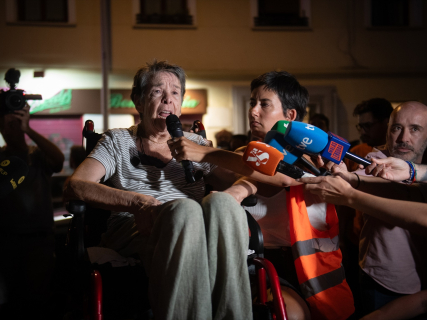

Until just two weeks ago, Maricarmen Abascal was a neighbor from Retiro who had spent practically her whole life in the same home. She was 87 years old and had lived for 71 years in an apartment on Alcalde Sáinz de Baranda street that had been her home since she was a teenager. The eviction carried out on September 23 made her story transcend the neighborhood and ended up becoming one of the main faces of the protests for housing in Madrid.
Maricarmen died this Wednesday at the Gregorio Marañón Hospital in Madrid, as communicated by the Tenants' Union, after being hospitalized since the day she had to leave her home. Her death comes when her name had already become associated with a mobilization that continued even after an agreement was reached for her to be able to return home.
A whole life in her home in Retiro
Maricarmen arrived at that home at 16 years old and remained there for 71 years. There she spent a good part of her life until the procedure to recover the property opened a conflict that gained public attention as the date of the eviction approached.
Her age and, especially, the time she had been residing in the apartment made the case quickly resonate among housing collectives. The Tenants' Union began to accompany her and the calls to try to prevent her eviction gathered neighbors and activists in front of the property.
The story then ceased to be solely about an eviction procedure. Maricarmen came to represent for the mobilized organizations the situation of long-term tenants who can lose the home in which they have developed a good part of their lives.
Symbol of the protests
The turning point came on September 23. The execution of the eviction and Maricarmen's exit on a stretcher multiplied the impact of a case that until then had been fundamentally confined to the housing movement and the neighborhood.
Her name began to appear from that moment in subsequent calls. The protests left Alcalde Sáinz de Baranda street and reached the center of Madrid, while "Maricarmen" became a regular reference on banners and slogans.
The mobilization ended up also leading to the camping at Puerta del Sol, from where different groups have expanded the demands far beyond their particular case, with demands related to evictions, the duration of contracts, or the price of rents.
The agreement that was supposed to take her back home
The story of Maricarmen took a turn just a week after her departure. The negotiations allowed for an agreement so that she could return to the home when she received the hospital discharge, with a new contract that made it possible for her to return to the apartment where she had lived for more than seven decades.
The pact also turned her case into a reference for those who had participated in the mobilizations. However, the return never came to happen. Maricarmen remained hospitalized until her passing this Wednesday.
Her family, her lawyer, and the Tenants' Union have bid her farewell remembering a request that, according to the statement released after her death was known, she conveyed to them during the conflict: "Fight, keep fighting for what is yours".
A name that ended up entering the political debate
In just two weeks, the case of an 87-year-old woman from Retiro ended up becoming part of the national debate on housing. The subsequent mobilizations coincided with the political discussion about the Government's measures regarding rents and evictions and with the later call for a general strike for housing.
Her personal story was thus linked to a much broader protest that continues after her death. The Tenants' Union has announced that it will maintain the mobilizations and has precisely positioned the continuity of that protest as part of the legacy it attributes to Maricarmen.