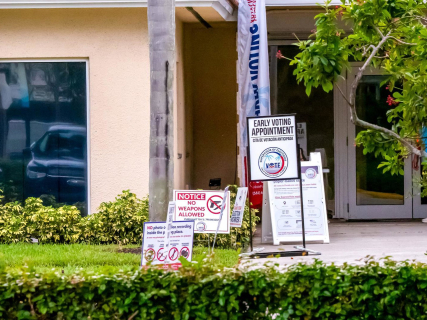

More than half of the around ten million Americans who have already cast their early vote for the legislative elections on November 3 in the United States are listed in the census as aligned with the Democratic Party. This initial push comes at a time when projections suggest that the 'midterms' could mark a significant turn in the political trajectory of the country, as a Democratic victory in at least one of the two chambers of Congress is deemed very likely.
Republicans, however, are accustomed to this start of Democratic mobilization and often make a comeback in the final stretch, often on the same day of the vote. This pattern was clearly seen in the presidential elections two years ago, when Donald Trump ended up prevailing over what many polls had positioned as the favorite, Kamala Harris.
At a recent dinner with party donors, former President Barack Obama reminded attendees with frustration that the volatility of the polls tends to harm Democrats. "We ended up losing by two points all the races that were tied going into the polls. That is the margin of error," he lamented, referring to contests that seemed close and ended up tipping against them.
This electoral cycle, however, presents new elements that worry Republicans. The main polls practically declare the House of Representatives lost for them, while control of the Senate remains up in the air. This scenario would have been hard to imagine before the severe fuel crisis triggered in February of this year following the start of the war with Iran, which has altered the political and economic climate of the country.
To this context is added the tradition that the legislative elections function as a kind of referendum on the administration in the White House, regardless of who occupies the presidency. Additionally, Trump supporters face these elections without the direct reference of their leader, as his name does not appear on the ballots, complicating the mobilization of the most loyal conservative electorate.
To try to compensate for this symbolic absence, the president has been immersed for weeks in an intense campaign tour with which he intends to convince his base that voting for Republican candidates is, in practice, equivalent to supporting him. This strategy could backfire, as his approval rating is at historic lows of his second term, according to the latest YouGov poll.
Meanwhile, early voting data shows registered voters as Democrats ahead of Republicans, in some cases with wide margins, in several key states. In Texas, where early voting began this Tuesday, traditionally Democratic counties like Harris and Dallas are recording record participation figures in a territory where no Democratic candidate has managed to prevail in the last three decades. In 2024, Trump won there by a margin of 14 points.
In Michigan, Democrats surpass Republicans by 55% to 36%, driven by the emergence of Senate candidate Abdul el Sayed, one of the most visible faces of the progressive wing that has reactivated a disenchanted electorate with the immobility of the party's old guard. This push has increased participation in North Carolina by 37% compared to the 2022 midterms, and in Iowa there is already a 30 percentage point gap in favor of voters from the 'blue' party.
The presence of ICE and the fear of intimidation at the polls
U.S. legislation strictly prohibits the presence of immigration agents, military, or armed police at polling places, except in exceptional situations where it is necessary to repel "armed enemies" of the country. The Department of Homeland Security itself has indicated that it does not foresee that scenario unless there is a court order, but the mere fear that ICE may deter part of the electorate has led Human Rights Watch (HRW) to demand clear guarantees from the Government so that every citizen can exercise their right to vote without fear.
"It is necessary for ICE agents to receive a public and explicit order to stay away from polling places and wherever people are voting," concluded HRW Executive Director Philippe Bolopion, demanding unequivocal instructions that prevent any type of intimidating presence.
A survey conducted in September by the University of San Diego revealed that 40% of the respondents took for granted that anti-immigration agents would be seen during the elections. A study carried out by HRW itself in 2025 pointed out that ICE used race and ethnic origin as a rudimentary criterion to infer the nationality of individuals in Los Angeles, proceeding to detain people on that basis.
As a result of these practices, among those arrested were naturalized U.S. citizens who were registered to vote. "It is very likely that, among non-white communities, the perception of the risks associated with an encounter with ICE is greater," warns the organization, alerting to a possible deterrent effect on the exercise of voting.
Another investigation by the NGO Democracy Forward, released on October 7 of this year, revealed that the ICE Investigations Division is building a database to track alleged irregular voters, despite the fact that this phenomenon lacks real weight in the final results. The file would include tens of millions of records and, furthermore, the agency would have considered deploying undercover agents to investigate organizations suspected of helping non-citizens register to vote.
In light of this situation, the League of Women Voters, the Electronic Privacy Information Center (EPIC), and the League of United Latin American Citizens (LULAC) filed a lawsuit on October 15 against the "secret and illegal effort by the Trump administration to collect sensitive personal information from millions of U.S. voters in a massive national database."
HRW reminds that "the abuses by ICE agents have already severely affected U.S. citizens, who have been intercepted, beaten, detained, deported, and even killed." In the organization's view, it would be unacceptable that, at this point, "they were afraid to go to the polls," laments Bolopion, who calls for immediate measures to prevent fear of immigration authorities from interfering with electoral participation.