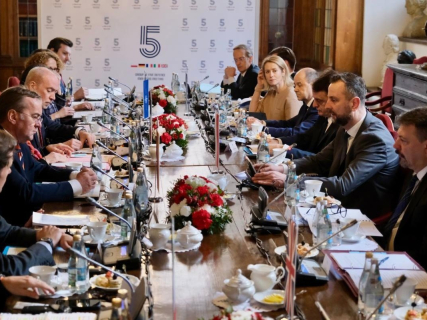

The defense ministers of the five European countries that allocate the most resources to the military —France, Germany, Italy, Poland, and the United Kingdom— have decided this Monday to intensify their political and military coordination in light of the increasing threats from Russia. The aim is to move towards a "more structured" and "more effective" cooperation through new rounds of work among their strategic planning officials and their high military commands.
The announcement came after the meeting in Paris of the so-called E5 format, a gathering that also included the participation of the High Representative of the European Union for Foreign Affairs, Kaja Kallas; the European Commissioner for Defense, Andrius Kubilius; and the NATO Deputy Secretary General, Radmila Shekerinska.
The German Defense Minister, Boris Pistorius, detailed that the five partners aspire to provide this forum with a "more organized" and "more effective" cooperation, capable of anticipating security challenges and translating political commitments into tangible actions.
In this regard, he noted that, in addition to high-level meetings, the five countries will hold specific meetings among their political planning officials and military leaders, with the first meetings scheduled for this year in Berlin.
"We want to speak with one voice as Europeans," emphasized Pistorius, highlighting that the five main military powers of the continent must remain "aligned" to provide a joint response to security challenges.
The French Defense Minister, Catherine Vautrin, emphasized the need for these five European powers to collaborate closely to build "a stronger Europe within a stronger NATO," in an increasingly unstable international environment.
Vautrin also advocated for strengthening the interoperability of European armies, increasing the resilience of supply chains, and ensuring greater control over strategic technologies, objectives for which she considers the financial instruments of the European Union essential.
In the same line, the European Commissioner for Defense, Andrius Kubilius, has highlighted that the E5 is consolidating as an informal space for coordination among the main military and industrial powers of the continent, with the capacity to exercise "political leadership" over the entire EU member states and, at the same time, strengthen cooperation with the United Kingdom.
Cooperation must be strengthened beyond politics
The Italian Minister of Defense, Guido Crosetto, has emphasized that none of the five countries, no matter how extensive their military or industrial capabilities are, is in a position to face the current security risks alone.
"Together we will have the strength and the capacity to do it from an industrial, economic, and military point of view," he stated, before stressing that cooperation must go beyond political meetings and be consolidated through the coordinated work of military leaders.
In similar terms, the Polish Deputy Minister of Defense, Pawel Zalewskiha, has advocated for strengthening the European pillar of NATO and increasing Europe's responsibility for its own defense. However, he warned that any potential reduction of the U.S. military presence on the continent must be agreed upon with Washington to avoid security vacuums.
At the same time, he emphasized that the United States remains "an important partner of NATO" and that Europeans "do not want that to change."
In this line, Kaja Kallas has reminded that Europe is allocating "record" amounts to defense, although she has warned that this budgetary effort must be reflected in "real capabilities" through the modernization of the Armed Forces and greater European military preparedness.
United Kingdom warns of the greatest threat since the Cold War
The British Minister of Defense, Wes Streeting, has warned that Europe is facing a scenario of threats and instability "that we have not seen since the end of the Cold War," and has emphasized that the risk posed by Russia "is not just a hypothetical future threat," but materializes "day by day, week by week" through hybrid attacks against European countries.
Streeting has defended, therefore, strengthening military cooperation among allies and increasing investment in defense, while emphasizing that the United Kingdom is undertaking "the largest sustained increase in defense spending since the end of the Cold War."
He has also insisted that Europe must not only spend more but "spend more intelligently," accelerate military innovation, and expand its industrial base to "produce more than our adversaries."
Firm support for Ukraine against Russian threats
During the meeting, the ministers analyzed the rise of hybrid threats attributed to Russia which, as Pistorius has denounced, aim to "instill fear," undermine citizens' trust in their institutions, and erode the unity of allied countries.
The German minister has also accused Russian President Vladimir Putin of "buying time" with negotiations to end the war in Ukraine, considering that there are no signs that Moscow is genuinely seeking peace while it continues to intensify its attacks on energy infrastructure and the Ukrainian civilian population.
For his part, the Polish Deputy Minister of Defense has denounced Russia's "brutal" hybrid attacks against European countries and has called for strengthening cooperation among allies to address these actions.
In this context, the five countries have reiterated their commitment to maintain military support for Kiev and to deepen collaboration with its defense industry, with special attention to increasing the production of armaments and improving air defense capabilities against Russian attacks.
NATO's Deputy Secretary General, Radmila Shekerinska, has finally urged allies to do "more" and do it "now" to strengthen Ukraine's air defense and missile defense capabilities, while insisting on the urgency of increasing European industrial production.
"The more we can produce, the more we can support Ukraine," she emphasized, also advocating for closer cooperation with the Ukrainian military industry for the manufacture of drones and anti-drone systems.