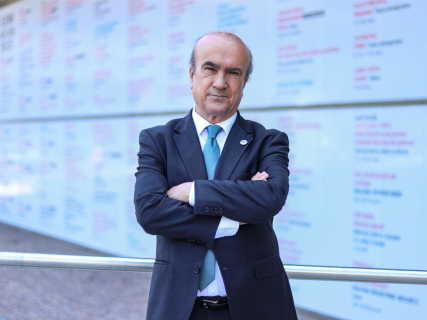

The secretary general of the Organization of Ibero-American States for Education, Science and Culture (OEI), Mariano Jabonero, has predicted that the XXX Ibero-American Summit that will take place in Madrid on the next 4 and 5 of November will be a "success", underscoring that on this occasion intensive work is being done to achieve concrete results, unlike other editions in which a "greater rhetoric" predominated.
"I think there has been an effort that I had not seen in previous summits. Comparatively there is a much greater effort in concreteness and a fairly solid commitment compared to other moments in which there has been greater rhetoric," he assured in an interview with the Europa Press agency days before the summit organized by Spain.
Jabonero insists that the Ibero-American Summit will be "a success" and recalls, as an element of contrast, that the previous meeting in Ecuador in 2024 "was a failure", due to the low attendance and the absence of significant progress. He also highlights Spain's "strong leadership" in the Ibero-American sphere and the direct involvement of the Royal House in the preparations, stressing that Felipe VI is a figure "with absolute prestige and reputation in the region".
In this context, the head of the OEI calculates the attendance of at least 14 or 15 heads of state from Ibero-American countries and downplays the possibility that the electoral calendar in Spain could overshadow the event, emphasizing that the dynamics of internal politics "influence relatively little" the holding of a meeting of this type.
Harmony between Europe and Latin America
In relation to the occasion that the Madrid summit represents to strengthen ties between two blocs that he considers "complementary", although without an always well-structured alliance, Jabonero maintains that both regions are part of the same "Western civilization" due to linguistic, political, and cultural affinities, which is why he calls for this reality to be translated into stronger links.
"The synergy between the regions is tremendously powerful, but that does not fall from the sky; it is a subject that has to be worked on," he stressed, reiterating that relations "naturally have to be magnificent" and that both regions are "complementary", although at times contacts have been neglected and he explains the lack of regular meetings between the European Union and the Community of Latin American and Caribbean States (CELAC).
At the same time, he admits that Europe is competing for influence in Latin America with the United States and China, so he advocates taking advantage of the historical trust that European leaders, especially those from Spain, Portugal and Italy, inspire, to strengthen their presence and make the relationship "more effective and operational" in the face of a United States that "lacks empathy" with Latin American countries.
As for regional integration initiatives, he underlines the role of the OEI as an executor of educational and humanitarian projects, highlighting its technical profile and its distance from partisan disputes. "Building consensus is very difficult when it is built from immovable principles," he explained and gives as an example that forums such as the Union of South American Nations (UNASUR) or the Bolivarian Alliance for the Americas (ALBA) have failed after being constituted "basically from ideological principles."
Conservative wave in Latin America
About the conservative wave that has been spreading throughout Latin America, Jabonero links it to a "process of democratic weakening in the region," in which citizens maintain a relationship of "distrust" toward the ruling class, which has ended up favoring more extreme options. "When people distrust who is there, they vote for someone else. Very simple proposals are being given to problems that are complex," he delves into.
Nevertheless, he highlights as a positive element that in the region "alternation" is observed and that democratic systems continue operating. "Whether you like it or not, people vote and then vote for something else and that's it. That years ago did not happen anywhere in the region because there were no elections," he stated in conversation with Europa Press.
In this sense, Jabonero admits that the transition periods when new governments arrive, sometimes more skeptical of the multilateral framework in which the OEI is inscribed, "must be lived through with greater or lesser suffering."
In any case, he has emphasized the "utility" of the organization even in those changes of political cycle. "We are capable of putting into value what the previous government has done and supporting the one that comes so that the things it proposes work."
"To act as a bridge between Governments, we do it habitually," he sums up, while admitting that alternations in power do sometimes have repercussions on the activity of the institution.
Throughout the interview, Jabonero highlights the OEI as the agency with the greatest volume of management throughout Latin America and underscores that during his eight years in office he has managed "almost 1.200 million" contributed by the member countries that "trust" the resources to promote more than 2,400 projects, with more than 22 million beneficiary people.
At present, the OEI maintains more than 3,200 agreements with educational and cultural institutions in the region, coordinated through a network of 20 field offices.