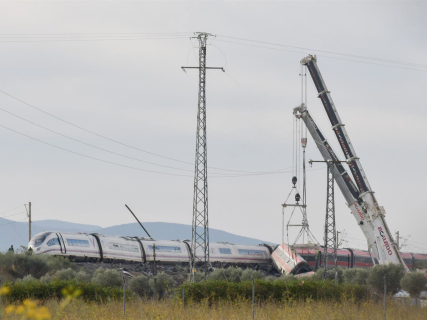
Electoral average after the Urda tragedy: the PSOE loses three seats on average and the right rises to 204 in the first polls

The Democrata model compares SocioMétrica, Sigma Dos and NC Report with its own previous polls. The PSOE drops seven tenths, to 25.6%, and stands at an average of 102 deputies. The largest setback appears in the only poll carried out entirely after the accident

fotonoticia 20261031100604 1920

fotonoticia 20261031100604 1920

Add DEMÓCRATA to Google

Ask FREN

Published

Last updated

3 minutes

Most read

Elecciones 29N · Encuestas

La media de las encuestas

Media a 2 de noviembre de 2026 · 16 institutos

  • PP30,6 %
  • PSOE27,3 %
  • Vox19,0 %
  • Frente Amplio6,4 %
  • Podemos2,6 %
  • ERC2,4 %
010203040ene 2024jul 2024ene 2025jul 2025ene 2026jul 2026

Media del último estudio de cada instituto en 30 días y su evolución semanal desde el 23J. Partidos con al menos un 2 %.

Todas las encuestas

Elecciones generales del 29 de noviembre · Demócrata

The first three polls published after the Urda rail tragedy coincide in one movement: all three give the PSOE less vote than in their previous release. They differ on how much it would cost them in Congress. Sigma Dos takes away eight deputies, SocioMétrica takes away two, and NC Report keeps its range unchanged. Demócrata’s average goes from 105.3 to 102 seats for the socialists: a loss of 3.3 deputies.

On the other side of the chamber, the right moves from an average of 201 to 204 seats, 28 above an absolute majority. There is more agreement on the size of that majority than on its evolution: SocioMétrica and Sigma Dos place it at 203 deputies and NC Report’s midpoint is 206. But, of the three, only the first two give it more seats than the previous week.

How many seats change after Urda, poll by poll
Institute PSOE: before → now Change Right: before → now Change
SocioMétrica 108 → 106 −2 200 → 203 +3
NC Report 101 → 101 0 207 → 206 −1
Sigma Dos 107 → 99 −8 196 → 203 +7
Demócrata average 105,3 → 102 −3,3 201 → 204 +3
Source: SocioMétrica for El Español, NC Report for La Razón and Sigma Dos for El Mundo. “Right” reproduces the sum published by each institute: it includes UPN-PP when counted within the bloc, without adding it twice. NC Report: midpoint of the ranges. Sigma Dos: most probable scenario published. Absolute majority: 176.

The PSOE falls in all three polls, but only Sigma Dos puts it at 99

The sharpest drop appears in the Sigma Dos study for El Mundo. Its 2,505 interviews were carried out on October 29 and 30, entirely after the accident. The PSOE goes from 26.1% to 24.6% and from 107 to 99 deputies in the scenario the newspaper considers most probable. Its range, from 97 to 103, still includes results above one hundred.

SocioMétrica, for El Español, records a smaller setback: the PSOE falls from 27% to 26.6% and from 108 to 106 deputies. Its tracking accumulates interviews since September and gives more weight to the recent ones. NC Report, for La Razón, places the socialists at 25.6%, two tenths less, but repeats its range of 100 to 102 seats. Its fieldwork began on October 26, before Urda, and ended on the 29th.

That difference matters. If only SocioMétrica and NC Report are taken, the average socialist loss is one deputy. If Sigma Dos is included, it rises to 3.3. The drop in vote appears in all three polls; the magnitude of the parliamentary loss depends much more on which poll is looked at.

Feijóo widens his lead from 5.5 to 6.4 points, although the PP barely rises in the average

The PP’s main gain is the distance it opens up with the PSOE. The popular average barely moves: it goes from 31.8% to 32.0%. The socialist one does clearly fall in the comparison, from 26.3% to 25.6%. Calculated before rounding, Feijóo’s lead increases from 5.5 to 6.4 points.

General elections of 29N: how the estimated vote changes
Institute PP PSOE Vox
SocioMétrica 32.0% → 32.2% 27.0% → 26.6% 18.6% → 19.1%
NC Report 32.9% → 32.6% 25.8% → 25.6% 19.0% → 19.3%
Sigma Dos 30.6% → 31.1% 26.1% → 24.6% 19.9% → 19.3%
Demócrata average 31.8% → 32.0% 26.3% → 25.6% 19.2% → 19.2%
The arrow compares the previous delivery with the one published on November 1 or 2, 2026. Simple average, rounded to one decimal place. The percentage published under the PP label is used, without separately adding that of UPN. Only Sigma Dos conducted all its interviews after the accident.

Sigma Dos gives the PP ten more deputies and Vox three fewer. In SocioMétrica both grow: the PP by two and Vox by one. NC Report draws the opposite movement to that of Sigma Dos: the popular range falls three seats at both ends and Vox’s rises two.

In fact, the combined percentage published for PP and Vox barely varies in the average of the three studies: from 51.0% to 51.2%. The right gains more ground in the seat projection than in vote. And the PSOE’s drop is not enough to claim that its former voters have moved directly to the PP or Vox.

How Demócrata calculates the change after Urda

Demócrata compares each poll with the previous delivery from the same institute and gives all three the same weight. For the seats it uses the figure published by SocioMétrica, the most likely scenario identified by Sigma Dos and the midpoint of NC Report’s ranges. In this last case, 101 is the arithmetic reference of the Socialist interval from 100 to 102, not an additional prediction from the pollster.

More key points, information and questions with FREN

AI-GENERATED CONTENT

What parliamentary procedures are necessary to call early general elections in Spain?

To call early general elections by decision of the Prime Minister, no authorization vote from the Congress or the Senate is required. No law is processed to approve the advancement: the decision is formalized through a decree of dissolution and call. This route must be distinguished from the mandatory dissolution due to lack of investiture, in which the Presidency of the Congress does carry out a specific procedure.

1. Early election by initiative of the Prime Minister

The initiative corresponds to the Prime Minister, after deliberation of the Council of Ministers and under his responsibility. The proposal is submitted to the King to formalize the dissolution and the electoral call. Therefore, Parliament does not have to previously approve the advancement, neither by a simple majority nor by an absolute majority.

It is advisable to distinguish this decision from other parliamentary mechanisms. A vote of confidence serves to check the Congress's support for the Government; a motion of censure allows replacing the Prime Minister with another candidacy. None of these procedures constitute a mandatory prior step to call early elections.

Dissolution is not an unlimited power either. Among constitutional restrictions, article 116.5 prevents dissolving the Congress while a state of alarm, exception, or siege is declared. The call must respect applicable constitutional and electoral conditions: a political announcement alone does not replace the formal decree.

2. Mandatory dissolution due to lack of investiture

Here there is indeed a decisive parliamentary sequence, regulated in articles 170 to 172 of the Congress Regulations:

  • Proposal of candidacy: upon receiving the King's proposal, the Presidency of the Congress calls the Plenary to hold the investiture.
  • Debate and first vote: the candidacy presents its program and requests confidence. To be elected, it needs an absolute majority of the members of Congress.
  • Second vote: if it does not achieve that majority, another vote is held forty-eight hours later. Then a simple majority suffices: more favorable votes than opposing.
  • Successive proposals: if confidence is still not obtained, other candidacies may be processed following the same procedure.
  • Expiration of the term: after two months from the first investiture vote without any candidacy obtaining confidence, dissolution and a new electoral call proceed.

The initial moment is important: the two months are counted from the first investiture vote, not from the elections nor from the constitution of Congress.

Article 172.2 provides that the Presidency of the Congress will submit the decree of dissolution of the General Courts and electoral call to the King's signature, and will communicate it to the Presidency of the Senate. No additional vote is required to authorize this consequence.

3. What role does Parliament retain

Once Congress is dissolved, the Plenary ceases to function ordinarily, but the Permanent Deputation continues. According to articles 57 and 59 of the Regulations, it assumes the corresponding powers over decree-laws and states of alarm, exception, and siege, and later reports to the new Congress on its actions. It does not authorize the early election.

4. A different exceptional case

Dissolution may also occur linked to a constitutional reform by the aggravated procedure. Article 147 of the Regulations requires that the revision principle obtains two-thirds in each Chamber before promoting the dissolution decree. This does require prior parliamentary agreements, but it is not the ordinary procedure for early elections.

What are the functions and powers of the Prime Minister regarding elections?

The Prime Minister has a decisive role in the initiative to dissolve the Cortes and call general elections, but does not direct or control the electoral Administration. His powers must be distinguished from those of the King, the Council of Ministers, the Ministry of the Interior, and the electoral boards. The main framework is in the Constitution, the Organic Law of the General Electoral Regime —LOREG— and the Government Law.

1. Propose dissolution and activate general elections

According to article 115 of the Constitution, the Prime Minister may propose the dissolution of the Congress, the Senate, or both Chambers, after deliberation of the Council of Ministers and under his exclusive responsibility. Deliberation is mandatory, but the initiative and responsibility correspond to the Prime Minister. The dissolution is formally decreed by the King.

This power allows anticipating elections but has limits: the proposal cannot be presented while a motion of censure is in process, nor can another dissolution be agreed upon before one year has passed since the previous one, except in the case of failed investiture under article 99.5. The Congress also cannot be dissolved during the validity of states of alarm, exception, or siege, according to article 116.5.

2. Election date and formal call

The dissolution decree must set the election date. Therefore, the Prime Minister has significant political capacity to determine when early elections are held, but cannot freely choose any date: he must respect constitutional and LOREG deadlines. Its article 42 establishes, for early dissolution, that elections are held on the fifty-fourth day after the call.

The call formally corresponds to the King, according to article 62.b of the Constitution. The Prime Minister endorses the royal decree and assumes responsibility for the act. If the legislature ends without early dissolution, the call is subject to the legal calendar, not to a discretionary extension by the Prime Minister.

There is an important exception: if two months pass from the first investiture vote without any candidate obtaining the Congress's confidence, the King dissolves both Chambers and calls elections with the endorsement of the President of the Congress, not the Prime Minister.

3. Coordinate the Government, not arbitrate elections

The Prime Minister directs the Government's action and coordinates its members, according to article 98.2 of the Constitution. Within this framework, he can promote the administrative and budgetary preparation of the elections. However, the material organization and development provisions correspond to the Government and competent bodies; they do not constitute a personal electoral power of the Prime Minister.

The electoral Administration acts to guarantee transparency, objectivity, and equality of the process, according to article 8 of the LOREG. The Prime Minister cannot give instructions to the Central Electoral Board, resolve electoral claims, alter results, or replace the bodies in charge of counting and proclaiming elected officials.

4. Neutrality and caretaker Government

During the electoral period, institutional action must respect neutrality and the prohibitions of article 50 of the LOREG, including public campaigns of achievements and forbidden inaugurations. These limitations do not prevent the Prime Minister from participating in the campaign as a political leader, but require distinguishing that activity from his institutional functions and resources.

After the elections, the Government ceases and continues in caretaker mode. Article 21 of the Government Law limits its action to ordinary business, except for accredited urgency or justified reasons of general interest. Additionally, the caretaker Prime Minister cannot propose to the King the dissolution of the Chambers nor the call of a consultative referendum.

What legal requirements must polling institutes meet to publish electoral surveys during the campaign according to current legislation?

Polling institutes may publish electoral surveys, but must comply with the obligations of transparency, technical information, and truthfulness of article 69 of the Organic Law of the General Electoral Regime (LOREG), in addition to respecting the prohibition of dissemination in the five days prior to voting. These rules apply from the electoral call, not only during the campaign, and bind both those who conduct the surveys and those who publish them.

1. Information that must accompany the survey

Article 69.1 of the LOREG requires that the conductors accompany each poll, under their responsibility, with the following specifications, which must also be included in any publication:

  • Identification: name and address of the entity, public or private, or individual who conducted the study, and of who commissioned its realization.
  • Technical characteristics: sampling system, sample size, margin of error, level of representativeness, procedure for selecting respondents, and date of fieldwork.
  • Questionnaire and non-response: full text of the questions asked and number of people who did not answer each one.

Therefore, it is not enough to publish voting intention percentages and a generic reference to the company. Regarding the client, the express obligation is to identify who commissions the study: this article does not impose publishing the contract price nor a breakdown of its financing.

2. Truthfulness and electoral control

The Central Electoral Board (JEC) monitors that the published data do not contain forgeries, concealments, or deliberate modifications. It also verifies compliance with mandatory specifications and temporal restrictions.

The Board may require the conductor additional technical information to carry out checks. This requirement has a limit: it cannot extend to data on matters that, according to current legislation, are for the exclusive use of the company or its client.

Article 69 does not establish, for private institutes, a special registry nor a general prior authorization or referral of each survey to the JEC. They must, however, comply with its control requests.

3. Temporary prohibition of dissemination

Article 69.7 states: "During the five days prior to the day of voting, the publication and dissemination or reproduction of electoral surveys by any means of communication is prohibited." The restriction therefore also affects reproducing already known surveys; it is not limited to publishing new studies. Its object is dissemination, not the internal conduct of polling work.

4. Additional obligations of public bodies

Instruction 1/2024 of the JEC requires public bodies to communicate their studies at least 48 hours before starting fieldwork. It covers questions about voting intention, party or leader evaluation, and includes studies started before the call that remain open.

The communication must detail technical characteristics, planned dates, and the questionnaire draft. Additionally, parties competing in the studied territory may request the results, which must be provided within 48 hours following the request, according to article 69.8.

5. Corrections and sanctions

Media must publish corrections required by the JEC within three days, indicating their origin and reason, in the same spaces or pages. If their periodicity prevents this, the director must do so at their expense in another medium of similar diffusion and the same area.

Administrative infractions regarding surveys may be sanctioned with 3,000 to 30,000 euros —article 153.2—. When constituting a crime, article 145 provides imprisonment from three months to one year, a fine of twelve to twenty-four months, and professional disqualification from one to three years.

Play

Test your knowledge with FREN!

How much do you know about this topic? Answer the following 3 questions.

How many seats does the PSOE average after the Urda tragedy according to the average of the three polling institutes?

Question 1 of 3

What is the absolute majority in the Congress of Deputies according to the news?

Question 2 of 3

Which polling institute recorded the largest drop in seats for the PSOE after the Urda tragedy?

Question 3 of 3