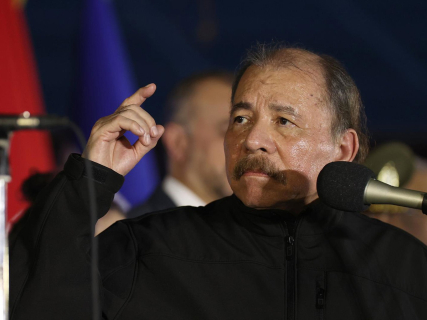

The Permanent Council of the Organization of American States (OAS) has given the green light this Wednesday to a resolution that calls for an extraordinary meeting of foreign ministers in light of the democratic crisis that Nicaragua is experiencing, after its president, Daniel Ortega, stated that there will be no elections in the Central American country.
The initiative has moved forward with 29 favorable votes, one against —that of Brazil— and the abstention of Mexico. The document, pushed by a group of States led by the United States, proposes to convene "urgently" and in application of articles 61, 62, and 63 of the OAS Charter a consultation meeting "as soon as possible" to "consider the situation in Nicaragua."
The text emphasizes that "the recent events in Nicaragua constitute an urgent problem of interest to the American States" and warns, furthermore, that "representative democracy, an indispensable condition for stability, peace, and development in the region, no longer exists" in the country.
The ambassador of Mexico to the OAS, Alejandro Encinas, has justified his country's abstention by considering that "the internal situation in Nicaragua does not constitute a threat to peace or hemispheric security."
"A characterization in that sense could open spaces to propose actions that exceed the powers of this organization when addressing internal matters of a state that is no longer part of the OAS and that could prove incompatible with the principles of respect for sovereignty, self-determination of peoples, non-intervention, and peaceful resolution of disputes enshrined in the OAS Charter, in the United Nations Charter, and in the American Convention on Human Rights," he has pointed out.
In the same way, he has warned that this type of decision "can generate dynamics of confrontation, deepen isolation, and open the door to measures that, far from favoring a peaceful solution, end up producing greater destabilization."
During a speech on the occasion of the 47th anniversary of the triumph of the Sandinista Revolution, Ortega stated that there will be no elections in Nicaragua, accusing the opposition of seeking its own benefit at the expense of the public sector and alluding to the approval of "laws" aimed at consolidating its purpose of blocking any electoral call.
Ortega, former guerrilla and general secretary of the Sandinista National Liberation Front (FSLN) —the movement that overthrew the Somoza family's dictatorship and came to power in 1979 following the trail of the Cuban guerrilla— has been leading Nicaragua since his return to the Presidency in 2007.
Currently, at 80 years old, he continues at the head of the Executive along with his wife, Rosario Murillo, who holds the position of co-president of the country after having served between 2017 and 2025 as vice president, a figure that disappeared after her rise.