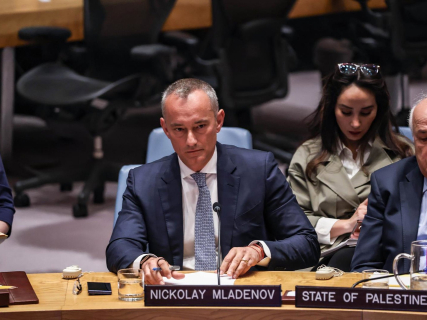

The director of the Peace Board, Nikolai Mladenov, has demanded this Wednesday that the Israeli authorities respect the ceasefire agreed upon last October, warning that each attack "that does not respond to an imminent threat" complicates the tasks of reconstruction and stabilization of the Gaza Strip.
Before the UN Security Council, he emphasized that "for the process to move forward, three conditions must be met: the International Stabilization Force must be deployed; the commitments made by Israel under the Sharm el Sheikh Protocol must be fulfilled; and Hamas must respect its commitments."
Mladenov has stressed that "every use of force that does not respond to an imminent threat costs this process something very difficult to recover," words that come a day after the Israeli Army attacked the vicinity of a school run by the United Nations Relief and Works Agency for Palestine Refugees in the Near East (UNRWA) in the north of the Strip, causing at least five fatalities.
The Bulgarian diplomat added that "every weapon that remains in someone's hands, every tunnel that remains operational, and every convoy that continues to be obstructed represents a setback for the peace process" designed by the United States for the Palestinian territory.
He also recalled that the 'roadmap', rejected by Israel but accepted by Hamas, includes the delivery of all the arsenal of the Palestinian factions. "The 'roadmap' encompasses the disarmament of all categories of weapons in Gaza. There are no gray areas or excluded categories," he detailed.
Regarding the withdrawal of Israeli forces from the Strip planned in that scheme, he explained that it will take place "after verified disarmament" and will be executed "in phases."
"Each step depends on the previous one being successfully completed. Progress is based on results, not on the calendar. Our approach during implementation will be to trust nothing and verify everything," he emphasized, while the government of Benjamin Netanyahu maintains that its troops will remain deployed in the enclave.
Mladenov has stated that "the Gaza crisis has never been solely a security or humanitarian issue, (but rather) it has always been a political and governance problem."
In this line, he has indicated that the outcome of this "transition" will be conditioned on "the Palestinians enjoying greater security, more reliable services, and a quantifiable improvement in their daily lives."
He has argued that "now we have the opportunity to spectacularly and sustainably improve the lives of the Palestinians in Gaza; to provide lasting security to the Israelis; and to move from a conflict that has destabilized the region to an environment that offers peace, prosperity, and economic opportunities for all of the Middle East."
On the other hand, the authorities of Gaza, under Hamas control, have assured this Wednesday that more than 1,300 Palestinians have lost their lives due to attacks by Israeli forces since the mentioned ceasefire came into effect.
They have added that, since the beginning of the Israeli offensive following the attacks of October 7, 2023 --which caused about 1,200 deaths and nearly 250 kidnappings, according to official figures--, 73,438 deaths and 174,447 injuries have been recorded, although they have insisted that there are still bodies under the rubble and in areas controlled by Israel.