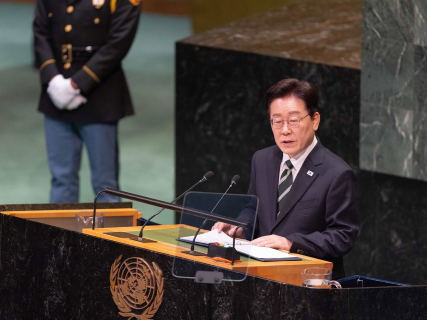

The president of South Korea, Lee Jae Myung, has claimed this Tuesday before the international community his role to "boost" a peace process on the Korean peninsula and, in this line, has expressed his intention for North Korea and the United States to resume "without delay" the bilateral talks.
"I hope that the dialogue, suspended for a long time, between North Korea and the United States can be resumed without delay. We will lay the foundations for this dialogue (between both countries) to become a dialogue among the parties involved to end the war on the Korean peninsula and transition to a peace regime," he assured during his speech before the UN General Assembly in New York.
In his speech, the South Korean leader praised the "determination" of the U.S. president, Donald Trump, who, he noted, has opened a "hard-won opportunity for change," referring to the repeated statements of the occupant of the White House about his willingness to dialogue with the North Korean leader, Kim Jong Un.
In another part of his address, Lee addressed the situation in the Middle East, focusing on the risks to the global energy supply chain arising from the blockade of the Strait of Hormuz and the hostilities surrounding the Bab el Mandeb passage, a scene of fighting between Houthi rebels and forces aligned with the recognized government of Yemen.
"Maritime routes in the Strait of Hormuz and the Red Sea have been repeatedly blocked, reminding us of a dark reality: that turning energy and logistics into weapons can cause serious shocks in the lives of citizens around the world," he warned.
The head of state also emphasized that "freedom of navigation and safe passage in international straits is part of International Law and constitutes one of the foundations of the global economy," which is why he insisted that attacks against ships and crews "cannot be justified under any circumstances."
Lee, who has called for "making better use of frameworks like those of the International Atomic Energy Agency (IAEA)," has advanced the implementation of "stronger cooperation frameworks regarding the global energy supply chain to prevent such crises or for them to become (...) uncontrollable escalations that affect the global economy."
Even so, he has reiterated his commitment to multilateralism as a way to respond to these "problems." "We cannot afford to remain inactive in the face of something that affects all nations. The most realistic and urgent way for countries that have this capacity is to unite their efforts to expand cooperation," he concluded.