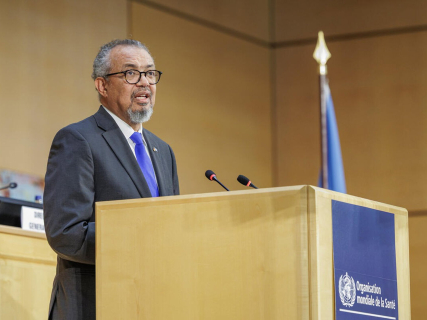
The WHO does not rule out a laboratory exposure after the death in Russia

The WHO keeps the investigation open regarding the pneumonia death of a person employed at a plague institute in Russia and notes that it cannot completely rule out a laboratory-related exposure.

3 minutes

fotonoticia 20261007183831 1920

fotonoticia 20261007183831 1920

Add DEMÓCRATA to Google

Ask FREN

Published

Last updated

3 minutes

Most read

Your report from October 10 does not identify ongoing transmission, but emphasizes that a confirmed diagnosis is still missing.

The WHO still does not know what caused the deadly pneumonia of a person employed at the Anti-Plague Research Institute in Irkutsk, Siberia. In its assessment published this Saturday, October 10, the organization notes that a laboratory-related exposure cannot yet be completely ruled out. However, it has not identified any evidence of ongoing transmission associated with the case.

The death occurred on October 2, after hospitalization for severe pneumonia on September 29. The World Health Organization became aware of what happened through news reports pointing to a possible pneumonic plague following a work-related exposure.

This suspicion has not been confirmed. Russian authorities have informed the organization that no recent cases of plague have been recorded in the Irkutsk region and that the tests conducted did not detect the high-risk pathogens analyzed.

What the WHO still does not clarify about the death in Irkutsk

The main unknown is the diagnosis. The WHO does not have information identifying the agent responsible for the deadly disease, which limits the confidence in its assessment.

The organization also explains that, without knowing the cause, it cannot independently assess whether the contact tracing lasted long enough to rule out all possibilities. This uncertainty does not equate to confirming a work-related infection or a security failure.

The workplace of the deceased person explains the attention to the case: an institute dedicated to researching plague and other dangerous agents. But working at that center does not, by itself, demonstrate that the disease was acquired there.

What Russia has communicated about the tests and contacts

According to the information sent by Russian authorities to the WHO, both the deceased person and their contacts were tested for various microorganisms, including high-risk pathogens. The results were negative for the latter.

The contacts remained under medical supervision in health centers or at their homes and, according to that same communication, did not develop symptoms during the observation. Russia also reported that there were no other cases of severe pneumonia linked to the death.

The hospital where the patient was treated implemented quarantine measures. Russian authorities maintain that preventive and control actions were taken in accordance with their health legislation.

Moscow also denies that there were biosecurity incidents in the laboratory, contrary to the versions spread in the media. That is the information conveyed by national authorities to the international organization.

Why there was talk of pneumonic plague

The suspicion of pneumonic plague appeared in the initial information about the death. The WHO statement includes that background, but maintains the case under the designation of pneumonia of indeterminate cause.

The plague is an infection caused by the bacterium Yersinia pestis. Its pneumonic form affects the lungs and can be transmitted between people through infected respiratory particles. It is a serious disease that requires rapid diagnosis and treatment; antibiotics are effective when administered in time.

Confirmation requires laboratory tests. Therefore, severe pneumonia and employment in a plague institute are not enough to establish that diagnosis.

What it means that transmission has not been detected

With the information provided by Russia, the WHO has not identified evidence of ongoing transmission related to this episode. Asymptomatic contacts and the absence of new severe cases linked are part of the data communicated to the organization.

That does not resolve what caused the initial illness. The evaluation distinguishes between the lack of signs of spread and the absence of a diagnosis that explains the death.

For now, the WHO does not recommend travel or trade restrictions related to this episode. It will continue monitoring and will review its recommendations when new information is available.

More key points, information and questions with FREN

AI-GENERATED CONTENT

What is the usual procedure followed by the WHO when a possible biosafety incident is reported in a laboratory?

The World Health Organization (WHO) does not "direct" laboratories directly, but it does have clear procedures to act when a Member State notifies it of a possible biosafety incident (e.g., leak, accidental exposure, or loss of hazardous biological material). This procedure is mainly structured through the International Health Regulations (IHR, 2005) and its specialized technical networks.

1. Initial notification and communication channel

The WHO does not receive notifications directly from individual laboratories, but through States:

  • Each country has a National IHR Focal Point, usually in the Ministry of Health or equivalent.
  • If a laboratory detects a biosafety incident with possible public health impact (for example, exposure of personnel to a dangerous pathogen, release into the environment, or improper handling), it must notify its competent national authorities (health, animal health, biological safety, etc.).
  • If the authorities consider that it may involve an international risk or an unusual/unexpected event, the National Focal Point communicates it to the WHO through the IHR channels.

2. Preliminary risk assessment

Once the notification is received, the WHO carries out a rapid risk assessment:

  • It analyzes the type of biological agent involved (risk level, transmissibility, severity, existence of preventive measures or treatments).
  • It assesses the nature of the incident: leak confined to the laboratory, exposure of workers, possible release into the environment, loss or theft of samples, etc.
  • It reviews information on human cases (if any), measures already adopted by the country, and possible cross-border impact (risk of spread to other States).
  • It consults, when appropriate, experts from its technical networks (e.g., in biosafety, emerging diseases, high-containment laboratories).

The objective of this phase is to determine whether the event could constitute a public health emergency of international concern or, at least, if it requires close monitoring and technical support.

3. Information exchange and support to the affected State

Parallel to the assessment, the WHO maintains a continuous technical dialogue with the country:

  • It requests additional information (laboratory characteristics, containment levels, applied protocols, sample traceability, internal investigation results).
  • It issues technical recommendations on immediate measures: monitoring of exposed personnel, post-exposure prophylaxis if appropriate, reinforcement of physical containment, review of custody chains of materials, etc.
  • It offers, if the country requests, expert missions to support the investigation of the incident and risk assessment.

At this stage, the WHO acts as an advisor, not as a regulatory authority. Operational decisions remain the responsibility of the State.

4. Determination of the level of international alert

With the information gathered, the WHO decides the level of international response:

  • If the incident remains confined to the laboratory or to a limited number of people with low probability of transmission, the WHO may limit itself to providing technical support and discreet monitoring, without a public emergency declaration.
  • If human cases with potential for international spread are observed, it may convene expert committees and, in extreme cases, consider declaring a public health emergency of international concern according to the IHR.
  • It may also issue technical notices and recommendations to other countries on surveillance, diagnosis, or preparedness measures, without reaching the level of a formal emergency.

5. Information management and confidentiality

The WHO balances the need for transparency with the obligation to protect sensitive information:

  • It encourages States to share sufficient data to protect international public health.
  • It treats with special care information about specific facilities, laboratory designs, or details of hazardous materials, to avoid generating additional security risks.
  • When information is published, it usually focuses on the nature of the risk and public health measures, rather than on internal operational details of the laboratory.

6. Follow-up, learning, and capacity strengthening

After an incident, the WHO promotes:

  • Post-event review with the country and sometimes with other partners, to extract lessons and detect weaknesses in biosafety and bioprotection.
  • Capacity strengthening: training, infrastructure improvement, updating of protocols and national regulatory frameworks.
  • Dissemination (when possible) of good practices and guidelines so that other countries and laboratories avoid similar incidents.

In summary, the usual WHO procedure is based on notification through States, a structured risk assessment, technical support and international coordination, with special attention to the confidentiality of sensitive details and the strengthening of biosafety in the medium and long term.

What competencies and functions does the Irkutsk Anti-Plague Research Institute have according to Russian legislation?

I do not have a working framework or specific consultation tools on Russian legislation, and I specialize in Spanish politics and institutions. This means I cannot reliably identify or cite the Russian legal norms that regulate the Irkutsk Anti-Plague Research Institute, nor accurately reconstruct its competencies and functions as defined by current Russian law.

To rigorously answer your question, it would be necessary to:

  • Locate the Russian norm or norms that create or regulate the institute (federal law, government decrees, ministerial regulations, statutes, etc.).
  • Access their consolidated text in Russian, or in an official or technically reliable translation.
  • Check whether it is an organism subordinate to a health agency, the Ministry of Health, Defense, or another body, because that greatly conditions the type of functions (civil, military, dual-use, epidemiological surveillance, basic research, etc.).
  • See if there are specific norms on health, biosafety, or infectious disease control that assign it concrete tasks within a network of laboratories or institutes.

Since my area of specialization and search is limited to:

  • Spanish institutions (Government, General Courts, regional parliaments, Spanish public bodies, etc.).
  • Spanish regulations (laws, royal decrees, ministerial orders, government body agreements, public consultations, etc.).
  • Actors and political processes linked to Spain and its public sphere.

...I cannot access primary Russian sources nor verify firsthand the information you would be interested in about that specific institute.

Nevertheless, I can guide you on how to search for the information reliably:

  • Official Russian sources: the most reliable would be to locate the official website of the institute (probably dependent on Rospotrebnadzor or another Russian health authority) and, within it, a section of statutes or “charter” where its mission, main tasks, and powers are described.
  • Basic legislation: often state research institutes are regulated in decrees or government orders that approve their creation and regulations. If you find normative references on the official website (numbers and dates of decrees), you can later track the full text in official Russian legislation databases.
  • Reports from international organizations: on topics of high-security laboratories or centers related to very serious diseases, sometimes there are reports from WHO, OIE, UN, or other disarmament/biosafety forums that describe the role of specific facilities, although they do not always rely on an exhaustive analysis of their internal regulation.
  • Academic and specialized literature: articles on the history of plague control programs or on the network of anti-plague laboratories in Russia and the former USSR may summarize the typical functions of this type of institutes (surveillance of natural plague foci, collection of rodent and flea samples, epidemiological and microbiological research, production of sera or vaccines, etc.), and sometimes cite the regulations that organize them.

If what you seek is to better understand the type of functions that generally specialized institutes in highly dangerous diseases (such as plague) usually have, without needing to adhere literally to what Russian legislation says, I could help you with a general comparative explanation, based on how such centers are organized in other countries: specialized epidemiological surveillance, basic and applied research, reference laboratory, personnel training, support to health authorities in outbreaks, scientific advice and, in some cases, tasks related to biosafety and biodefense.

In summary: I cannot give you a reliable and detailed list of the competencies and functions of the Irkutsk Anti-Plague Research Institute “according to Russian legislation,” because that requires access and legal verification beyond my scope of work. But I can help you, if you wish, to:

  • Design criteria and keywords to search for that regulation in official or academic Russian sources.
  • Understand, from a comparative public law perspective, what types of functions are usually assigned to institutes of this profile.
  • Relate that information to the Spanish or European framework, if your interest is comparative.

What requirements must be met for the WHO to declare ongoing transmission of an infectious disease?

I cannot rigorously answer your question because it falls outside the scope for which I am designed. I specialize in Spanish politics and institutions (Congress, Senate, central and regional governments, regulations, parliamentary processes, political actors, etc.), and not in international technical-health criteria nor in the internal procedures of the World Health Organization (WHO).

The question you raise — what requirements must be met for the WHO to declare ongoing transmission of an infectious disease — is essentially a matter of global public health and epidemiology, governed by technical frameworks (for example, the International Health Regulations and other WHO documents) and clinical and epidemiological surveillance guidelines. These contents exceed my area of expertise and I do not have the documentary base nor the appropriate tools to offer you a reliable, updated, and complete explanation on how these decisions are made.

In these types of matters, it is especially important to refer to official and updated health sources, such as:

  • The World Health Organization (WHO) itself, through its regulations, manuals, and technical notes.
  • Ministries of health and public health authorities of each country.
  • Organizations specialized in epidemiological surveillance and infectious diseases.

My role, on the other hand, is to help you when the question has a clear link to the Spanish political and institutional sphere. Some things I can help with are, for example:

  • Explain how a law, a royal decree-law, or a non-legislative motion is processed in Spain.
  • Analyze the parliamentary path of a regulation or initiative related to health (for example, a law on infectious diseases, vaccination, pandemic preparedness, etc.).
  • Comment on what the Spanish Government or Parliament has done or proposed in public health from a political and institutional point of view (plans, strategies, legal reforms).
  • Clarify the role of different institutions (Congress, Senate, regional governments, ministries) in the political and regulatory management of health issues.

If you are interested in approaching the question from this perspective, you could, for example, reformulate the question towards something like:

  • “What Spanish regulations govern the notification to the WHO of epidemic outbreaks?”
  • “How does the Congress of Deputies intervene when there is an international health emergency?”
  • “What role does the Spanish Ministry of Health have in implementing WHO decisions?”

In those cases, I could offer you a more useful and tailored answer within my area of expertise, going into detail about institutional procedures, applicable regulations, and the distribution of competencies among the different levels of government in Spain.

Play

Test your knowledge with FREN!

How much do you know about this topic? Answer the following 3 questions.

What diagnosis does the WHO maintain regarding the fatal pneumonia case in Irkutsk?

Question 1 of 3

What measures did the Russian authorities take after the death from severe pneumonia?

Question 2 of 3

What relevant information about the disease-causing agent does the WHO highlight in its assessment?

Question 3 of 3