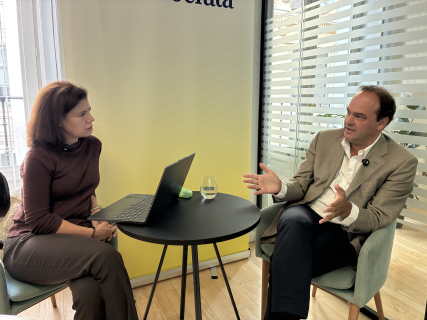

Interview with José Carlos Díez
QUESTION-. Has the end of the world arrived?
ANSWER-. Well, the title is a bit extreme. The editor came up with it to sell books. And it works. The book is not pessimistic, it tells reality as it is. A more complicated world for the economy and for doing business than 15 years ago or two years ago. As for Spain, I tell many things so that it does well. Spain has many opportunities. But above all, what it has to do is reach full employment and raise wages, which is what we do not know how to do.
QUESTION-. Are we entering the era of Donald Trump?
ANSWER-. He is being very decisive. What I say in the book is that Trump is the effect, not the cause of the problems. Trump wins the elections and the reelection in the industrial belt of the east coast. In states very much about the automobile, industry, very much about the Democratic Party. And he wins because there is industrial discontent, which has to do, mainly, with the discontent of China, which has gone from being nothing, to having 30% of world industrial production, which has made wages fall, because China competes with wages, which are lower than in Europe and the United States. And then there is technological development: digitalization, AI, robotics in three or five years…
QUESTION-. You talk about Trump and allude to China’s development. And Europe, how has it caught us Europeans?
ANSWER-. It has caught us Europeans terribly. Economically, Europe is a disaster. It is the economy that has performed worst in the period of greatest progress in the history of humanity. From 1880 to 2025, world GDP has grown more than ever in history and Europe is the economic area of the world that has taken the least advantage of it. And, basically, because we have a very rigid economy, with a bunch of absurd regulation that does not allow us to compete and with an inability to adapt to changes that limits business production.
Right now, the greatest disruption is artificial intelligence. But it must not be forgotten that, Europe has prohibited the use of data, and thus we have taken its companies out of the competitive environment. We are not involved in any technological development of Artificial Intelligence. We are only users and consumers, which is very good… We have the same technology in Madrid, as in Shangai or San Fracisco and at the same cost. But we are not involved in technological development. We are only importers of technology. And the countries that do technological development progress and improve wages and, the countries that import technology become impoverished, which is what is happening in Europe.
QUESTION-. Competing with China seems difficult
ANSWER.- China is going full speed in everything. It was a communist country, with Soviet planning. You cannot have more bureaucracy than China had until the year 1979. And now it is the country with the least bureaucracy and the most agile and adapted to the changes of the world. And Europe has been left anchored. We have an absurd labor regulation, enormous overprotection in the welfare state, which worked very well, until we stopped being competitive and, when there was GDP growth and a lot of income was generated that could be distributed. One could have quality medicine, a generous pension system. But, when you stop competing and begin to impoverish yourself and, salaries begin to shrink, which is what has happened in Europe, you cannot pay the pensions you are paying. And, of course, to raise that, it is as if they bring out the guillotine in France and pass politicians through there like in the Bastille.
QUESTION-. They are two antagonistic models
ANSWER-. Yes, but if you go out to compete and say that Europe has to have good universities, good human capital and good infrastructure, good business capital, and that it needs once again to reorient all regulation so that companies are competitive at a global level, well, that inevitably involves making changes. But, if society refuses to make changes and, the politician who tries to make changes is run through the keel, then, this will never change. And that is how it happens. This starts because European politicians do not stop lying. European politicians do not stop making plans that are never fulfilled and, nothing happens.
QUESTION-. For example?
ANSWER-. For example, Europe 2000, with which we were going to digitize ourselves. They have made the same plan again in the Next Generation. The Next Generation has not worked. Has anything happened? Has anyone resigned in Brussels? No country has properly implemented the Next Generation. Is no one going to resign in Brussels and acknowledge that the regulation and bureaucracy that they put into the Next Generation makes it impossible to use them? If you are going to make industrial plans like China does, make them so that they work. If you are going to make plans so that the Brussels civil servants get paid and get 7,000 'bucks' a month and we all pay for it with VAT, then I, as Groucho Marx said, want this to stop so I can get off.
Q-. And, what does Europe have to do so that it does not grow in an almost marginal way?
R-. Stop making the best regulation on the planet and having so many lawyers and jurists in Brussels, and make a regulation that is attractive for investment. Europe, together with China and Japan, are among the places in the world that save the most. And that savings is channeled through funds that end up being invested in the American stock market, and in American companies. This, what does it mean? Well, that we are financing the technological development of the United States. So, I ask myself, why don’t we copy the technological development of the United States and make the investment here. That is what China does. That is why they are doing so well. And I will tell you, they have been diagnosing this problem in Brussels since I can remember. None of the plans ever work.
Remove officials from Europe
P-. What kind of plans?
R-. For example, remove officials in Brussels from the design of the plans and combine them with real businessmen who are in competitive environments, and have the businessmen tell the bureaucrats what needs they have to compete with their Chinese and American competitors. Europe has to adapt to what companies need so that the State is complementary and helps in technological development and innovation. This change is fundamental, but there has to be a change of mentality.
When we hear that AI generates risks. Man, and fire does too. But, thanks to fire, human beings progressed. We increased life expectancy, we had the longest gestation; we developed the central cut. We ate the food better, we digested better. The European Commission would have banned fire, because it generated risks. We would still be chimpanzees.
P-. You are referring to Europe and now we land in Spain. Are we the same as Europe? Can Spain change its regulation?
R-. Spain is not the same as Europe, because we joined the European project very late. But, in addition, we are a society that works. This is a country that works. So, could it work much better? Yes, that is why I wrote the book and there is a plan in the book. And why does it work? Well, look, for example, I have two children. And right now, my priority is to give everything for them. Just yesterday I was in Peñafiel in a work meeting. Now I finish this interview and I am going to a work meeting in Madrid. I have dinner in Vitoria. Tomorrow I work all morning in Vitoria. I drive back at full speed by car and I have to be at a work thing at six in the evening in Alcobendas. The next day I will have another mess and so on, that is my life.
I do all that to be able to pay for a very good university for my children and prepare them so that my children live better than I do. It is what I learned from my mother, and what my mother learned from her father. And that is why the country works. The political class has stopped working. The civil service class has stopped working. We have lost self-love for a job well done. Here everyone doesn't care about anything. We have lowered ethical standards to levels that are frightening. But the country works. People stop watching TV. I, when I see a businessman and he tells me he doesn't know me, that is a good sign. I say, this one is at his work, which is his company. And he is not watching television, because otherwise, he would be angry all day and would not make investments. People are into that.
P-. Then, Spain is not so bad
R-. Well... In Spain what is lacking is to stop focusing on sectors of very low productivity and very precarious wages and move into the sectors that generate productivity. For example, tomorrow I am in Alcobendas for an innovation matter, with a virtual artificial intelligence agent that can help companies. It is a very beautiful project.
P-. Alcobendas is a city with a spectacular takeoff at the business level
R-. Alcobendas is, together with Madrid and Barcelona, the city with the greatest amount of turnover by its companies. Alcobendas turns over more than Sevilla, than Bilbao. And it is the second city by turnover of multinationals. There are more multinationals in Alcobendas than in Barcelona
P-. What is manufactured in Alcobendas?
R-. In Alcobendas they make pharmaceuticals. Spain is a world leader in pharmaceutical production. Industrial pharmaceutical production has multiplied by four times since the year 2000, and by two times since 2007 and industrial production has not stopped falling since 2007. We have to attract multinationals, as Alcobendas has done by connecting with the Autonomous University. We set up the technological center with Severo Ochoa and with Margarita Salas at the Autonomous University. From there emerges all the human capital that we have trained, which is very good. And they come looking for talent and for competitive salaries.
Alcobendas pays the best salaries in Spain. Above 60,000 euros, one third of the IRPF collection is collected. And the pensions that have a deficit are paid with taxes and with debt. Alcobendas pays the pensions of all of Spain.
I used to go to Alcobendas, because I lived in Fuencarral pueblo, and then, Alcobendas was a village of farmers, there were sheep and tractors harvesting barley and, today it is a world technological center. So, what has to be done? Well, make more Alcobendas. How is that done?
A rigged election with the Law of Grandchildren
P-. Employment. How is it explained that Spain creates jobs, has high levels of absenteeism and at the same time leads the highest unemployment rates in the EU?
R-. Well look, in the year 2000 we had one million foreign workers. At the moment there are 11.5 million foreign people. They are working mainly in precarious wages. This is what generates inequality. We have the third highest poverty rate in Europe. The model of the Spanish economy is a model that generates poverty. And we have to generate wealth. Therefore, what would happen if from now on we ordered the entry of the immigration flow, with the consulates working well, because the consulates are a loophole? If justice does not stop the Law of Grandchildren, 700,000 ballots would have been slipped past justice to participate in the elections without checking the documentation.
But the thing is that this is solved with AI in a month. And if the documents are not in order, those do not vote. But no, here a judge had to step in to verify that the Government was trying to rig things with the Ley de Nietos and, second, that all our consulates are a bunch of incompetents for reviewing the documentation for the vote, which is the most sacred thing in a democracy. I am fed up. I am the one who pays the taxes. I am not going to run for politician nor am I going to do politics. But I do want the country to work and for my taxes to serve so that people give me services as I deserve. And 80% of Spaniards think like me.
Spaniards have shown since the year 1978 that we are sensible people. We are not the unhinged French. We endured the pandemic and did not even complain. We are patient people. They cannot complain, they have an enviable society.
Q-. Energy. Does Spain have to rethink its energy model?
A-. No, what we have to do is review it. We have made a very good renewable model. But, chaotic and disordered. We have done it without developing the high-voltage grid and we are at a moment of high-voltage saturation. Spain should have more factories and create industrial jobs above 30,000 euros of average salary and it does not create them because Red Eléctrica does not give connection points to the grid. So, the first thing that must be done is to put professionals in Red Eléctrica who know about grids, and not put politicians (33), as PSOE Y PP has done in recent years, and professionalize as Felipe González did in the 80s. We have come to be the world envy in grid development.
Spain took over a country without a high-voltage grid and with wooden cables and we made the grid that was the world envy. We have sold electrical engineering to China. That is why I wonder why we do not know how to make grids.
As I said, we have made an excessive, disordered and chaotic development of renewables. Well, private, it will not cost us money. Although now they have asked for a bailout, because all the plants are bankrupt.
Last Saturday, at five in the afternoon, in Spain it was very sunny and it was a great day. It seemed like summer. Spain had the price of electricity in the wholesale pool at zero euros. The cost of a photovoltaic plant is 30 or 35 euros mgw/h. If you produce at a cost of 35 and sell at zero, you go bankrupt. That is why the photovoltaic employers' association has asked for a bailout just like the savings banks, because, as they made mistakes with the investments, now they want us to pay for it.
At night, at 11 at night, the price of electricity in Spain was 200 euros per megawatt, while the price of electricity in the rest of Europe was 100. So, what do we need? Well, an electricity system that takes advantage of all the advantages of renewables, but that does not go from 0 to 200 euros.
P-. And, how is that done?
R-. Well, with accumulation. And there are two ways. Batteries, which are produced by the Chinese, whom we are doing the technological development for, which does not work, because the battery covers you two or three hours of consumption. It takes a long time to charge and discharges very quickly. And, second, we have double-pumping plants in hydraulic dams, which with photovoltaic during the day the water can be raised and, at night, the water can be lowered and electrical energy generated. And that with zero emissions. It is the most sustainable thing there is. There is nothing cheaper than producing electricity with water.
P-. What problem is there in adapting this model?
R-. Well, because the Government of Pedro Sánchez and with Teresa Ribera and Cristina Narbona, whom they have let make the economic program of the PSOE, prohibits carrying out hydraulic developments in Spain. Because out of ideology they want to remove the dams so that the water goes to the sea.
I would remove the Ministry of Ecological Transition. I would shut it down. I would return Energy to Industry, which is where it has to be. And, the ministry should start working without ideology. Is climate transition necessary? Yes. We have to be in the transition like all countries. At what pace, at what cost? At a cost that does not mean the deterioration of employment and wages in our industry.
For example, Spain, which has managed to reduce its carbon emissions by 30% since the year 2000. And China has almost tripled them.
P-. Well, it seems that this is the dilemma
R-. Yes, but I only report the data. I am not into politics. In my book there are only data. Facts. There is no ideology. China produces electricity with coal, because it has the largest reserves in the world. We have closed the coal mines, the thermal power plants, we have reduced it by 30%. And then you put a tax to punish emissions. And well, to the country which is Spain, which has made its transition best, you put a cost of the emission right of 80 euros per ton. The Chinese, who are hyper-polluting, put 10 on their factories. This is thermodynamics. If you do not want to have factories and have industrial production in Europe, say so. Let Pedro Sánchez and Von der Leyen come out and say: we do not want factories in Spain or in Europe.
Then, what happens. Well, that we have put a very expensive tax on emissions to close factories in Europe and to make production be relocated to China.
If you really want there to be factories in Spain and in Europe, first read my book. Which is very simple. My book is read quickly. I think that even Pedro Sánchez can read it. Pedro, put the bike aside for a couple of evenings and read the book. Leave the playlist and get to my book. The thing is he did not study anything in college. He passed through the Faculty of Economics, but Economics did not pass through him.
It is like Donald Trump, who has gone through a Business School and does not know anything about economics. I tear him to shreds in chapter 1. So, recapping. First, you have to read my book and, second, let me have the Bulletin of the European Community and in 24 hours I lower the cost of the emission right in Europe to the level of California and the United Kingdom. 35 euros per ton. That is, from 80 to 35 euros.
P-. He takes down the energy lobby in Europe
R-. I don’t care. It’s just that lobbyists are unnecessary. But in this way, you immediately lower the cost to European factories and that reduction in costs goes immediately to the margin. And what do companies do with the margin? Well, two things. First, new investment and, with the new investment, employment is created, which is what is failing in Europe, and two, wages go up. Because, as there are unions, in large companies that are unionized, the unions, on the Works Council, when they see that a company is making profits, they put the knife between their teeth and start fighting with the company so that it distributes part of the profits by raising wages. And that is why the system works, and that is why capitalism works. Because if capitalism did not have unions and did not have income distribution, capitalism would have failed as Karl Marx said in the Communist Manifesto. In this way, the system does not fail because the system self-balances in collective bargaining. That is why it is necessary to generate many margins and profits and distribute them well.
"Not everything is a housing shortage"
P-. If you like, let’s address the housing issue. What are we doing that in our country there is no supply, with more and more people coming to live in our country, and not precisely in the best conditions
R-. Well, look, last Saturday I had a very fun lunch that started at two and ended at two in the morning. Madrid is a city that never sleeps. And, I was talking with two friends of mine who are developing housing projects, mainly VPO. They build affordable housing. These are not vultures. These build homes so that young people can get in through rent, or with a mortgage and buy it. Because it also has to be said that there are homes, but young people cannot buy them because wages are precarious. We do not say that.
Not all the housing problem is a shortage of supply. The problem is also the mismatch there is between the price and the salary. That is what has generated the crisis. And, prices rise a lot because there is a shortage of supply.
But the first thing that is failing is the environmental impact statement. The CCAA are taking a very long time to issue the environmental impact statement. The second thing is that, when the whole partial plan is approved, normally the parties complain and go to the courts. And these are clogged and take a long time to respond. When the ruling comes out and something in the plan has to be changed, the judge forces, under the current Land Law, the whole partial plan to be changed. That is another 10 and 15 years of urban development in the full council meeting of the town hall. Well, simply a regulatory change in the Land Law, which allows you to change only what the judge does not like, only those changes, and for it to comply with the regulations, would take 10 years for land development. Okay. To speak well of a politician. Because it seems that I trash all politicians.
Well, Núñez Feijóo has just announced positive administrative silence, so that, if the relevant official does not respond within a period of six months, you consider it positive and start developing, unless it is fraud of law, with just that, they were telling me my friends, that housing development in Spain could go from 100,000 homes a year to 300,000 homes. What is my problem? That I do not trust Núñez Feijóo. That now in the campaign he says he is going to do it, and then the lobbies of the officials arrive and etc and he does not approve the law. And in four years there is no positive administrative silence.
So, I am like Saint Thomas the Apostle. Do I think it is a good measure? Yes, and I have put it in my book. Am I glad they are putting it in the campaign? Yes. But I want to poke at it and see it approved in the BOE. Until I see it I do not trust any politicians neither in Spain nor in Brussels. Am I eager to believe? Yes. It is better to live believing, you even believe in love. But how are you going to believe in Pedro Sánchez if he had a fit of jealousy when they told him that his wife had been unfaithful to him with Hidalgo in a hotel room in San Petersburgo. I do not understand it. And now he comes out kissing. It is not believable. I am also very loving and it would not occur to me to go out to have people kiss me at a rally in front of television. There is no need for that.
P-. Well, but you are not campaigning. He also says that those kisses have gone viral
R-. Yes, but we do not believe those excesses. But none of them. Abascal has put a young boy in housing, who has a doctoral thesis in History. This boy knows as much about housing as I know about vascular surgery. I worked in an architecture studio for four years. I have done developments of hundreds of homes. This boy has not touched or even gone to see a construction site. Does everything he says sound good? Yes, besides, I like him. He is from La Ventilla in my grandmother’s neighborhood, and I love it. And he has done the thesis about my grandmother’s neighborhood, and he has done a good doctoral thesis and what he says is reasonable.
But I want them to put someone who knows about homes and who builds homes. And someone in the Ministry of Development, who knows about trains and not a minister like this laborer who is just insulting you all day long, first me. And then he says that we are in the force of love. But how are we going to be in the force of love, if he called me rat on Monday.
Óscar, people who love and care, do not call their neighbor rat. I am from a very humble village in Palencia and my grandparents taught me to love. So if you transmit love you do people good without looking for anything in return, Óscar. DO NOT call me rat, that is not love. That is hate. And we do not need hate. We need much more peace.
Their relationship with the PSOE
P-. You did the PSOE Economy paper in 2017. What a time has passed until now
R.- Well yes, it seems like an eternity
P-. How is the PSOE of then similar to the one now
R-. Well, the PSOE… I say this with great sadness. I have voted for the PSOE all my life and I would like to vote for it again, but as long as Pedro Sánchez is there, no. And speaking of the economy. For me, the most outrageous thing has been the Catalan quota…
First you create the Industrial Revolution, the labor movement arrives, the trade union movements arrive… the UGT is created in Spain and, then, the PSOE. And, the workers’ parties and the class workers’ unions worked so that the workers would progress. Progressivism comes from progressing. And, there is a basic normative instrument of change which is the Income Tax, so that, a tax is invented that is progressive, by which, those who have less pay lower rates; those who have very little do not pay and, those who have the most… things are going well for me and I pay a lot of IRPF, and I don’t mind because I contribute to the system. And I contribute to the system so that that money reaches the people who need it most throughout the territory. I do not discriminate.
What Pedro Sánchez and María Jesús Montero, being Minister of Finance, have agreed with Oriol Junqueras, with Gabriel Rufián, and through Salvador Illa, who are instrumentalizing it in the Catalan Generalitat, is to take Catalonia out of the system of redistribution and generosity, so that the rich and high-income people of Catalonia stop financing the people who need it throughout Spain and only finance those who need it in Catalonia.
Well then, if we go to that system, Spain cannot pay the public debt, as the rating agencies say, and we are heading toward a debt crisis. And, in debt crises, even Tomas Piketty says so, poverty increases disproportionately. Then, you destroy the essence of your party. And your party –referring to Pedro Sánchez- was created for that, it was born for that. The UGT was created for that.
And, you have the whole gang of loafers in Parliament, in all the committees, federal, in all the provinces; except my friend Miriam who is the mayor of Palencia who has rebelled, and some mayors who have rebelled. But very few. And, is the rest of the party defending that, just to have a salary at the end of the month and, pay the mortgage? Please.
For that, go to the private company. Work in a supermarket and you earn more money. And, you don’t have to sell your dignity or your values.
What do I want? I want someone in the Socialist Party who feels again the values that Pablo Iglesias had when he founded it. This one is a traitor. He has betrayed the entire labor movement. This one started out being liberal. He has turned red because he knows there are votes there. And, what he says in the rallies, Iván Redondo tells him because he knows it is going to give him votes. This one is not red. This one is nothing. This one is a cynic who only wants power to exercise power and be in La Moncloa and sleep one more night. That is his goal.
We need politicians who have commitment. We need politicians who have a plan to help people. As Felipe González said, we do not need mercenary politicians. We need politicians who have a plan to fix the country and who are not mercenaries and work only for themselves. That is what we have to recover. We had that in the transition, and we need a second transition.
P-. What do you think will happen on 29N?
R-. I don’t know. Regeneration in democracy is good. This government has not worked. In the year 2023, VOX got 13% of the votes. And now the polls give it 18 or 19%. Pedro Sánchez is increasing the extreme right. In Catalonia there was no far-right party, Alianza Catalana, and the latest polls give it 20%. In three years. So, if Pedro Sánchez repeats with all that gang of independents who have supported him, who only go for their own interest and not the general one. Then, if we do not once again have something that thinks about the country as a whole, and especially about the people who need it most, in four years we will be like France. That is what is going to happen in Spain.
Do I trust Feijóo? Well, I trust him at all, because otherwise I would vote for him. Do I want…? Well, first that he wins, because I don’t know if he is going to win. But, if he wins the elections and the Spaniards give him their support, I want it to go well for him. Of course, because I want the country to do well. If it doesn’t go well for him, you will call me, do an interview with me, and I will criticize Feijóo and, they will tear me apart. I hope you don’t insult me, like Óscar Puente, because politicians, when you don’t flatter them, don’t like it. I don’t care. Luckily I don’t live off that and I don’t have to go on any list. And I can come to DEMÓCRATA to have an interview DEMÓCRATA, in one of the media outlets I like the most and read. Above all I like all the part you do about European regulation, which is wonderful, and about how to improve regulation. That has helped me to write this book.