Bridge ensures that the Madrid-Seville line is not abandoned or forgotten

Óscar Puente rejects that the Madrid-Seville high-speed line has been abandoned and defends the LZB system while announcing a major renewal plan.

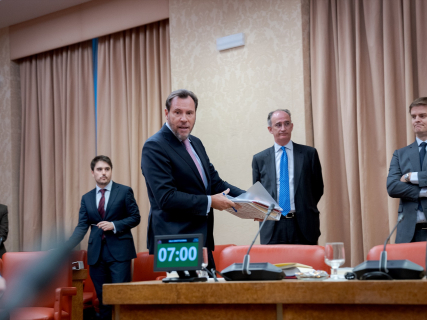
EuropaPress 7888551 ministro transportes movilidad sostenible oscar puente comparece peticion

EuropaPress 7888551 ministro transportes movilidad sostenible oscar puente comparece peticion

Add DEMÓCRATA to Google

Ask FREN

Published

Last updated

2 minutes

Most read

Elecciones 29N · Encuestas

La media de las encuestas

Media a 2 de noviembre de 2026 · 16 institutos

  • PP30,5 %
  • PSOE27,4 %
  • Vox19,1 %
  • Frente Amplio6,4 %
  • ERC2,4 %
  • Podemos2,4 %
010203040ene 2024jul 2024ene 2025jul 2025ene 2026jul 2026

Media del último estudio de cada instituto en 30 días y su evolución semanal desde el 23J. Partidos con al menos un 2 %.

Todas las encuestas

Elecciones generales del 29 de noviembre · Demócrata

The Minister of Transport and Sustainable Mobility, Óscar Puente, defended this Tuesday that the high-speed connection between Madrid and Seville is not an infrastructure "abandoned or forgotten" and stressed that the LZB signaling system is a "very proven" system.

As he recalled, the Madrid–Seville line, inaugurated in 1992, "is not an infrastructure that is abandoned or forgotten." "On the contrary, it has been the Government of which I was part that has set in motion a renewal plan with an investment of 780 million euros," an amount which, in his view, should be counted as maintenance spending and not as investment.

That plan translates into close to 90 public contracts with direct actions on the line’s infrastructure itself, from correcting structural defects, waterproofing bridge decks, adapting tunnels, stabilizing slopes or improving drainage, to correcting embankment settling, improving access roads and fencing, as well as replacing switches and sleepers, electrification, and implementing the ERTMS level 2 system.

During his appearance, Puente highlighted that "without a doubt, this is the first major renewal of Spanish high-speed rail," in a statement at his own request before the Permanent Delegation of the Congress to give an account of the Executive’s management following the railway accident in Urda (Toledo) on October 28, 2026, in which at least 69 people have died.

LZB and ERTMS on the Madrid–Andalusia line

With regard to safety systems, the minister insisted that the LZB is "a very proven" system, imported from Germany and that continues to be used in that country, in Austria and in metro networks in several European cities with traffic of "high density".

The LZB system (abbreviation of the German term 'Linienzugbeeinflussung', which translates as "train control lines") is a protective mechanism for high-speed lines that monitors the train’s movement, speed, and position to ensure safety. A failure in this system preceded the collision between an AVE and an Iryo recorded last Wednesday in the Urda (Toledo) accident.

In the face of criticism over the delay in implementing the ERTMS to replace the LZB on the Madrid-Andalucía line, Puente recalled that it is a "very complex" system and alluded to the fact that it took ten years to go into service after the Angrois accident in 2013, in which 80 people died. "The contracts were tendered by the Government of the Partido Popular and five years later it was not in service. In fact, another five were needed to complete the installation," he said.

Lastly, the head of Transport outlined the measures included in the plan to strengthen high-speed rail safety approved this Tuesday by the Council of Ministers, including new software for control centers and the addition of an artificial intelligence (AI) agent tasked with supervising the system’s operation.

Puente admitted that "in these two points we are operating in unknown territory," since currently there is no software or equipment that performs these functions in a railway safety system. "So we are going to have to innovate and research and manage to develop this type of tools," he concluded.

More key points, information and questions with FREN

AI-GENERATED CONTENT

What is the parliamentary process for the resignation of a minister in Spain?

In Spain, the resignation of a minister does not require a parliamentary approval procedure. It is submitted to the President of the Government and formalized by dismissal by the King, at the proposal of the president. The Congress and the Senate can demand explanations and exercise political control, but they do not accept or reject the resignation.

1. The resignation and its formalization

The minister communicates to the President of the Government their intention to leave the office. They do not have to submit a request to the Congress Board nor undergo a parliamentary vote. It is important to distinguish this political communication from the legal act that ends the performance of the position: the dismissal.

The constitutional rule is in Article 100 of the Constitution: it corresponds to the president to propose to the King the appointment and separation of the other members of the Government. This distribution of functions is also explained by the Constitutional Court: the Congress grants confidence to the president, while the president chooses the members of their Government, whose appointment formally corresponds to the King. Therefore, the departure of a minister does not require prior authorization from the Cortes.

The president can promote their replacement without the Congress having to invest the new head of the ministry. Parliamentary investiture corresponds to the Presidency of the Government, not to each minister individually.

2. What can Parliament do?

The fact that the Chambers do not decide on the resignation does not mean they are excluded from its reasons or consequences. Parliament can control the Government's actions and demand explanations about the management that caused the resignation. Among the instruments provided in the Congress Regulations are:

  • Questions: deputies can request answers from the Government, in writing or orally, about facts, decisions, and actions related to the ministry.
  • Interpellations: allow debating the reasons or purposes of the Government's policy or a department. They can lead to a motion expressing the Chamber's position.
  • Appearances: Government members can report before the Plenary or a commission, at their own request or through the corresponding parliamentary agreements. Articles 202 and 203 regulate these informative sessions.
  • Requests for information: the Chambers and their commissions can collect documentation to examine government actions.

These instruments do not constitute ratification of the resignation. Nor should the appearance of a minister who still holds office be confused with that of one who has already ceased: the Regulations distinguish the presence of Government members from the appearance of other authorities or persons competent in the matter.

3. Individual resignation and Government continuity

The departure of a minister does not by itself cause the dismissal of the entire Government. Article 101 of the Constitution contemplates the dismissal of the Executive after general elections, due to loss of parliamentary confidence, or due to resignation or death of its president. The resignation of a minister does not equate to any of these cases.

If the crisis affects the entire Executive, there are two different mechanisms. The motion of no confidence requires the signature of at least one-tenth of the Congress, an alternative candidacy for the Presidency, and an absolute majority to be approved. It does not serve to dismiss only a minister.

The vote of confidence can only be proposed by the president, after deliberation of the Council of Ministers, on their program or a general policy statement. It is passed by simple majority. Neither of these mechanisms is automatically triggered by a resignation: they are separate procedures of political responsibility of the Government before the Congress.

What are the powers and functions of the Minister of Transport and Sustainable Mobility?

The Minister of Transport and Sustainable Mobility directs the state policy on infrastructures, transport services, and sustainable mobility. Their function is to set priorities, promote regulations and investments, and supervise their execution; not to personally manage each road, train, port, or airport. It is important to distinguish the department's competencies from the powers exercised by its head.

Areas of competence

Article 1 of Royal Decree 253/2024, of March 12, assigns to the ministry the proposal and execution of the Government's policy in the following areas:

  • Transport infrastructures: land, air, and maritime infrastructures of state competence, along with the planning and programming of the corresponding investments.
  • Transport services: their control, organization, and administrative regulation in areas corresponding to the State. Includes road, rail, air, and maritime transport.
  • Sustainable mobility: its promotion in social, economic, and environmental dimensions, including active mobility. The regulatory objective is to guarantee safe and sustainable mobility, based on social justice criteria.
  • Postal services: normative regulation of the sector, a competence distinct from the material provision of services.
  • Geographic information and Earth sciences: promotion and direction of state services of astronomy, geodesy, geophysics, and cartography, linked to the National Geographic Institute.

This distribution appears in the Official State Gazette of March 13 and is explained on the ministry's website.

Minister's own functions

As a member of the Government and head of the department, the minister transforms these sectoral competencies into political and administrative decisions. Their main functions are:

  • Direct the department: establish objectives, give instructions to its superior and managerial bodies, coordinate their actions, and evaluate compliance with set priorities.
  • Promote regulations and plans: promote regulatory projects, strategies, and action programs, and exercise regulatory power — approve provisions within their scope and legal authorization. Decisions corresponding to the Council of Ministers must be submitted to this body.
  • Manage public resources: exercise budgetary powers, expenditure authorization, and contracting recognized by legislation, without confusing them with technical tasks of preparation and execution.
  • Resolve administrative matters: decide on appeals and procedures attributed to the department head, with applicable distribution of competencies and delegations.
  • Represent the ministry: maintain relations with other administrations, European institutions, and international organizations in matters of their competence.

How their decisions are executed

The minister mainly relies on two bodies: the Secretary of State for Transport and Sustainable Mobility and the Undersecretariat. The first develops, under their direction, sectoral policies; the second handles management and common services of the department.

The Secretary of State oversees the general secretariats of Land Transport, Air and Maritime Transport, and Sustainable Mobility. This organization allows integrating infrastructures and services, coordinating investments, and promoting the combination of different means of transport. It can be consulted in the official organizational chart.

Scope and limits

Their responsibility does not automatically cover all transport in Spain: it is limited to state competencies and must coordinate with the powers of other ministries, autonomous communities, and local entities. For example, the department cooperates in sustainable urban mobility plans, but that cooperation does not make the minister the manager of all municipal services.

In short, their role combines political direction, regulation, investment planning, and supervision. Concrete execution corresponds to competent bodies and entities, within the legal and budgetary framework.

What were the results of the last general elections in Spain and how many seats do the main parties have?

The last general elections held in Spain were on July 23, 2023. The PP won with 137 seats, followed by the PSOE, with 121, Vox with 33, and Sumar with 31. No candidacy alone reached the absolute majority in the Congress, set at 176 of its 350 deputies.

These figures correspond to the 2023 electoral result, not to the estimates of polls for the November 29, 2026 elections. As of November 3, that upcoming call has not yet taken place and therefore has no results.

Seat distribution in the Congress

The full distribution from the polls was as follows. Besides the four candidacies with the most deputies, seven other formations obtained representation:

  • People's Party (PP): 137 seats. It was the candidacy with the most votes and deputies, with approximately 33.1% of the votes.
  • Spanish Socialist Workers' Party (PSOE): 121 seats. It came in second place, with around 31.7% of the votes.
  • Vox: 33 seats. It was the third candidacy by representation in Congress.
  • Sumar: 31 seats. It occupied fourth position; Podemos ran integrated in this candidacy, so its deputies should not be added separately to Sumar's result.
  • Republican Left of Catalonia (ERC): 7 seats.
  • Junts per Catalunya: 7 seats.
  • EH Bildu: 6 seats.
  • Basque Nationalist Party (PNV): 5 seats.
  • Galician Nationalist Bloc (BNG): 1 seat.
  • Canarian Coalition (CC): 1 seat.
  • Navarrese People's Union (UPN): 1 seat.

In total, these candidacies gathered the 350 seats of the Congress. You can consult the electoral breakdown at the Congress results. The results of the top four candidacies are also recorded in the Demócrata comparison, which expressly distinguishes between the real 2023 results and later projections.

What those results meant

The first relevant difference was the gap between winning the elections and having a sufficient majority: the PP obtained 16 more deputies than the PSOE, but was 39 seats short of the absolute majority. Therefore, being the most voted candidacy did not mean having 176 representatives of its own.

The sum of PP and Vox was 170 seats, six less than the absolute majority. If the UPN deputy was added, the total rose to 171. Meanwhile, PSOE and Sumar totaled 152 deputies, 24 less than that threshold. These are sums of the electoral result: by themselves they do not imply agreements between the formations.

The four main candidacies concentrated 322 deputies; the other seven gathered the remaining 28. This distribution helps understand the importance of formations with fewer seats in the subsequent parliamentary arithmetic, analyzed by Demócrata about 23J.

How to interpret the figures

When asked how many seats parties "have," it is important to distinguish the result from the polls from subsequent changes in parliamentary groups. Here the distribution obtained by the candidacies on 23J is offered, not an update of the individual affiliation of each deputy during the legislature.

Also, all the above figures refer to the Congress of Deputies, not the Senate. The essential conclusion is that the PP finished first, PSOE second, Vox third, and Sumar fourth, but none obtained an absolute majority of their own.

Play

Test your knowledge with FREN!

How much do you know about this topic? Answer the following 3 questions.

How many control employees are currently at the Atocha center?

Question 1 of 3

What is the planned investment for the renovation of the Madrid-Seville high-speed line?

Question 2 of 3

Which safety system is being progressively implemented on the Madrid-Andalusia line?

Question 3 of 3