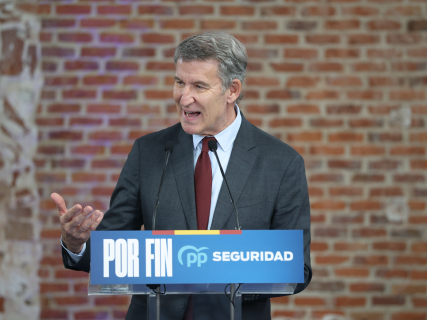

The PP interprets that the deadly accident in Urda (Toledo) has once again evidenced the Government of Pedro Sánchez's "railway chaos", in the same way that happened just nine months ago with the tragedy of Adamuz (Córdoba). In its view, this new accident has shifted the focus of the campaign toward the management of infrastructure and public services. The Popular Party will resume its electoral agenda this Monday with the guiding idea that, if they come to power, they will do everything possible so that Spain "works again", according to sources from the party leadership tell Europa Press.
"With this way of managing, one cannot continue," proclaimed this week the president of the PP, Alberto Núñez Feijóo, after going to the advanced command post set up in Urda because of the railway collision, which has cost dozens of lives. With less than a month to go before the general elections, at the 'Génova' headquarters they admit that the "bad management" of Pedro Sánchez during these eight years, which the PSOE intended to "forget", is now back in the spotlight. "There are elections on November 29 and it is also decided who appoints the next Minister of Transport: Sánchez or us," sources from Feijóo's team emphasize.
In the PP they maintain that the Executive collects more than ever through taxes but Spain "does not work". "We are talking about the decomposition of the State," the party's national spokesman, Borja Sémper, came to denounce on Friday, who stressed that citizens "do not ask for miracles, simply that Spain works again".
PP offensive against Sánchez's management
In January, after the Adamuz accident in which 46 people died, Feijóo already described a "collapsed" Government and even stated that "the state of the tracks is a reflection of the state of the nation". Now, with more than 60 dead from the collision between an AVE train and an Iryo in Toledo, in the PP they consider that the "negligence" and the "nefarious" management of the Executive are once again placed at the center of the debate, according to 'popular' sources.
For this reason, the 'populars' face the electoral campaign --which officially starts at midnight on November 13-- with a direct offensive against the management of Pedro Sánchez's Government and its policy of appointments in the Ministry of Transport: from the former minister José Luis Ábalos (in prison for the public contracts during the pandemic) to the "Twittering" minister Óscar Puente, whom they accuse of neglecting his Department.
In 'Génova' they maintain that "years of political sectarianism" and of "placing friends instead of expert people in technical positions have consequences". Feijóo repeats in his interventions that from this situation "you only get out with rigor, experience and knowledge": "Management, management and management," he emphasized on Friday after meeting with railway safety specialists.
Audits and review of the railway network
The PP links the management failures to the absence of the General State Budgets (PGE) and to the investment deficit in the railway network in recent years. Feijóo himself pointed in that direction this Friday: "46 people have died in Adamuz due to deficient maintenance by the Government and at least 69 in Toledo because the Government did not renew an obsolete safety system when it should have done so".
The PP leadership, which in other campaigns has championed the management of the Governments of José María Aznar and Mariano Rajoy, considers that this new accident turns the way of managing the crisis into a nuclear issue of the electoral contest.
The purpose, in Feijóo's words, is to "show people that Spain can once again be a country that works, with a reliable and safe train again", although he recognizes that it is necessary to be "honest" because "there are improvements that can be put into operation immediately" while others will require more time since "they need projects, contracts and works". In the middle of the pre-campaign, he stresses that he will do "everything necessary to recover lost trust".
Feijóo has already begun to detail some of the measures he will promote if he reaches La Moncloa, with special emphasis on audits to review the state of the railway network. He thus advocates an "independent technical review" for a "total reset" that recovers safety for users, together with an "emergency plan" that places safety, maintenance and conservation as "priority one". He has also announced that, if he governs, he will strengthen the Security area of Adif and Renfe.
Executive Committee to reactivate the campaign
This Monday, Feijóo has convened the National Executive Committee of the PP with the aim of analyzing the Urda accident together with his 'barons', his hard core and the main territorial leaders, and thus resuming the campaign agenda ahead of the general elections.
Since the train crash, with more than 60 fatalities, the PP decided to suspend its election events during the three days of official mourning and reduce its public exposure. The party's general secretary, Miguel Tellado, called on the same day of the accident for restraint and prudence from all officeholders, pending more data.
Nevertheless, Feijóo intends to reactivate the campaign starting this Monday --despite it being a holiday in several autonomous communities-- and has convened the national leadership to a meeting to assess the accident and relaunch the electoral strategy, in which management and security will play a central role. "The problem is management. It has been badly managed," Feijóo settled on Friday, accusing the Government of Pedro Sánchez of having "forgotten the culture of security".
In 'Génova' they assume that the railway tragedy conditions the campaign designed for these elections and the PP is already outlining its message: contrast its management model with the "chaos" that, according to the party, Pedro Sánchez's Executive represents.