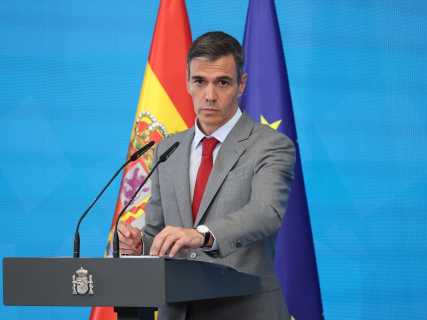

Being on vacation does not mean ceasing to hold a public office or suspending the responsibilities associated with it. The difference with an employee is in the very nature of the position: while an employee maintains a labor relationship with a company, a Prime Minister, a minister, or a mayor holds an institutional position whose ownership does not disappear during a period of rest.
In the case of the Prime Minister, his position derives from the Constitution and the confidence of Parliament, not from a private employment contract. Therefore, even if he reduces his agenda, is absent for a few days, or is on vacation, he continues to be the ultimate responsible for the Executive.
The president does not stop being one during his vacation
The Constitution does not specifically regulate what happens when the Prime Minister is on vacation, sick for a few days, or absent due to a trip. It does establish, however, the general rules regarding the functioning and cessation of the Executive.
Article 101 of the Constitution establishes that the Government ceases after the holding of general elections, in cases of loss of a vote of confidence or approval of a motion of censure, and by resignation or death of the president.
A temporary absence is not listed among those causes. Therefore, the president maintains his status and his powers as long as he continues in office.
The activity of the Executive, moreover, is not paralyzed during his absence. The vice presidencies and ministries allow for the organization of Government activity and the assumption of certain functions through the legally provided mechanisms of substitution and delegation.
This means that another member of the Executive can exercise certain functions during an absence, but does not thereby become the new Prime Minister.
What happens if the president has to be absent?
The organization of the Government allows certain functions to be temporarily assumed by vice presidents or ministers when the president cannot exercise them directly.
It may happen, for example, that a vice presidency presides over a meeting of the Council of Ministers when the president is absent, always within the corresponding rules of substitution and delegation.
The key is to distinguish between the ownership of the position and the specific exercise of certain functions. The president continues to be president even though for a few days other people may perform some of his tasks.
In the case of a situation of special gravity or urgency, the president can also be required to intervene or return to activity.
A minister does not stop being a minister
The same principle applies to members of the Government.
A minister maintains his status during his vacation. His temporary absence does not imply cessation, and the functioning of the department must be guaranteed through mechanisms of substitution and internal organization.
In certain circumstances, another member of the Government may temporarily exercise certain functions or sign by substitution. But the titular minister continues to hold the position.
The situation is, therefore, different from that of a worker enjoying their vacation within an employment relationship. In the institutional sphere, rest does not imply a suspension of the position.
What about a mayor when they are on vacation?
A similar logic operates in municipalities.
A mayor continues to be a mayor even if they go on vacation. Local regulations provide for the figure of deputy mayors, who can substitute the titular in the cases provided, including temporary absence, illness, or impediment.
During that period, the corresponding deputy mayor can assume certain functions, such as signing resolutions or presiding over certain sessions when appropriate.
This does not mean that there is a new mayor. The ownership of the Mayor's Office remains in the hands of the elected person until their cessation occurs or they lose the corresponding status.
What happens with a councilor?
The situation of a councilor is even simpler.
A councilor continues to be a member of the municipal corporation during their vacation. If their rest period coincides with a plenary session, they may not attend that session, but they do not lose their status as an elected official.
When they have certain delegations assigned, these can be temporarily organized according to the rules of operation of the municipality.
Only a formal cause of loss of the status of councilor —such as a resignation or one of the legally provided circumstances— causes their definitive substitution.
The difference with an employee
The main difference lies in the origin of the relationship.
A worker is subject to an employment contract, the Workers' Statute, and, where applicable, the corresponding collective agreement. Their vacations are part of the rights linked to that employment relationship and during that period they are released from their ordinary work obligations.
A public official, on the other hand, does not have a "working day" that is legally suspended by vacations in the same sense.
They can rest, reduce their activity, and be temporarily absent, but they maintain the status attributed to their position and the political responsibilities associated with it.
The absence does not eliminate political responsibility
The fundamental issue is to differentiate between temporary absence and cessation.
A Prime Minister can be on vacation without ceasing to be Prime Minister. A minister can be absent for a few days without ceasing to be a minister. A mayor can be outside the municipality without losing the Mayorship and a councilor can enjoy their vacation without ceasing to be a member of the council.
What changes is how the functions are organized during that absence.
The mechanisms of substitution and delegation allow institutions to continue functioning while their holders rest. But the ownership and political responsibility remain until a cessation occurs or one of the circumstances that legally terminate the mandate takes place.
In the case of the Prime Minister, the Constitution is especially clear on this last point: vacations are not a cause for cessation. As long as there is no election, a motion of censure, the loss of a vote of confidence, their resignation, or their death, they continue at the head of the Executive.