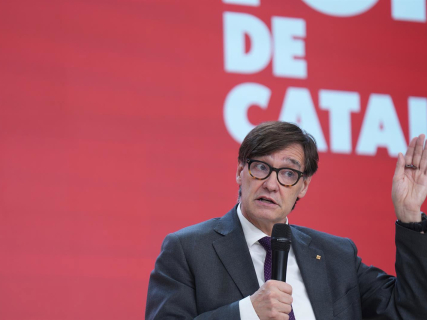

The president of the Generalitat, Salvador Illa, warned this Monday that a decisive confrontation between democratic systems and authoritarian regimes is opening up on a global scale. In this context, he proclaimed: "Catalonia chooses democracy. Democracy is today our main cause".
During the inauguration of the third edition of Prisa's World in Progress in Barcelona, he stressed that the life and coexistence model of the coming decades will depend on this struggle: "Either a world governed by international law and multilateral institutions or a world divided into great blocs and governed by force and greed".
"This is at stake in Brazil, in the United States, in Europe and Spain", Illa emphasized, warning that there are those who are trying to reinforce the perception that democracy is no longer capable of giving effective answers or meeting the needs of citizens.
He also recalled that historically all expressions of authoritarianism have resorted to fear to justify the erosion of democratic institutions and the persecution of critical thinking, culture and science "with the promise of greater security".
The president linked this discourse with "the same false promise that asserts that the market without limits and rules is the only source of prosperity and social progress", and defended that Western democracies must not delegate progress to actors who do not attend to the real demands of the population.
"Democratic radicalism" against dehumanization
For this reason, Illa called for promoting "a new democratic radicalism without complexes" that addresses the root of the problems through reason, science, courage and transformative ambition, always from respect for human values.
In a global "refoundation" scenario, in which, in his view, the international order born after World War II is being undone without an alternative framework having yet crystallized, he pointed out that this indefinition generates a stage of uncertainty with "dangers, risks but also opportunities".
He urged using this moment to keep moving forward, placing the dignity and values of people at the center, in the face of what he considers a "worrying dehumanization and a divisive and confrontational politics".
Likewise, he has underscored that institutions and governments must listen to, protect, and give certainty to citizens in times of instability, guaranteeing issues such as living in peace; that housing be conceived as a right and not only as a business; a health system based on science, universal and free; a decent wage, and the feeling of belonging to a community.
Collboni calls for security, coexistence and opportunities
In the same vein, the mayor of Barcelona, Jaume Collboni, has spoken, who has focused on the accelerated transformations, the current challenges and the growing distrust toward institutions, politics and the future, as well as on polarization and the rise of extremism, among them the increase of the far right "which exploits fears and insecurities, and of ultra-liberal approaches".
Faced with this panorama, he has defended that democratic politics must generate trust and that this is built by guaranteeing coexistence. In his view, the episodes of vandalism experienced in Barcelona and in other European cities in recent weeks show that "order, security and coexistence are indispensable conditions for democracy and progress".
"There is no freedom without security," Collboni emphasized, after highlighting that on Saturday normality could be maintained thanks to prevention and coordination between the Mossos d'Esquadra and the Guàrdia Urbana, bodies to which he thanked their professionalism.
The mayor added that coexistence is also sustained by opportunities, social cohesion and shared future horizons, claiming that Barcelona has known how to get ahead with transformations that open new spaces in different areas. "More housing, more protected housing, must be built, and above all economic opportunities must be guaranteed, also in cities, good public services and cohesive neighborhoods," he specified.
González Laya warns of the global clash of forces
The former minister and president of World in Progress, Arancha González Laya, likewise agreed in warning of the intense clash of forces that is sweeping the planet and that, in her opinion, can trigger transformations of great significance.
She pointed out, in addition to the impact of technology, Artificial Intelligence and scientific progress, the possible consequences derived from the new geopolitics of power, such as a break with cooperation, diplomacy and economic balances.
All of this, she has detailed, happens in a globalized environment where structural inequalities persist, fueling social discontent and in which "the end of conflicts still goes through diplomacy".
"Europe, our continent, is today the laboratory of this clash of forces", González Laya pointed out, warning that this struggle could lead to a scenario without rules, dominated by relationships to the highest bidder, or to another that opts to adapt and reform international institutions, including the United Nations, to avoid an open conflict.
She has also warned that periods of uncertainty are fertile ground for those who promise supposed revolutionary transformations or social refoundations: "Be careful, because, often, they are only facades for authoritarian capture, for digital control, for the dismantling of institutional checks and balances, and ultimately for the end of democracy".