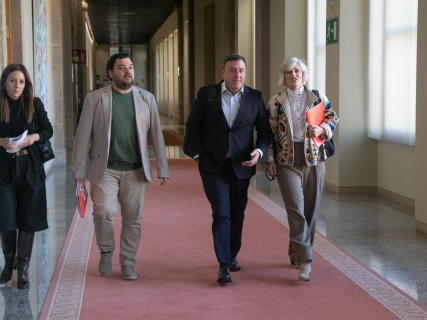

The president of the Diputación de A Coruña, Valentín González Formoso, has warned of the "clamor" of the 93 municipalities of the province, which "face serious operational difficulties to provide the most basic public services" and are "on the brink of financial crack" due to the "lack of resources" and the "continued" assumption of "improper powers".
Formoso appeared this Monday before the Economic Commission of the Parliament of Galicia to explain the accounts of the Diputación for the next fiscal year, with which the current term will be closed. As he advanced, the provincial institution will have the "highest budget in history," with an increase of 14.6%, to 293,930,000 euros.
In his presentation, he insisted that the situation of the concellos is of "important seriousness and is not getting better," since many are "on the brink of financial crack, suffocated by costs". He pointed out that "energy supply, water purification, garbage collection and treatment, and home help services are strangling local budgets".
He recalled that behind every municipal service there are neighbors with rights and people with basic needs and that by "underfinancing municipalities financially, inequality is being deepened and social, health, and territorial gaps among the population are increasing".
This "lack of resources" has become, in his view, a "continuous practice," just like the "unceasing transfer of improper powers" to the municipalities "without evaluating their effective cost and without transferring the necessary funds for their execution".
In this context, he acknowledged that the draft budgets for 2027 of the Xunta de Galicia foresees an increase in the Fondo Galego de Cooperación Local, raising the unconditional amount to 170 million euros from 203 million, 8.4% more for the 313 Galician municipalities. Nevertheless, he emphasized that, "recognizing the progress, it is insufficient".
"If we question that figure it is because the contrast between the financial policy of the Xunta toward the municipalities and the effort of the Diputación de A Coruña is evident. In relative terms, the budgetary effort of the Diputación to finance the municipalities is 20 times greater than that of the Xunta," he noted.
He added that "the Provincial Council makes available to its 93 town councils an amount equivalent to half of everything that the Xunta allocates for the 300 of Galicia" and regretted that the provincial institution receives "zero euros" from the Fondo Galego de Cooperación Local, which, he said, "violates the constitutional mandate that establishes the participation of local entities, including the provinces, in the taxes of the Community".
For this reason, he has asked the Parliament of Galicia to address a "deep" reform that guarantees sufficient resources to local governments, taking advantage of the processing in the Chamber of the Draft law on local administration.
Record budget and priority to social spending
During his speech, Formoso detailed the main items of the provincial accounts for next year, when the Diputación de A Coruña will have the "highest budget in history", with 14.6% more, up to 293,930,000 euros. He specified that this increase comes in its "practical entirety" from the increase in State transfers.
After warning that this "municipal underfinancing" has a "critical" impact on challenges such as the fight against depopulation and aging, he claimed that the Diputación promotes direct measures with "budgetary impact and real execution" to face these challenges.
In this sense, he highlighted initiatives such as Mercanavila and the homes for older adults, "a pioneering public model of care in rural areas in Galicia" based on open centers with 59 places distributed in four living units, aimed at guaranteeing quality care. He announced that the first centers will be located in As Pontes, Rianxo and Ordes, with the objective of "reducing the gap" in existing residential places.
In terms of investment, he highlighted that the Plan Único de Concellos, initially endowed with 92 million, constitutes the main works and services program of the four provincial councils and a "reference in the state sphere", and that next year it will grow by 4.54%.
He also emphasized that the second most relevant spending block is social, which accounts for 11.75% of the total, with an increase of 4.6% to 34,555,000 euros. He explained that most of this increase will be allocated to the Servizo de Axuda no Fogar, with which the Diputación plans to finance 395,804 hours of this essential service.
All of this, he underlined, while the Diputación maintains a "zero debt" situation, without resorting to loans or paying financial interest and "keeps provincial rates and public prices frozen". For this reason, he defended that the accounts for 2027 reflect a "rigorous" administration, with "zero debt", "committed to public services and fully dedicated to the protection of municipalism".
Position of the parliamentary groups
In the groups' turn, the PSdeG deputy Patricia Iglesias has valued the work of the Diputación, which, in her view, "shows that there is another way of governing, another way of managing public resources and of understanding institutional cooperation". She criticized the PP for continuing to transfer to the concellos "year after year" "improper" powers without the necessary funding to exercise them.
From the BNG, the deputy Iria Taibo, whose party co-governs the Diputación together with the PSdeG, has insisted on the "urgent" need to redefine municipal financing, given that city councils assume improper powers by "action or by omission of the Xunta" without it "compensating through the economic route".
Regarding the distribution of funds, Taibo defended that the presence of the BNG in the institution seeks, "from a critical spirit" regarding the functioning of these bodies, "a better distribution" of resources to correct inequalities and partly alleviate the "irresponsible lack of support from the Xunta" for local entities.
In the other position, the PP deputy described as "contradictory" that the provincial president goes to the Chamber to explain that he does not need to go into debt or raise rates and, at the same time, maintains that the city councils "have financing difficulties".
In addition, he rejected the criticisms of the Xunta accounts, highlighting the items allocated to the concellos, whose increase he said makes him "very proud". At the same time, he accused the Diputación of engaging in a "fraudulent practice" in the management of funds by "bypassing the subsidies law" through the hiring of public events with an association led by "prominent members of the BNG, such as the Plataforma Quermeos Galego".
"One thing is to subsidize and quite another to hire with public funds an association so that, instead of providing service to the administration or to the administered, it launches ideological messages", he criticized.