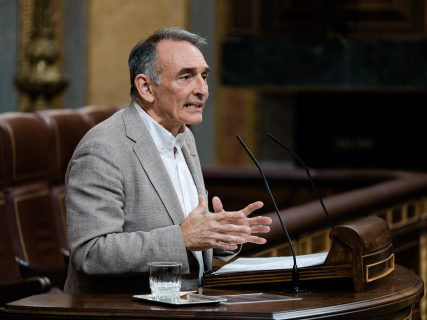

The parliamentary spokesperson for IU and deputy of Sumar in Congress, Enrique Santiago, has urged the Government to consider the possibility of not granting its approval to the new ambassador of Colombia in Spain, Carlos Felipe Mejía, whom he describes as an "enemy of peace" and a defender of "far-right" positions.
This request is articulated through a series of parliamentary questions directed at the Executive, where he expresses his opposition to the former Colombian senator assuming the Embassy at the proposal of the country's president, Abelardo de la Espriella.
In these initiatives, Santiago accuses Felipe Mejía of being a "prominent opponent of the end of armed conflicts" and, in particular, of the peace agreement signed in 2016 between the then Colombian Government and the FARC, in which the deputy himself participated as a mediator.
Criticism of the candidate's profile and the impact on the peace process
According to the IU leader, "his far-right positions and his trajectory against the peace process and reconciliation are particularly relevant in relation to the future diplomatic representation of Colombia in Spain due to the role that Spain has played, and continues to play, in the international support of the Colombian peace process."
He also recalls that the Spanish Government has recently reiterated its commitment to "peace and stability" in Colombia, as publicly stated in April by the Ministry of Foreign Affairs, European Union and Cooperation.
"In this context, his belligerence (referring to the proposed ambassador) against the peace process cannot be overlooked, especially when there are documented precedents of spreading false news and public statements with the sole aim of undermining the institutions of the Colombian peace process," emphasizes Santiago, who also denounces his "political activity on social networks openly hostile against political opponents."
Reactions from the Colombian community and legal framework
The deputy claims to have been aware of expressions of concern within the Colombian community residing in Spain regarding the appointment of Carlos Felipe Mejía. Among them, he cites a public initiative that calls on the Government to review this appointment and to specifically take into account the "public trajectory of the candidate."
At the same time, remember that Article Four of the Vienna Convention on Diplomatic Relations of 1961 establishes that the sending State must verify that the person proposed to head a diplomatic mission obtains in advance the consent of the receiving State, and that the latter "is not obliged to communicate the reasons for any eventual refusal."
"For these reasons, we consider it essential that the Government is clear that the proposed person is not the most suitable at a time when the defense of peace, democracy, and human rights continues to be a priority for millions of Colombians inside and outside the country," concludes Santiago.
Consequently, the leader of IU asks the Executive if it intends to evaluate in detail the profile of Felipe Mejía before granting him the approval as ambassador of Colombia and if it considers the option of rejecting his accreditation.