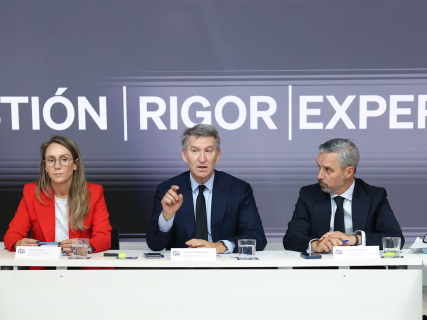
"Management, rigor and experience": the scenery with which Feijóo seeks to project an alternative to Sánchez after Urda

The PP leader brings together railway experts in Génova and turns three words into the visual axis of his appearance

EuropaPress 7878793 presidente partido popular alberto nunez feijoo reunion expertos

EuropaPress 7878793 presidente partido popular alberto nunez feijoo reunion expertos

Add DEMÓCRATA to Google

Ask FREN

Published

Last updated

3 minutes

Most read

Elecciones 29N · Encuestas

La media de las encuestas

Media a 27 de octubre de 2026 · 15 institutos

  • PP31,0 %
  • PSOE27,3 %
  • Vox18,9 %
  • Frente Amplio6,3 %
  • Podemos2,9 %
  • ERC2,3 %
010203040ene 2024jul 2024ene 2025jul 2025ene 2026jul 2026

Media del último estudio de cada instituto en 30 días y su evolución semanal desde el 23J. Partidos con al menos un 2 %.

Todas las encuestas

Elecciones generales del 29 de noviembre · Demócrata

A work table, several specialists in railway infrastructure, and three carefully chosen words on a dark background. "Management, rigor and experience". Alberto Núñez Feijóo appeared this Friday at the national headquarters of the Partido Popular after meeting with experts from the sector to analyze the railway crisis opened by the Urda (Toledo) accident. However, the message of the opposition leader was not limited to his statements. The arrangement of the participants, the profiles that accompanied him, and the chosen staging were also part of the political communication of the day.

The meeting was held just two days after the accident that has caused at least 69 deaths and when one month remains until the general elections of November 29. In that context, the PP has sought to accompany its demands for political responsibility with an image of technical preparation and management capacity, moving away from the usual aesthetics of party events to adopt the appearance of an institutional working meeting.

Three words to summarize the alternative that the PP wants to project

The choice of "management", "rigor" and "experience" is not solely a matter of aesthetics. They are the three concepts with which Feijóo has been questioning the appointments and decisions of the Executive in railway matters, and which he had already used on Thursday during his visit to Urda.

The popular leader then defended that positions of responsibility should be occupied by people with knowledge and proven track record, a criticism aimed at the appointment policy of the Government of Pedro Sánchez.

One day later, those same ideas have moved from the speech to the substance of the appearance.

Each term serves a different function. "Management" refers to the ability to solve problems and combat the deterioration of public services; "rigor" appeals to technical knowledge and informed decision-making; and "experience" reinforces Feijóo's trajectory as former president of the Xunta de Galicia.

The choice of words also allows the PP to partially shift the discussion. Faced with a debate centered on who should resign because of the accident, Feijóo tries to introduce another question: who has the knowledge and the necessary teams to manage the country's infrastructure.

Ethel Vázquez, the technical profile that reinforces Feijóo's image

Among the participants in the meeting stands out Ethel Vázquez, civil engineer and former conselleira of Infraestruturas e Mobilidade of the Xunta de Galicia during Feijóo's governments.

Her presence provides a concrete element to the PP's message. Vázquez appears not only as a former political collaborator of the popular leader, but as a professional with technical training and experience in the administration of public infrastructure.

During her time in the Xunta, she worked on the planning and management of roads, transport and mobility, responsibilities that the PP now uses to support its discourse on the importance of specialized profiles.

The image of Feijóo accompanied by Vázquez thus allows the concept of experience to be associated with an identifiable administrative trajectory.

Also participating in the meeting were leaders from the party's national structure, among them Alma Ezcurra, deputy secretary for Sectoral Affairs, and Juan Bravo, deputy secretary for Finance, Housing and Infrastructure.

The combination of political leaders and specialists helps build a team image, in which Feijóo appears accompanied by people he could turn to to develop government proposals.

The Urda crisis leads the PP to reinforce Feijóo's managerial profile

The staging accompanies an intervention in which Feijóo has accused the Government of abandoning the "culture of safety" and has called for political responsibility from both Óscar Puente and Pedro Sánchez.

"It has been badly managed. It has been badly managed continuously and the Government has abandoned the culture of safety," he declared after the meeting.

The president of the PP has also announced some of the measures he would promote if he were to reach La Moncloa, among them an independent technical review of the railway network, audits of management and spending, and greater priority for the maintenance of existing infrastructure.

Feijóo has defended that safety must prevail even when this entails reducing speeds, temporarily interrupting certain services, or postponing new inaugurations.

These proposals make it possible for the image of the meeting not to be isolated from the political content. The party is trying to back the promise of rigor with commitments that, if applied, would affect the organization and priorities of Renfe and Adif.

More key points, information and questions with FREN

AI-GENERATED CONTENT

What is the status of the processing of the Popular Party's railway proposals in Congress?

The PP's railway proposals in Congress have three different statuses: initiatives already approved, a bill that expired on October 6, 2026, and requests for government oversight. Therefore, there is no single package pending approval: it is advisable to separate what has completed its parliamentary process from what requires administrative execution or a new initiative.

Bill: processing expired

The Bill adopting measures on transport matters, file 122/000153, was presented by the Popular Group on January 23, 2025, admitted for processing on January 29, and published on January 31. It included the continuation of public transport discounts and aid to administrations and users; it was not exclusively railway-related. Its processing expired on October 6, 2026, so it is no longer pending progress in Congress and its text did not become law through that procedure (text of the bill).

Proposals already approved

  • Purchase of high-speed trains. The Transport Commission approved on September 29, 2026, a non-legislative motion from the PP requesting a review of Renfe's tender and, if legal causes concur, to annul it and call another. The proposal has already passed its debate and approval in commission; this does not automatically cancel the tender, whose modification requires decisions by the contracting entity (approval in commission).
  • Compensations for delays. Congress approved on November 13, 2025, the amendment from the Senate to restore compensations of 50% for delays over 15 minutes and 100% for delays over 30 minutes. This change had already passed parliamentary decision; it should not be confused with a proposal still pending debate (approval of the amendment).
  • Compliance with railway obligations. The Plenary approved on June 18, 2026, another non-legislative motion from the PP to demand the restoration of compensations, the first two phases of the extraordinary shock plan, urgent passenger care, and a protocol for analyzing incidents causing delays over 20 minutes. Its parliamentary process ended with approval; execution corresponds to the Government (PP statement).
  • Actions in Galicia. The Plenary approved on February 6, 2024, a popular initiative with thirteen railway measures: high-speed variants and connections, stations, Atlantic Corridor, link with Portugal, improvements to conventional lines, commuter trains, and freight. This is also approved, not pending processing; approval alone does not guarantee that the works have been executed (Congress agreement).

Parliamentary oversight and other proposals

The most recent request located is the urgent appearance of Pedro Sánchez before the Permanent Deputation, registered on October 29, 2026, by the PP after the Urda accident. Its presentation is recorded, but its approval or holding is not confirmed in the consulted sources (appearance request).

There are also proposals about reopening Madrid–Aranda–Burgos and infrastructures in Andalusia and Zamora, linked to commission documentation. No sufficiently precise individual result is recorded to attribute approval or rejection (parliamentary documentation).

The practical key is to distinguish approval from compliance: non-legislative motions request actions from the Executive without legally obliging it. The identified legislative proposal expired; the agreements already approved require monitoring their execution, not continuing their processing.

What are the legal functions and powers of the president of the Popular Party in opposition?

The president of the Popular Party, when his party is in opposition, does not acquire government powers or public powers by that reason. Three levels must be distinguished: the internal leadership of the party, the parliamentary powers he has by holding a seat or representing a group, and the political leadership of the opposition.

1. Being leader of the opposition does not equate to an executive position

At the state level, the Congress Rules do not establish a position of leader of the opposition with its own powers. Therefore, presiding over the PP does not allow ordering actions to the Administration, dismissing ministers, calling elections, or imposing decisions on Parliament.

The distinction responds to the nature of parties. The Constitutional Court Ruling 48/2003 explains that they have functions of constitutional relevance, but "they are not State organs" nor holders of public power. Their political influence should not be confused with a legal authority.

2. Parliamentary powers: depend on the seat

If the PP president is a deputy, he can exercise the rights recognized by the Congress Rules, not by leading the party, but by his parliamentary status:

  • Debate and vote: attend with vote the Plenary and commissions of which he is a member, according to article 6.
  • Request information: obtain data, reports, and documents from public administrations through the Presidency of Congress, with prior knowledge of his group, according to article 7.
  • Control the Government: formulate questions and interpellations, that is, request explanations about its actions or general orientations, according to articles 180 and 185.
  • Participate in legislative activity: intervene in procedures and debates according to regulatory requirements, without having unlimited personal initiative.

If he holds a seat in another Chamber, he cannot automatically transfer the powers of that Chamber to Congress. Presiding the party does not substitute the requirements of each institution.

3. Powers of the group and its spokesperson

Many tools correspond to the parliamentary group or require collective support. Groups can present non-legislative motions — proposals for resolutions of the Chamber — according to article 193. The creation of an investigative commission can be proposed, among others, by two groups or one fifth of the deputies, but must be agreed by the Plenary: the PP president cannot constitute it unilaterally.

Also, the Board of Spokespersons is formed by those who exercise the spokesperson roles of the groups. Being party president does not automatically grant a seat on it. Its decisions are made by weighted vote, considering the parliamentary weight of each group.

The motion of censure is also not a personal prerogative: it requires the signature of at least one tenth of Congress, an alternative candidacy that accepts it, and an absolute majority to be approved. In contrast, proposing a vote of confidence corresponds to the president of the Government, not the opposition leader.

4. Party leadership and political leadership

The representation, organization, and internal leadership of the PP must be distinguished from state powers: their concrete scope must be established according to their statutes and decisions of their bodies. It is not appropriate to attribute unlimited powers over appointments, candidacies, or discipline to the president without examining those rules.

Representing an alternative, negotiating agreements, and criticizing the Government are political functions, not executive powers. Also, leading the party does not allow withdrawing a seat from a representative by itself: this is recalled by Ruling 298/2006. In sum, his political authority can be broad; his legal powers depend on each position and procedure.

What has been Ethel Vázquez's professional and political career before collaborating with Feijóo?

Before collaborating with Alberto Núñez Feijóo, Ethel María Vázquez Mourelle developed a fundamentally technical career: she trained as an engineer, worked in the private sector, and joined Augas de Galicia. Two moments should be distinguished: her collaboration with Feijóo's Government began in 2009, while her entry as conselleira occurred in 2014. Therefore, several of her first managerial positions were already part of that collaboration, not prior to it.

Education and initial professional experience

Vázquez is a Civil Engineer (Roads, Canals, and Ports) from the Universidade da Coruña. This training forms the basis of her later specialization in hydraulic works, infrastructures, and public service management. Her initial career was linked to professional engineering practice before assuming political responsibilities in the regional Government.

After finishing her studies, in 1996 she began working in the private sector, within the field of hydraulic works. That first stage allowed her to acquire sectoral experience before moving to the Administration. The biographical profiles consulted place the start of her career here, without identifying a prior parliamentary or government trajectory. Her education and career can be consulted in profiles published by La Voz de Galicia.

Joining the Galician Administration

In 2003 she joined Augas de Galicia, an agency of the Xunta specialized in water management. This step is important to organize her biography: her arrival at the regional Administration preceded by six years the first Government presided by Feijóo. Therefore, she did not start her public activity directly as part of his political team.

During that stage she consolidated a profile linked to hydraulic management and Administration functioning. The continuity of that professional link also appears in information about her later decision to return to her civil servant position at Augas de Galicia, recorded by Demócrata.

From technician to senior official of the Xunta

The shift to management responsibilities occurred in April 2009, when she was appointed president of Augas de Galicia and the Public Company of Hydraulic Works and Services. From that moment she was already working within Feijóo's Executive. Her promotion was linked to the then Minister of Environment, Territory and Infrastructures, Agustín Hernández, according to the profile published by El País.

Before becoming conselleira, she expanded her responsibilities towards infrastructures: in September 2010 she assumed the General Directorate of Infrastructures; in April 2011, the presidency of the Galician Public Investment Society; and in January 2012, the direction of the Galician Infrastructure Agency. This sequence appears in the review of her career published by VigoÉ.

What political trajectory did she have previously?

The most relevant point is that her access to the first political level came from administrative management, not from a prior parliamentary career. In June 2014, Feijóo chose her as conselleira of Environment, Territory and Infrastructures to replace Hernández, who left the Xunta to assume the Mayor's office of Santiago.

In summary, before working with Feijóo she had accumulated experience as an engineer in the private sector and at Augas de Galicia. Before becoming his conselleira, she also had five years of public management within his Government. This difference explains her career: first technical professional, then senior manager, and finally member of the Galician Executive.

Play

Test your knowledge with FREN!

How much do you know about this topic? Answer the following 3 questions.

What three concepts did Feijóo highlight in his appearance after the Urda railway accident?

Question 1 of 3

Who is Ethel Vázquez, the technical participant in the meeting organized by Feijóo?

Question 2 of 3

What is one of the measures Feijóo has proposed to improve railway safety?

Question 3 of 3