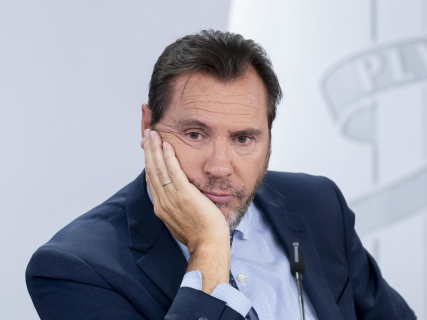

The Minister of Transport and Sustainable Mobility, Óscar Puente, has publicly criticized King Felipe VI for his greeting to Javier Negre during his recent trip to Colombia. The socialist leader described the scene as "absolute ignominy" and shared on X a post from an anonymous profile that accompanied the images with the expression "Republic now!".
Felipe VI agrees to greet him. The images were initially published by Negre himself on Instagram and later spread by the account that ended up sharing the minister. Puente added his own assessment of what happened: "This situation seems to me an absolute ignominy".
The meeting between Felipe VI and Javier Negre in Colombia
The meeting took place during the King's trip to Colombia on the occasion of the inauguration of President Abelardo de la Espriella, held on August 7 in Cali.
Felipe VI attended the event as part of the Spanish representation, as he has done at the inaugurations of various Latin American presidents. On this occasion, he was accompanied by the Minister of Foreign Affairs, José Manuel Albares, who was part of the official Spanish delegation.
The organization and scheduling of the monarch's international trips is carried out in coordination between the Ministry of Foreign Affairs and the Royal House. The meeting with Negre occurred within a closed venue during the stay of the Spanish delegation in Colombia.
Puente describes the scene as "absolute ignominy"
The word used by Óscar Puente to refer to Felipe VI's greeting to Javier Negre has increased the political repercussions of the episode. The minister did not limit himself to sharing the video, but accompanied the post with a direct assessment of the scene.
"This situation seems to me an absolute ignominy," wrote Puente. According to the Dictionary of the Royal Spanish Academy, "ignominy" means "public disgrace" and has among its synonyms terms such as shame, dishonor, offense, grievance, or outrage.
This situation seems to me an absolute ignominy. https://t.co/aw1gFN7KZX
— Óscar Puente (@oscar_puente_) August 10, 2026
The minister did not specify in that post which specific aspect of the meeting he considered an "ignominy." The images show Negre requesting a greeting from the head of state and the monarch agreeing to shake his hand and to his request.
The message shared by Puente called for "Republic now!"
The controversy is not limited to the expression used by the minister. Puente shared a post from an anonymous and republican profile that used images of the meeting between Felipe VI and Javier Negre.
The account Bilboa III República accompanied the content with the expression "Republic now!". Puente reposted that message with a quote and later added his comment on the "absolute ignominy."
The episode represents a particularly striking public criticism of the head of State from a socialist member of the Council of Ministers. The original text states that there is no precedent in democracy for a public criticism of this nature made by a PSOE minister against the King.
What the Constitution says about the King and the ministers
Freedom of expression is recognized in Article 20 of the Spanish Constitution, while the institutional relationship between the head of State and the members of the Government is regulated in different provisions of the Magna Carta.
Article 64 establishes the system of countersigning the acts of the King. According to this provision, the acts of the monarch are countersigned by the president of the Government and, when appropriate, by the competent ministers, who assume responsibility for those acts.
On the other hand, Royal Decree 707/1979 regulates the formula used for the taking of possession of public offices and functions. In the case of ministers, it includes the oath or promise to faithfully fulfill the obligations of the office with loyalty to the King, to uphold and enforce the Constitution, and to maintain the secrecy of the deliberations of the Council of Ministers.
The controversy comes after the Ceuta crisis
Puente's post also comes after the political differences that arose around the crisis recently recorded in Ceuta, which Pedro Sánchez described as a "violation of the territorial integrity of Spain."
The Royal House issued an informal note on August 1 in which it recorded the "indignation" of Felipe VI over what happened and his support for the defense of the territorial integrity of the State.
Subsequently, on August 6, Felipe VI received in a private audience in Marivent the president of Ceuta, Juan Jesús Vivas, to whom he expressed his desire to visit the autonomous city.
The possible trip of Felipe VI to Ceuta
The possibility that Felipe VI visits Ceuta has also provoked statements from the Government. The Minister for Digital Transformation and Public Function, Óscar López, assured that this trip would take place when "it is appropriate" and in "full coordination".
The monarch's desire to travel to the city became known after his meeting with Juan Jesús Vivas and in a context marked by the institutional response to the events recorded in Ceuta since the end of July.
The Constitution establishes in its article 56 that the King is the head of State and symbol of its unity and permanence, while article 62 includes among its functions being informed of State affairs and presiding, when he deems it appropriate and at the request of the president of the Government, the sessions of the Council of Ministers.
The institutional relationship between Zarzuela and Moncloa
The controversy provoked by Óscar Puente's words thus adds to the debate about the relations between the Government and the Royal House. The original text links the episode with the differences that arose around the Ceuta crisis and with the management of the possible visit of Felipe VI to the autonomous city.
The King held his traditional meeting with Pedro Sánchez on July 29 at the Palace of Marivent. The meetings between the head of State and the president of the Government constitute one of the mechanisms through which Felipe VI receives information about the political situation and State affairs.
Now, the words of Óscar Puente about Felipe VI open a new controversy after a member of the Council of Ministers publicly described a scene featuring the head of State as "absolute ignominy" and shared a post that demanded "¡Republic now!".