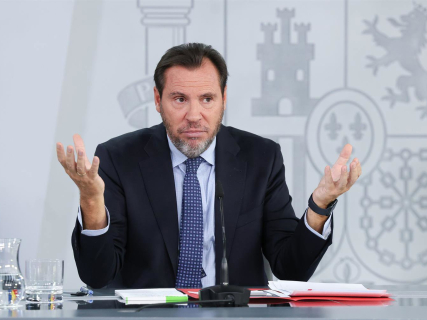
Political reactions to Puente's resignation: Abascal, Muñoz, Rufián and Colau, the first to speak out after the minister's fall

The head of Transport leaves the Government after being cornered by calls for his resignation from the right and the left following the rail accidents in Adamuz and Urda. His combative profile on X had made him one of the main political targets of the opposition

fotonoticia 20261103150910 1920

fotonoticia 20261103150910 1920

Add DEMÓCRATA to Google

Ask FREN

Published

Last updated

4 minutes

Most read

Elecciones 29N · Encuestas

La media de las encuestas

Media a 3 de noviembre de 2026 · 17 institutos

  • PP30,4 %
  • PSOE27,4 %
  • Vox19,2 %
  • Frente Amplio6,5 %
  • ERC2,4 %
  • Podemos2,4 %
010203040ene 2024jul 2024ene 2025jul 2025ene 2026jul 2026

Media del último estudio de cada instituto en 30 días y su evolución semanal desde el 23J. Partidos con al menos un 2 %.

Todas las encuestas

Elecciones generales del 29 de noviembre · Demócrata

They had been looking forward to Óscar Puente, politically speaking. The until now Minister of Transport, one of the members of Pedro Sánchez’s Government who is most combative and controversial for his interventions on social networks, has submitted his resignation this Tuesday after being practically sidelined by requests for political responsibilities following the rail accidents in Adamuz (Córdoba) and Urda (Toledo).

His departure from the Executive occurs in the middle of the pre-campaign for the general elections of 29 November. Santiago Abascal, leader of Vox, has been one of the first political leaders to react publicly to his resignation, through a message on X.

The reaction of the Vox president comes after earlier this same morning he insisted that political responsibilities should not end at Puente, but should reach the Government’s own president. Abascal had demanded that he resign who appointed him and kept him in office, referring to Pedro Sánchez.

For her part, the PP spokesperson in Congress, Ester Muñoz, also rushed to assess this Tuesday night in the Lower House the resignation announcement of Óscar Puente pointing out that his resignation “arrives 116 deaths late”, referring to the victims of the rail accidents that occurred in Adamuz (Córdoba) and Urda (Toledo) within less than a year.

Rufián and Colau’s farewell

Without yet making it public, from ERC, Gabriel Rufián has said goodbye to Óscar Puente with the following words: “You have been a great minister”. The Congress microphone 'caught' the spokesperson for EC when he approached to bid farewell to the now former minister at the end of the Permanent Deputation.

Meanwhile, Ada Colau, has dedicated a post on X to him: “I want to thank Óscar Puente for the dignity of this difficult gesture. I’m sure it’s a step forward to rebuild trust in the train our country deserves”. The posting by the leader of En Comú Podem comes after this same morning she had asked him to resign.

Óscar Puente, the minister who turned social media into a political battleground

Puente’s departure has a dimension that goes beyond his time in charge of the Ministry of Transport. Since he entered the Executive, the socialist leader had turned his profile on X into one of his main instruments of political confrontation.

His replies to PP and Vox leaders, his criticisms of journalists, and his frequent digital controversies had placed him among the ministers most exposed to public confrontation. His direct, ironic style and, at times, especially harsh approach won him support from socialist sectors and deep animosity among his opponents.

Puente never shied away from that confrontation. On the contrary, he made it a recognizable feature of his political activity, extending on social media the clashes he maintained in Congress and in his public appearances.

This activity also ended up becoming an argument for his critics. This same Tuesday, Alberto Núñez Feijóo once again reproached him for having devoted more time to social media than to railway and road infrastructures, a recurring accusation by the PP president against the minister.

Cornered by the right and by the left after the rail accidents

In any case, it has not been his digital controversies that have precipitated his departure from the Government, but the political pressure that has accumulated after the two major rail accidents recorded this year.

The accident in Adamuz, in January, and that in Urda, last Wednesday, October 28, placed the management of the Ministry of Transport at the center of the political debate.

From the first moment, PP and Vox demanded his departure. Junts also joined the criticism, while parties located to the left of the PSOE, such as Podemos and the parties integrated in the Sumar space, demanded that he assume political responsibilities.

Especially significant was Ada Colau’s position, a candidate for the Presidency of the Government for the Frente Amplio, who demanded his resignation by appealing to humanity and empathy with the victims.

Pressure also came from the trade-union sphere, with organizations such as CCOO calling for the minister to step aside.

From rejecting a resignation in the morning to leaving the Government by night

This Tuesday’s session has proved decisive. During the press conference after the Council of Ministers, Puente was still defending his continuation in office and arguing that he had not taken or omitted any decision that had contributed to causing the accidents.

The minister then acknowledged that he could understand the requests for his resignation made in good faith, such as that of Ada Colau, but he rejected those coming from the PP and from Alberto Núñez Feijóo, whom he accused of applying a double standard in matters of political responsibility.

Hours later, during his appearance before the Standing Committee of the Congress, the scene changed with the announcement of his resignation.

His departure means the exit of one of the PSOE’s main political battering rams against the opposition and leaves Pedro Sánchez with the need to reorganize the Ministry of Transport at a particularly delicate moment for the Spanish rail system.

For the opposition, the resignation now opens another front: determine whether political responsibility for the accidents ends with Puente’s departure or must extend to the head of government.

More key points, information and questions with FREN

AI-GENERATED CONTENT

What powers does the Minister of Transport have according to Spanish legislation?

The Minister of Transport has the political leadership of their department and the responsibility to propose and implement state policies on infrastructure, transport services, and sustainable mobility. It is important to distinguish their personal powers as minister from the competencies of the Ministry, which are also exercised through secretariats of state, general directorates, and attached entities.

1. General powers as minister

Article 4 of the Law 50/1997, of the Government, assigns all ministers four basic functions, applicable to the Minister of Transport:

  • Develop the Government's action in their department, following the agreements of the Council of Ministers and the guidelines of the President of the Government.
  • Exercise regulatory authority in matters pertaining to the department: issue provisions within their competence and respecting higher norms.
  • Exercise other competencies assigned by laws and government organization and functioning provisions.
  • Endorse, when appropriate, the acts of the King related to their competencies.

Therefore, the minister directs their scope of action but does not replace the Council of Ministers. Article 5 of that law reserves to this body, among other decisions, the approval of draft laws, royal decrees, and regulations that correspond to it.

2. Specific areas of Transport

Article 1 of the Royal Decree 253/2024, of March 12, specifies the competencies of the Ministry of Transport and Sustainable Mobility. Its core is the "proposal and execution of the Government's policy" in the following areas:

  • Transport infrastructure: land, air, and maritime infrastructure under state competence. This includes planning and programming the corresponding investments.
  • Transport services: control, organization, and administrative regulation of services associated with those modes of transport.
  • Sustainable mobility: its promotion in social, economic, and environmental dimensions, including active mobility. The regulation guides these policies towards safe and sustainable mobility based on social justice criteria.
  • Postal services: their normative organization. This attribution should not be confused with personally assuming the provision of all postal services.
  • State geographic and scientific services: promotion and direction of those related to astronomy, geodesy, geophysics, and cartography.

3. How these competencies are exercised

The same royal decree places under the direct dependence of the minister the Secretariat of State for Transport and Sustainable Mobility and the Undersecretariat. The former defines and proposes sectoral policies under the minister's direction, and develops them through its dependent bodies and attached entities.

Among its tasks are strategic planning of infrastructure and services, monitoring the railway network, general transport organization, and promoting intermodality: facilitating different means of transport to operate in a coordinated manner.

It also programs investments, prioritizing safety, maintenance, and daily mobility; executes infrastructure directly or through attached entities; and supervises the actions of dependent organizations. These are functions of the ministerial apparatus, not actions that the minister must personally resolve in each case.

4. Limits and coordination

Competencies over infrastructure and transport are limited to the state scope: they do not make the minister responsible for any road, service, or infrastructure existing in Spain. Additionally, article 1.5 requires exercising them in coordination and without prejudice to the attributions of other ministries.

At the international level, a unit directly dependent on the minister coordinates the department's relations and representation, especially before the European Union, in collaboration with Foreign Affairs.

What has been Óscar Puente's political trajectory before becoming minister?

Before joining the Ministry of Transport and Sustainable Mobility in November 2023, Óscar Puente developed his career mainly in Valladolid: he was a councilor, local PSOE leader, and mayor for eight years. At the same time, he gained national prominence as spokesperson for the federal socialist leadership between 2017 and 2021 and, finally, as a deputy for Valladolid in 2023.

Early steps: membership and organization of the PSOE

Born in Valladolid in 1968, Puente graduated in Law from the University of Valladolid and worked as a lawyer between 1995 and 2015. During part of that period, he combined his profession with political activity; he left law practice upon becoming mayor, according to his official biography.

He joined the PSOE in 1990, although his first significant responsibilities in the organization came in 2004, when he assumed the deputy general secretary of the Provincial Executive of Valladolid. That position preceded his entry into municipal institutions and marked the beginning of a trajectory linked both to the party and the City Council.

2007-2015: councilor and municipal opposition

In 2007 he obtained his first councilor seat in the Valladolid City Council. A year later, he became president of the Socialist Municipal Group and in 2009 was elected secretary general of the PSOE Municipal Executive, a responsibility he held until December 2021.

His first institutional stage was, therefore, in municipal opposition: he was a councilor for eight years before reaching the mayoralty. During that time, he accumulated responsibilities of public representation and party leadership in the city, as noted in the Demócrata profile.

2015-2023: two terms as mayor

In June 2015 he was elected mayor of Valladolid. Although the PP had been the most voted force, Puente secured the necessary support from other parties to form an alternative majority. His investiture ended two decades of PP municipal governments.

He renewed the mayoralty after the 2019 municipal elections, in which the PSOE was the most voted candidacy. He remained at the head of the City Council until June 2023, completing two consecutive terms.

Additionally, he held municipal representation responsibilities outside Valladolid. He presided over the Spanish Network of Healthy Cities of the Spanish Federation of Municipalities and Provinces between November 2015 and December 2019; was a member of the FEMP Governing Board between 2019 and 2023; and represented this federation in the Urban Initiatives Network between 2020 and 2023.

2017-2021: first national projection

While mayor, he supported Pedro Sánchez in the 2017 socialist primaries. After Sánchez's victory, he assumed the spokesperson role of the PSOE Federal Executive Commission, which he held from June that year until October 2021. Thus, he combined municipal management with public communication of the party leadership.

In December 2021, he took over as Secretary General of the PSOE of Valladolid, according to his official biography, after leaving the federal spokesperson role.

2023: from City Council to Congress

In the May 2023 municipal elections, the PSOE was again the most voted force in Valladolid, but the agreement between PP and Vox allowed Jesús Julio Carnero to access the mayoralty. Puente then led the socialist candidacy for Valladolid in the general elections on July 23 and obtained a seat.

On September 26, he was the PSOE's spokesperson during Alberto Núñez Feijóo's investiture, increasing his national visibility. Two months later, he joined the Government: in November 2023 he was appointed Minister of Transport and Sustainable Mobility, his first position in the central Executive, as RTVE explained when announced.

What parliamentary procedures are necessary to reorganize the Ministry of Transport after the resignation of its head?

The resignation of the Minister of Transport does not, by itself, require any parliamentary procedure to replace them or to carry out an ordinary reorganization of the ministry. No authorization from the Congress or the Senate is needed, nor a new investiture. It is important to distinguish the Executive's decisions that make the replacement effective and the mechanisms through which the Chambers can subsequently control that decision.

1. Dismissal and appointment of the minister

According to article 100 of the Constitution, ministers are appointed and dismissed by the King, at the proposal of the President of the Government. Therefore, the resignation must lead to the corresponding formal dismissal act, implemented by royal decree; the appointment of the replacement also follows this route.

The new minister does not need to individually obtain the confidence of the Congress. The investiture regulated in articles 170 to 172 of the Congress Rules corresponds to the candidate for the Presidency of the Government, not to each member of the Council of Ministers. The Senate also does not ratify the appointment.

For the same reason, the replacement does not require raising a vote of confidence nor does it automatically trigger a motion of censure. These are different procedures related to the Government's political confidence or responsibility, not necessary steps to replace a minister.

2. Reorganization of the department

Changing the minister does not require modifying the ministry: its name, competencies, and structure can be maintained. If the president decides to reorganize it, the corresponding organizational instruments must be approved, usually royal decrees, depending on the scope and the competent body for each change.

An ordinary reorganization may include changes of name, redistribution of areas among departments, or modifications of its administrative structure. It does not generally require a law nor a parliamentary vote. It is important not to confuse the organizational royal decree with a royal decree-law: the former is not subject to the Congress's validation procedure.

The limit arises when the reform intends to modify what is established by law or regulate a matter reserved for it. A regulatory provision cannot do so alone: a law-level norm would be necessary and, therefore, the corresponding parliamentary intervention depending on the instrument used. The need would arise from the content of the reform, not from the resignation.

3. Appearances and parliamentary control

There is no mandatory prior appearance simply by assuming the ministry. However, this does not eliminate the obligation to submit to parliamentary control when activated according to applicable rules.

  • Appearances: article 44 of the Congress Rules allows commissions to request the presence of Government members to report on matters of their departments.
  • Questions and interpellations: articles 180 to 192 allow demanding explanations about the resignation, reorganization, and its consequences.
  • Information and documentation: commissions can request the necessary elements to examine the decisions made.

These mechanisms allow debating and overseeing the reform but do not constitute ratification of the appointment. The STC 124/2018 highlights the constitutional relevance of parliamentary control of the Government.

4. Practical sequence

In short, the ordinary process is to formalize the dismissal, appoint the replacement, and, if the department is modified, approve and publish the pertinent organizational royal decrees. Congress and Senate do not have to authorize these decisions beforehand. Their intervention may occur through political control or, if the reform requires changing a law, through the corresponding legislative procedure.

Play

Test your knowledge with FREN!

How much do you know about this topic? Answer the following 3 questions.

What was the main reason that led Óscar Puente to resign as Minister of Transport?

Question 1 of 3

What characteristic especially defined Óscar Puente's political activity as minister?

Question 2 of 3

What stance did the PP take regarding Óscar Puente's resignation?

Question 3 of 3