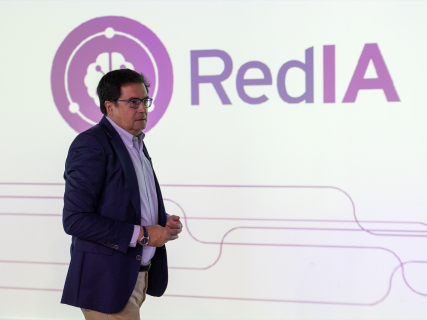

The Government is finalizing the distribution of 180 million euros for more than 372 artificial intelligence projects in companies and in the healthcare sector. The Minister for Digital Transformation and Public Function, Óscar López, announced this Monday that seven out of ten selected initiatives are driven by SMEs and that the aid, ranging from 400,000 to 5 million euros, will reach all autonomous communities.
López made the announcement during his speech at the 40th Meeting of Digital Economy and Telecommunications of AMETIC, which is being held in Santander and brings together representatives from companies, public administrations, and the technology sector.
The money is channeled through two programs managed by Red.es and financed with FEDER funds. RedIA has 130 million euros for business research and development projects, while RedIA Health reserves another 50 million to introduce artificial intelligence in different healthcare areas.
"We are soon going to resolve the AI calls with an investment of 180 million euros for more than 372 selected projects," López announced. According to the data provided by the minister, "7 out of 10 will be driven by SMEs."
Who could apply for the aid
The 180 million do not constitute an open subsidy for any organization that wants to incorporate an artificial intelligence tool. The two calls are aimed at companies capable of developing technological projects, although RedIA and RedIA Health set different objectives.
In the case of RedIA, companies with a tax residence in Spain could apply, from SMEs to large companies. The applications had to propose research and technological development projects and demonstrate that the public aid had an incentivizing effect: that is, that the project would not be carried out, or would be developed in a more limited way, without the subsidy.
Companies could submit up to three projects and Red.es would finance a maximum of two per entity.
The business response was high. RedIA received more than 1,000 applications worth over 884 million euros, far exceeding the 130 million available. Among those who applied, small companies predominated, with around 60.5% of the applications, followed by large companies, with approximately 22.5%, and medium-sized companies, with 17%.
The advanced selection this Monday by López further increases the weight of SMEs: seven out of ten chosen projects are driven by small and medium-sized enterprises.
RedIA Salud also targets companies capable of developing artificial intelligence solutions, in this case specifically applied to the healthcare field. The projects can incorporate the collaboration of the necessary agents to test the technology, such as hospitals, universities, health services, or other organizations linked to its execution.
From 400,000 to five million per project
The two lines establish a wide range of funding. The aids can range between 400,000 and 5 million euros per project, while the intensity of the grant varies between 25% and 60% of the amount, depending on the type of company and the characteristics of the initiative.
The bulk of the budget corresponds to RedIA, with 130 million euros. Its purpose is to finance experimental development projects capable of creating new products, processes, or services, or introducing substantial improvements in existing ones.
This implies that the program is not simply designed for a company to purchase a commercial artificial intelligence tool. The projects must incorporate technological development through prototypes, pilot tests, or validations.
What the 130 million from RedIA will be used for
Artificial intelligence occupies a central place, but it is not the only technology that can receive funding. The bases allow the use of the 130 million in projects of AI, robotics, cybersecurity, internet of things (IoT), virtual reality, space technologies, or advanced connectivity, among other technologies considered strategic.
The proposals submitted to the call already show where much of the business interest is directed: Red.es identified artificial intelligence, cybersecurity, and robotics among the areas with the greatest prominence.
The application field can belong to practically any economic sector, with one exception: healthcare was excluded from RedIA because it has a specific call, RedIA Salud.
The projects can thus be transferred to industrial, logistical, or productive processes through tools such as predictive systems, advanced automation, intelligent information analysis, sensors, or solutions capable of improving products and processes.
50 million and 72 projects to apply AI to health
The second leg of the program focuses exclusively on the health sector. López has announced that 72 AI projects will be launched in different areas of health with a public investment of 50 million euros.
Here the bases precisely delineate what can be done with the money. RedIA Salud finances artificial intelligence solutions aimed at acting in different phases of the care process: prediction, prevention, diagnosis, treatment, care, and follow-up of patients.
Projects related to clinical, biomedical, and pharmacological research, management of health systems, or response to health emergencies are also included.
Among the possible applications range from assisted diagnosis to personalized medicine. The call seeks, therefore, to bring artificial intelligence both to the direct relationship with the patient and to research and the internal functioning of the health system.
Health AI will have to be tested with real data
RedIA Salud incorporates a requirement that conditions the type of projects that can receive funding: the solutions must be demonstrated, validated, or certified in an environment with real data.
It is not enough, therefore, to propose a theoretical development. The call is aimed at experimental development projects that allow verifying the functioning of the technology in conditions close to those in which it will have to be used.
To do this, companies can count on the effective collaboration of the necessary agents to execute the project, including hospitals, universities, health services, or other organizations.
The combination of both calls allows the Government to mobilize the 180 million euros announced by López: 130 million to incorporate AI and other strategic technologies into production chains and another 50 million reserved for health.
The selected projects will receive between 400,000 and 5 million euros. The main novelty announced this Monday is the weight that smaller companies will have in the distribution: according to López, 70% of the chosen initiatives will be driven by SMEs.