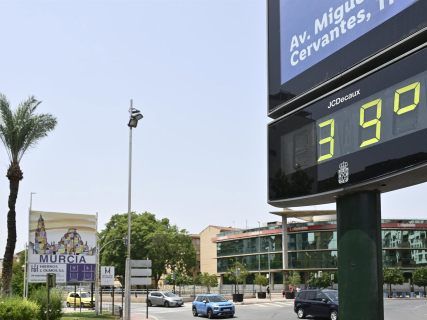

The high temperatures have already left 5,140 deaths attributable to heat in Spain during the current summer season, according to estimates from the Daily Mortality Monitoring System (MoMo), dependent on the Carlos III Health Institute.
The balance includes the period from mid-May to August 26 and exceeds the 4,789 estimated deaths during the same interval in 2022, which until now was the highest reference.
The data comes after a summer marked by extraordinary temperatures. AEMET has confirmed that June and July 2026 formed the warmest summer bimonthly period in the historical series that began in 1961, with an average temperature of 24.5 degrees, 0.7 degrees above the previous highs of 2022 and 2025.
August has been the month with the most deaths attributable to heat
The mortality statistically associated with high temperatures has intensified as summer progressed.
According to MoMo data, August concentrates up to the 26th a total of 2,055 deaths attributable to heat in Spain, becoming so far the month with the greatest impact.
It is closely followed by July, with 2,025 deaths, while June left 937. To these figures, another 123 estimated deaths during the second half of May are added. In total, the balance amounts to 5,140 deaths.
The figure does not mean that in 5,140 death certificates heat is expressly listed as the cause of death. It is a statistical estimate of mortality attributable to temperature, calculated from the relationship between observed deaths and thermal conditions.
Madrid drops from 590 to 267 deaths despite record temperatures
The evolution is very different in the Community of Madrid, where deaths attributable to heat have been considerably reduced compared to last summer.
MoMo estimates 267 deaths from mid-May to August 26, compared to the 590 recorded during the same period in 2025. The drop therefore exceeds 50%.
The figure for Madrid represents approximately 5.2% of the national total and is among the lowest in the regional series since monitoring began in 2015. Only 2020, with 263 estimated deaths during this same period, presented a lower balance.
The difference is still greater compared to 2022, when Madrid reached a maximum of 1,308 deaths attributable to high temperatures. The current 267 deaths amount to just over one fifth of that record.
June worsened in Madrid, but August completely changes the trend
The accumulated decline in Madrid has not occurred uniformly throughout the summer. In June 93 deaths attributable to heat were recorded, compared to 48 in the same month of 2025. The increase was 93.75%, coinciding with an intense heat wave during the latter part of the month.
In July, another 121 deaths were recorded, accounting for 45.3% of all deaths attributed to high temperatures in Madrid during the analyzed period. The figure was slightly below the 129 estimated cases a year earlier.
The main change has occurred in August. Up to the 26th, Madrid records 53 deaths attributable to heat, compared to the 413 recorded on the same dates in August 2025. The reduction reaches 87.16%.
Over 65 years old, the most vulnerable group
Age is once again one of the main risk factors. In Madrid, practically all the people whose deaths are statistically attributed to heat were over 65 years old. Of the 267 calculated deaths, 160 correspond to women and 107 to men.
The most adverse dates were the 8th and 9th of July, with 17 and 16 estimated deaths, respectively. July 10 and the 24th and 25th of June recorded another 15 deaths each. The Ministry of Health estimates that the risk of mortality increases by between 9.1% and 10.7% for each degree that the temperature exceeds the health risk threshold.
The elderly, people with cardiovascular or respiratory diseases, those living alone, and workers exposed for hours to high temperatures are part of the groups that require greater monitoring during heat waves.
What it means for a death to be "attributable to heat"
The MoMo data require significant precision.
The system does not only count deaths in which a doctor has identified heat stroke as the direct cause. Its methodology uses a statistical model that crosses daily recorded deaths, temperatures provided by AEMET, and population structure.
From that information, it calculates how many deaths can be statistically attributed to an excess or deficiency of temperature.
For this reason, the MoMo figures are different from the data on deaths directly diagnosed as heat stroke. Many extreme temperatures can aggravate pre-existing conditions, especially cardiovascular, respiratory, or renal diseases, without the heat necessarily being listed as the main cause on the death certificate.
2026, on track to close one of the hottest summers
The high national mortality coincides with an exceptional summer from a climatic point of view.
June and July recorded a combined average temperature of 24.5 degrees, 2.9 degrees above the average of the reference period 1991-2020. Furthermore, the five warmest June-July bimesters in the series have been recorded since 2015.
The latest assessment from AEMET already points out that the summer of 2026 is the hottest in the historical series in peninsular Spain, after persistently higher than normal temperatures since mid-May, except for some specific episodes of cooling.
The balance thus leaves an uneven picture. Spain reaches 5,140 deaths attributable to heat, the highest record for this period, while Madrid drastically reduces its mortality compared to 2025 despite also having endured extraordinarily high temperatures.
The decrease in Madrid, however, does not change the national trend: 2026 again shows the strong health impact that extreme heat episodes can have, especially among the older population.