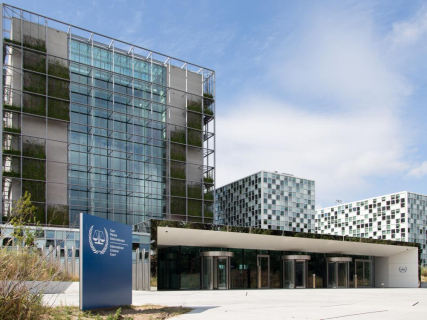

Spain has expressed its rejection of the sanctions imposed by the United States against the president of the International Criminal Court (ICC), Tomoko Akane, and the chief prosecutor of its Office, Abdoulaye Seye.
The Ministry of Foreign Affairs has stated in an official statement that "Spain deplores" the measures announced by Washington against the two officials of the court.
The decision intensifies the campaign of the Administration of Donald Trump against the ICC, which is at odds with the United States over its investigations related to Israel and Afghanistan.
The sanctions target the president and a prosecutor
The Office of Foreign Assets Control of the U.S. Department of the Treasury confirmed on August 18 the addition of Akane and Seye to its list of sanctioned individuals.
Akane, of Japanese nationality, presides over the International Criminal Court. Seye, a Senegalese citizen, serves as the chief prosecutor of the Office.
The sanctions involve the blocking of their assets under U.S. jurisdiction and restrictions on operations with individuals or entities from the United States.
The Treasury has authorized, however, a temporary license to settle certain pending transactions until September 17, 2026.
The Secretary of State, Marco Rubio, justifies the measures by claiming that the Court investigates or prosecutes citizens of countries that do not recognize its jurisdiction.
Neither the United States nor Israel are part of the Rome Statute. Tensions increased after the ICC issued arrest warrants against Israeli Prime Minister Benjamin Netanyahu and former Defense Minister Yoav Gallant for alleged war crimes and crimes against humanity.
The Court denounces an attack on its independence
The ICC has rejected the new restrictions and has labeled them a "flagrant attack" on its independence.
According to the court, with these measures, nine of its 18 judges, its two deputy prosecutors, a former prosecutor, and a staff member are already sanctioned.
The institution maintains that it will continue to fulfill its mandate and warns that sanctions against judges, prosecutors, and staff harm the functioning of international justice.
The president of the European Commission, Ursula von der Leyen, and the president of the European Council, António Costa, have also expressed their support for Akane and the court officials.
Both leaders argue that the Court must be able to act independently and without external pressures.
Sánchez asked to protect the Court from U.S. sanctions
The Spanish Government had already previously proposed a European response to these measures.
On May 6, Pedro Sánchez requested Brussels to activate the Blocking Statute, a mechanism aimed at neutralizing within the European Union the effects of certain foreign sanctions.
According to La Moncloa explained, the proposal sought to protect both judges and prosecutors of the ICC as well as the UN Special Rapporteur for the Palestinian territories, Francesca Albanese.
The Spanish request would require incorporating the corresponding U.S. regulations into the European regulation. The request does not mean that the mechanism has been activated for these new sanctions.