

It has been almost two decades since the only visit of a king to Ceuta. On November 5 and 6, 2007, Juan Carlos I and Queen Sofía were in Ceuta and Melilla on a trip that provoked a diplomatic controversy with Morocco. Rabat called its ambassador to Spain, Omar Azziman, for an indefinite consultation and suspended the bilateral meetings that were scheduled after Mohamed VI considered the trip a provocation due to the Moroccan claim over both cities.
Azziman remained 65 days outside of Madrid and did not return until January 2008, after the then Minister of Foreign Affairs, Miguel Ángel Moratinos, traveled to the capital of the neighboring country and delivered a letter from José Luis Rodríguez Zapatero to try to redirect relations.
The massive entry of immigrants on June 30 and the unprecedented social and political crisis that has erupted in the autonomous city have led many voices to call for the presence of King Felipe VI in the region. The presence of the monarch would have great symbolism and would be historic. After a decade of reign, Felipe VI has still not set foot on Spanish territory located on the African continent, and the only precedent is that of his father almost 20 years ago.
All as one
Juan Carlos I became in November 2007 the first head of state to visit Ceuta in 74 years, and in front of the thousands of citizens who came out to welcome the Kings, he assured that he had a "pending commitment" with the Ceutans. The trip thus acquired a strong symbolic component within Spain, incorporating the two autonomous cities into the agenda of the Head of State after decades without a visit of this nature.
Furthermore, in the parliamentary sphere, the expedition garnered unusual support among the main parties. Although no one was unaware of the diplomatic crisis that the presence of the monarchs could trigger, from the PP to IU supported the trip. For its part, the socialist government of Zapatero defended the trip as an exercise of "institutional normality."
The doubts of a deputy
While there was unanimity about the Spanishness of both cities, the political controversy would arise later and revolved around how to manage the diplomatic consequences with Morocco.
Just a week after the trip, the socialist deputy Francisco Garrido Peña, representative of Los Verdes, but attached to the Socialist Group, registered a series of questions to the Government in which he considered a "crisis in the relations between Spain and Morocco" to have been provoked and asked the Executive if it had participated in the planning of the trip, why it had decided to break the precedent of the absence of heads of State in Ceuta and Melilla, and if it was aware in advance of the repercussions that it could have on the relationship with Rabat.
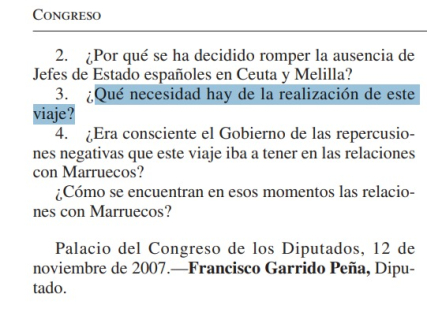
A week later, Garrido registered a second initiative specifically dedicated to the "Consequences of the Kings' trip to Ceuta and Melilla". However, both questions remained unanswered and expired with the dissolution of the Cortes and the end of the VIII Legislature.
A DEPUTY WITH HIS OWN VOICE
Francisco Garrido Peña won a seat in the 2004 elections thanks to the PSOE-Los Verdes electoral agreement. Elected from Seville, he attached himself to the Socialist Group, but maintained a distant position.
Garrido threatened on several occasions to integrate into the Mixed Group due to the "repeated failures" by the socialist leadership to fulfill commitments made in energy policy, urban planning, and animal rights. He also threatened to vote against the General State Budgets for 2008.
What is happening with Felipe VI?
The folder of the monarchs' trip in 2007 was closed and has not returned to public debate until now. After the event of July 30, which left 88 dead, the Royal House communicated that it was closely following the migration crisis.
In this context, Felipe VI received in Marivent on August 6, the president of the autonomous city, Juan Jesús Vivas. Upon leaving, Vivas assured that the monarch had personally conveyed to him his intention to travel to Ceuta and stated that the visit would take place because "the King fulfills his commitments," although without specifying when. A day later, the Government, questioned on this matter, conveyed that the trip fell within institutional normality and indicated that it would take place "when it is appropriate" and with "absolute coordination" between the Government and the Royal House.
But the absence of a date, while many authorities did come to the city, ended up transferring the matter to partisan confrontation. On August 22, Alberto Núñez Feijóo assured that Felipe VI "wants to go" to Ceuta, but clarified that he would have to wait for the Government of Spain to authorize it, thus turning the management of the trip into a direct reproach to Moncloa.

For its part, the Executive later rejected that interpretation: it defended that Casa Real "is the owner of its own agenda," denied that the Government had put obstacles to the trip and assured that it was also not aware of a formal request from Zarzuela to carry out the trip. For now, the Casa del Rey has not officially announced the visit nor set a date, so the commitment conveyed by Vivas remains unfulfilled.