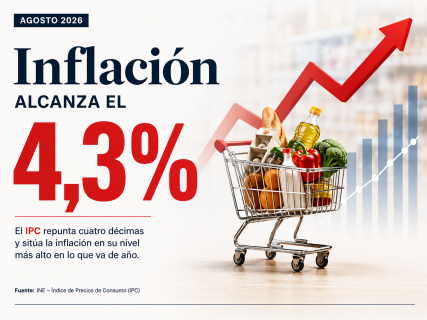

Inflation has once again accelerated strongly in August. The Consumer Price Index (CPI) has increased by seven tenths compared to July and has placed its year-on-year rate at 4.3%, according to the advance indicator published this Friday by the National Institute of Statistics (INE). It is the highest level since February 2023.
The rise has a main responsible: fuels. The INE points out that the prices of fuels and lubricants for personal vehicles have increased in August, compared to the decrease recorded in the same month last year. Food and non-alcoholic beverages have also contributed to the increase, although to a lesser extent, as their prices have decreased less than a year ago.
The rise already has a direct translation for drivers. Filling a tank can cost up to 16 euros more than at the beginning of summer, while the price of diesel has accumulated a strong increase in recent weeks. The rise in fuel prices, moreover, is not limited to the expenses of those who use the car: it is part of the transportation and distribution costs and may end up being passed on to other goods and services.
The general data contrasts with the evolution of core inflation, which excludes energy products and unprocessed foods. This rate has moderated by one tenth, to 2.9%. The Harmonized Consumer Price Index (HICP), used to compare price developments between European countries, has stood at 4.5%.

Featured story
How much money from households has lost since the inflationary crisis began
5 minutes
The Government attributes the rise to the energy shock
The Government places the origin of the rise in the increase in fuels due to the persistence of the energy "shock" caused by the war in Iran. The Ministry of Economy highlights that core inflation remains below general inflation and argues that the increase in prices has not yet been transferred with the same intensity to the overall basket.
The Executive assures that it maintains a "minute-by-minute" monitoring of the evolution of the conflict and its effects on the Spanish economy.
At the same time, it maintains support measures for fuels. Since September 1, the temporary reduction of the hydrocarbon tax applied to diesel will be 20 cents per liter, compared to the five cents initially planned. In the case of gasoline, the reduction will be five cents.
The evolution of energy thus occupies the center of the data for August, although its consequences may extend beyond the price that the consumer pays directly at a service station.

Spain registers more inflation than its European partners
The evolution of prices in Spain is also separating from that recorded in the whole of the European Union. The latest comparable data available from Eurostat, corresponding to July, placed harmonized inflation at 2.9% in the eurozone and at 3% in the whole of the European Union.
Spain was already above both rates. With the preliminary data for August, the Spanish HICP reaches 4.5%, compared to the estimated 3.5% for the eurozone.
The difference is particularly relevant for companies competing in European markets. Higher inflation does not in itself imply an immediate loss of competitiveness, but it can become a problem when the gap is maintained for several years.
It is precisely the effect that Rafael Pampillón, professor of Applied Economics at CEU San Pablo University, highlights when analyzing the consequences of the new rise in prices.
Pampillón: "When prices rise more than our salaries, our money buys fewer things"
"Inflation has an effect that anyone understands: when prices rise more than our salaries, our money buys fewer things," he explains to DEMÓCRATA, Rafael Pampillón, professor of Applied Economics at San Pablo CEU University.
The professor points out that in recent months salaries have grown around 3%, below inflation. The consequence is a loss of purchasing power: although payrolls increase in nominal terms, the increase does not fully compensate for the rise in the prices of goods and services.
Pampillón believes that there is also another less visible effect that may become more important over time: the loss of competitiveness of Spanish companies.
"If in Spain prices rise faster than the countries we compete with, our companies lose competitiveness," he argues.
The difference between Spain and the euro zone allows observing the phenomenon. The Spanish HICP reaches 4.5%, while the European reference is around 3.5%. For Pampillón, a year with a one-point difference does not alone determine the competitive position of a country. The problem arises when that distance is maintained and accumulates.
The effect can be especially relevant for a Spanish company that sells in other European markets. If its costs increase for years faster than those of a German, French, or Italian company, it will have to reduce its margins or manage to produce more efficiently.
“If it does not achieve the latter, it ends up losing ground,” he explains.
The evolution of prices can also make foreign products relatively more attractive to Spanish consumers.
Pampillón believes that the answer lies in increasing competition in those sectors where regulation, entry barriers, or supply shortages favor price increases. He also points out productivity as a fundamental element so that wages can increase without permanently passing that increase on to prices.
“Producing more value for each hour worked allows paying better wages without continuously passing that cost on to prices,” he states.
Belonging to the euro introduces an additional difficulty. “In a common currency, we cannot later erase that difference by devaluing,” he recalls.
Santacruz: “Energy and food prices” explain a good part of the blow
For Javier Santacruz Cano, an economist at DEMOCRATA, the evolution of August brings back to the table the weight that energy and food have in household budgets.
“Just because it was expected does not mean that milk... the prices of energy and food have not been greater. Just like in 2022,” he points out.
Santacruz recalls that both components represent more than a third of the shopping basket. Therefore, when they experience a significant increase, the effect ends up reflecting in the general index.
“It is logical that in the face of a very pronounced increase in both, it ends up impacting in the way it has in the CPI,” he explains.
The leading indicator from INE confirms that fuels have been the main factor in the rise of August, while food and non-alcoholic beverages have also contributed to the advance. The details of the evolution of each product will be known when the agency publishes the definitive data.
The importance of energy is not limited, moreover, to household spending. Fuel is a cost for the transportation of goods and for numerous economic activities, so a prolonged increase may end up being passed on to other prices.
Core inflation, situated at 2.9%, currently shows a more contained evolution of the rest of the components. The difference compared to the 4.3% of general inflation reflects the weight that the energy component is having in the current rise.
Where will the spending be felt?
1) Diesel. A strong increase in prices is expected during the summer. Filling a tank may cost up to 16 euros more than at the beginning of summer.
2) Gasoline. The price has increased in recent weeks Higher cost of travel.
3) Food. They contribute to the rise because their prices have decreased less than a year ago Pressure on the budget allocated for purchases.
4) Transportation. Fuel is part of their costs It can pass on the increase to other goods and services
5) Energy. It is the main source of the current rise Increases costs for households and businesses
6) Income Tax (IRPF). The lack of deflation generated 2.294 billion in additional revenue in 2025 for the Treasury. The effect of inflation on the IRPF can reduce disposable income when nominal wages increase.
Rotellar: "It is diminishing the purchasing power of families"
The accumulated effect on families is the aspect that highlights José María Rotellar, director of the Economic Observatory of the Faculty of Francisco de Vitoria.
"The exponential increase in inflation, with an upward trend already for many months, is diminishing the purchasing power of families", he states.
Rotellar incorporates into that analysis the evolution of tax pressure over the last few years. "If we add to that the increase in taxes that has occurred in the last eight years, today a net average salary in constant terms is lower than it was eight years ago," he argues.
In his opinion, the result is "the impoverishment of the middle class and, with it, of the entire Spanish economy."
The evolution of wages in nominal terms does not allow, by itself, to determine if households have improved their situation. To know the evolution of real income, those earnings must be compared with the increase in prices and take into account the effect of taxes.
It is at this point where the issue of the deflation of the IRPF arises.
When the salary rises, but the tax bill also increases
The consulted experts maintain that inflation can generate an additional effect on taxpayers when the brackets and parameters of the IRPF are not updated in the same proportion as prices.
In fact, the mechanism, known as cold progressivity, occurs when a person receives a salary increase that fully or partially compensates for inflation, but the increase in their nominal salary means that a larger portion of their income is subject to tax.
Thus, in real terms, the worker may not have gained purchasing power. However, they may end up paying a larger amount of IRPF.
The Government itself has quantified this effect. The economic documentation sent by the Executive estimates that 2.294 billion euros is the additional revenue obtained in 2025 due to the non-deflation of the rate and the minimums of the IRPF.
The figure allows for sizing a phenomenon that does not imply a formal increase in tax rates, but can raise the effective tax burden when salaries increase due to inflation.
In the case of families, therefore, the increase in the cost of living can occur through several simultaneous channels: the rise in prices of goods and services, the slower growth of real wages, and, in certain cases, a higher tax bill.