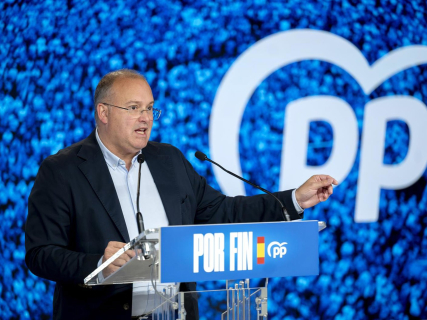

The PP maintains that it is "patent" that the Ministry of Foreign Affairs maintains "a passive and obstructive conduct" aimed at the "effective disobedience" of the resolution of the Supreme Court that ordered the suspension of the vote of those nationalized by the known as 'grandchildren's law'. It also warns the authorities and officials that ignoring what was agreed upon by the high court could lead to fines and prison sentences of six to 24 months.
This is stated in the burofax, which Europa Press has accessed, sent by the general secretary of the PP, Miguel Tellado, to the director general of Spaniards Abroad and Consular Affairs, Carolina de Manueles Álvarez. In that document, he formally demands that she "immediately and urgently" comply "real and effectively" with what was ordered in the Supreme Court orders of September 10 and October 12 regarding the 'grandchildren's law'.
This Tuesday, the deputy secretary of Sectoral Coordination of the PP, Alma Ezcurra, already denounced that the Government has been more than a month without sending "a single piece of data" to the Census Office, despite the two orders issued by the judges, and demanded that "what the Supreme has ordered be complied with immediately." "We warn that in case of non-compliance we will demand all, and I mean all, responsibilities from whoever corresponds, including criminal ones," she warned.
The PP points to possible criminal responsibilities of high-ranking officials
In its burofax, the PP emphasizes that the "passive and obstructive conduct" of the Government "may entail personal criminal responsibilities" for both the director of Spaniards Abroad and for "their hierarchical superiors," including Minister José Manuel Albares, who "may have ordered or encouraged this conduct" of the director general and "even of the hierarchical subordinates" who "were collaborating in this disobedience."
It also recalls that Article 118 of the Constitution establishes the obligation to comply with the firm resolutions of judges and courts and to provide the collaboration required by them in the procedure and in the execution of what has been resolved.
According to the details, the precautionary measures adopted by the Supreme Court regarding the 'grandchildren's law' are enforceable from their notification and have become firm after the only appeal against them was rejected. It adds that, once the compliance deadlines have expired, the court may "impose coercive fines of 150 to 1,500 euros on the authorities, officials, or agents who fail to comply with the court's requirements" and "deduct the appropriate testimony from individuals to demand the criminal responsibility that may correspond."
In the criminal sphere, the PP continues, authorities and public employees who refuse to execute judicial resolutions are also sanctioned. Similarly, it recalls that the General Electoral Regime Law (LOREG) punishes the actions of officials who violate "the legally established rules for the formation, preservation, and public display of the electoral roll," with penalties of "six months to two years in prison and a fine of six to twenty-four months."
Specific requirements from the PP to Foreign Affairs
For all these reasons, the PP expressly requires the director general of Spaniards Abroad and Consular Affairs to "immediately and urgently carry out all actions within her competence to ensure real and effective compliance with the provisions of the Supreme Court's orders."
Firstly, it demands that she transfer to the Electoral Census Office the necessary data to carry out the breakdown of all persons registered in the Electoral Census of Absent Residents (CERA) who obtained Spanish nationality by virtue of the eighth additional provision of the Democratic Memory Law, "distinguishing the files that arise from the direct application of the cases of exile and those initiated and approved under the subsequent instruction."
Secondly, it urges her to order those responsible for the consular registers to issue certifications that prove the status of descendant of an exile, "referring to August 1, 2026, and without applying the presumption of the Instruction of October 25, 2022, regarding the persons who have proven it, and to communicate to the Electoral Census Office, before the start of the sending of electoral documentation, the list of the certifications issued."
In third place, it claims that the consular registry officials who have processed nationality files be ordered "to publish in the announcement board of each consular office the dispositive part" of the ruling of October 12 from the Supreme Court, "with the warning that the ruling itself orders," and that "it certifies the date on which such publication has been made in each of them."
Notice about possible criminal consequences
The PP indicates that the requested actions "must have been carried out" and communicated in writing "before October 23, 2026." It recalls that the Organic Law of the General Electoral Regime obliges the Provincial Delegations of the Electoral Census Office to send ex officio the electoral documentation to all registered in the Electoral Census of Absent Residents starting from October 24.
"If on that date the Electoral Census Office does not have the data that only that General Directorate can provide, the documentation will be sent indiscriminately to the 163,020 voters whose electoral effects are suspended, and the non-compliance with the precautionary measures will become irreparable for the elections of November 29, 2026," it states.
The PP reiterates that "the passivity, resistance, excuse, or obstruction of the authorities and officials" may result in "their personal responsibility, including criminal, which the Popular Party will demand before the competent bodies and instances."
Response from Albares: accuses the PP of making a "fool of themselves"
This Wednesday, a day after the sending of the burofax, Minister Albares has demanded that the PP stop "harassing" and "intimidating" the consuls and the staff of the Foreign Service, assuring that it is making a "fool of themselves" with its threat to take them to court. In his opinion, what the PP intends is to "cover up" its electoral proposals, such as the cut in pensions.
In an interview on "TVE," reported by Europa Press, Albares has accused the leader of the PP, Alberto Núñez Feijóo, of lying by stating that the consulates were not complying with the Supreme Court's requirement to verify who acquired nationality under the additional provision of the Law of Democratic Memory and descend from exiles in order to vote in the elections of November 29.