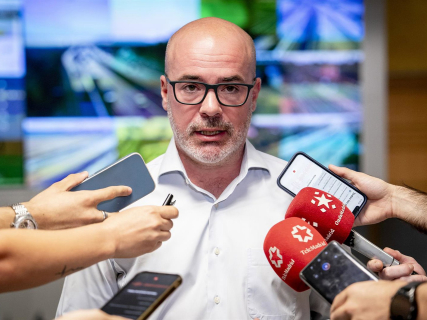
Timeline and reactions to the resignation of Francisco Martín as the Government delegate in Madrid: a new front in the PSOE a month before the 29N

Óscar Puente questions the moment chosen by the now former Government delegate in Madrid and suspects that there are more reasons behind his departure. Elma Saiz qualifies it as a personal decision, while the PP and the police union JUPOL criticize his management.

fotonoticia 20260828114107 1920

fotonoticia 20260828114107 1920

Add DEMÓCRATA to Google

Ask FREN

Published

5 minutes

Most read

Elecciones 29N · Encuestas

La media de las encuestas

Media a 26 de octubre de 2026 · 15 institutos

  • PP31,0 %
  • PSOE27,3 %
  • Vox18,9 %
  • Sumar6,4 %
  • Podemos2,9 %
  • ERC2,3 %
010203040ene 2024jul 2024ene 2025jul 2025ene 2026jul 2026

Media del último estudio de cada instituto en 30 días y su evolución semanal desde el 23J. Partidos con al menos un 2 %.

Todas las encuestas

Elecciones generales del 29 de noviembre · Demócrata

The resignation of Francisco Martín as delegate of the Government in the Community of Madrid has opened a new political front in Ferraz just over a month before the general elections of November 29. Martín announced his departure on Sunday, after being left off the socialist lists for Congress and the Senate. The decision has provoked criticism within the party for the timing chosen and has given arguments to his political adversaries, who link his departure to the conflicts that have marked his time at the head of the Delegation.

Martín alleged that "the conditions to continue exercising his responsibility are not met," according to sources from the Government Delegation. The leader had held the position since March 2023, when he replaced Mercedes González, and his departure comes after a week marked by the confirmation of the PSOE candidacies for the 29-N.

Puente regrets his departure and points to other reasons

The first significant reaction from the Government came this Monday from the Minister of Transport, Óscar Puente, who lamented the resignation, although he questioned that it occurs in the midst of the electoral pre-campaign. In his opinion, the decision does not benefit either Martín himself or the PSOE.

In Óscar Puente's view, the decision does not benefit either Martín or the PSOE

"We must be attentive to what the organization decides at each moment, we cannot get angry when they do not count on us and be happy when they do," Puente stated during an informative breakfast of Nueva Economía. The minister recalled that socialist positions are subject to the party's decisions and defended that they must accept them even if they do not personally favor them.

Puente, who has assured that he maintains an "extraordinary" relationship with Martín, added that he suspects there may be "other reasons" behind his resignation, beyond his exclusion from the electoral lists. He also revealed that the now former delegate called him to inform him that he was going to announce his decision.

The Government spokesperson and Minister of Inclusion, Social Security and Migrations, Elma Saiz, has chosen to distance herself from the reasons for the departure. In an interview on Cadena SER, she described the resignation as a "personal decision" and stated that "everyone has to take responsibility for their personal decisions."

Saiz has avoided entering into the internal circumstances that have surrounded the departure and has defended that the PSOE is focused on an electoral appointment that it considers decisive, with the aim of expanding the progressive majority.

The lists and the primaries, in the background

The exclusion of Martín from the socialist candidacies is the immediate trigger for his departure. The process of preparing the lists closed without the delegate obtaining a position for the general elections on November 29, a decision that has fueled speculation about his political future.

In that context, the internal dispute for the socialist candidacy for the Mayor of Madrid has also regained relevance. Last July, Martín supported Enma López against Reyes Maroto in the municipal primaries, which the latter ended up winning. The temporal coincidence has led to linking both episodes, although there is no public confirmation that the result of those primaries directly explains his resignation.

Martín supported Enma López against Reyes Maroto in the municipal primaries, which the latter ended up winning

Martín arrived at the Delegation from the General Secretariat of the Presidency of the Government, after having held various technical positions in Moncloa. During his three years in office, he acquired a markedly political profile, with frequent confrontations with the Madrid president, Isabel Díaz Ayuso, and with the mayor of the capital, José Luis Martínez-Almeida, who have missed the opportunity to poke the wound. 

Ayuso and Almeida, against his management

The departure of the delegate comes, moreover, after several weeks of institutional tension due to the protest camp for the right to housing set up in Puerta del Sol since September 26. The decision not to evict it provoked reproaches from the City Council and the regional Government, who accused Martín of allowing the situation to prolong.

Ayuso celebrated his departure and described Martín as "the worst delegate" that Madrid has had, framing his exit in the wear and tear of Pedro Sánchez's Government. The regional president had been demanding a more forceful action regarding the camp and questioning the management of the Delegation.

The mayor of Madrid, José Luis Martínez-Almeida, has criticized this Monday the reasons for the resignation and has stated that Francisco Martín leaves the position because the PSOE has not reserved a place for him in the candidacies for the elections on November 29.

"No one is going to miss him, not even his party, because it seems that he is leaving because, according to him, his party has not treated him as he deserves," Almeida has stated. The mayor has insisted that Martín was acting as "delegate of the sanchismo" and not as an institutional representative of the Government.

"One cannot resign for a party issue. You are the Government delegate, you are not the delegate of the Socialist Party," he reproached. Almeida believes that the delegate should have left the position due to his management and not for being left out of the electoral lists.

The mayor has linked this criticism to several episodes of his mandate, including the incidents recorded during the passage of the Vuelta Ciclista through Madrid and the protest camp set up in Puerta del Sol. He has also questioned the response of the Delegation to the security problems associated with that settlement and has accused Martín of using the position to confront the City Council and the regional Government.

Almeida has gone further by stating that the former delegate leaves "thrown aside" the bodies and security forces of the State at a delicate moment. His statements add to the criticisms from the Madrid president, Isabel Díaz Ayuso, who also celebrated the departure and lashed out at Martín's management.

The crisis of the Sol camp has thus become one of the last episodes of a stage marked by the clash between the Government Delegation and the Madrid administrations. Martín's departure does not alone close the discrepancies over the management of the protest nor the responsibilities that each institution attributes to the others.

JUPOL celebrates the resignation and reproaches its treatment of the Police

The police union JUPOL has also spoken out, valuing the resignation "positively" and accusing the former delegate of using the National Police "as a shield" when it suited him and abandoning it when criticism arrived.

The union had been demanding his departure for some time and has placed the last disagreement on the police charges recorded on October 14 during a protest linked to the educational strike at the Complutense University. Martín then requested an urgent investigation considering that the images of the intervention required clarifications and that the action may not have been proportionate.

Martín's departure now leaves the leadership of the Government Delegation pending, in a period marked by mobilization at Puerta del Sol and the preparation for the general elections. The decision also leaves an open question within the PSOE: whether the resignation responds solely to his exclusion from the lists or if, as Puente has suggested, there are other factors that have not yet come to light.

More key points, information and questions with FREN

AI-GENERATED CONTENT

What is the usual procedure for filling the vacancy of the Government delegate in an autonomous community?

Insufficient information was found in the consulted sources to rigorously explain the usual procedure for filling the vacancy of the Government delegate in an autonomous community.

The answer must distinguish between the appointment of a new holder, which fills the vacancy, and temporary substitution, which allows the functions to be attended to while that appointment takes place. I do not have sufficient verified information to specify who proposes and agrees on the appointment, how it is formalized, or which substitution rule applies. I prefer not to attribute competences or procedures without documentary support.

What competences and functions does the Government delegate in the Community of Madrid have according to Spanish legislation?

The Government delegate in the Community of Madrid represents the Government of Spain, directs and supervises the state Administration in the territory, and guarantees citizen security within state competences. Its main regulation is found in articles 72 and 73 of the Law 40/2015, on the Legal Regime of the Public Sector. It is not an organ of the autonomous Government nor its hierarchical superior.

1. Representation and institutional position

Article 72 establishes that it represents the Government of the Nation, without prejudice to the ordinary representation of the State that corresponds to the autonomous Presidency. It has the rank of undersecretary, depends organically on the president of the Government and functionally on the competent ministry in each matter. It is appointed and removed by the Council of Ministers by royal decree, at the proposal of the president of the Government.

2. Direction and coordination of state services

According to article 73.1.a), it promotes, coordinates, and supervises the activity of the General State Administration and its public bodies in Madrid. It directs the services integrated into the Delegation according to ministerial objectives and instructions; non-integrated services maintain their dependence on the competent central organ.

It also appoints the subdelegates in its scope, directs and coordinates their activity, and must report on proposals for appointment of heads of state territorial organs. It may request information about activity, personnel, organization, and assets to ensure coordinated management.

3. Citizen security and fundamental rights

Article 73.3 assigns it the protection of the free exercise of rights and freedoms and guarantees citizen security. To this end, it exercises the leadership of the State Security Forces and Corps in its territorial scope, under the functional dependence of the Ministry of the Interior. This attribution does not imply general direction of all administrations nor all police forces existing in Madrid.

4. Cooperation with the Community and municipalities

Article 73.1.c) entrusts it with exchanging information between the Government of Spain, the autonomous Government, and local entities, and maintaining coordination and cooperation relations. It promotes agreements, especially on state financing programs, and participates in monitoring their execution. Likewise, it intervenes in mixed transfer commissions, bilateral commissions, and other cooperation bodies when determined.

5. Information and improvement of public policies
  • Information: coordinates the dissemination of state programs and activities, promotes collaboration to inform citizens, and annually submits a report to the Government on state public services in Madrid —article 73.1.b)—.
  • Management: proposes objectives for state plans and measures to avoid duplications and optimize personnel and resources. It also coordinates the use of state administrative buildings according to patrimonial regulations —article 73.1.e)—.
6. Legality control and other powers

Article 73.1.d) allows it to resolve administrative appeals against acts of Delegation organs, after report from the competent ministry, and suspend their execution when legally appropriate. Additionally, it must ensure the constitutional competences of the State and the application of its regulations, promoting or filing legally provided actions. It cannot freely annul autonomous decisions: it must use the corresponding procedures.

Finally, article 73.2 recognizes sanctioning, expropriatory, and other powers attributed by norms, delegation, or deconcentration. Each action requires a specific competence: the position does not grant unlimited powers over any matter occurring in Madrid.

What were the PSOE results in the Community of Madrid in the last general elections?

In the last general elections held, those of July 23, 2023, the PSOE obtained in the Community of Madrid 1,004,599 votes, 27.84%, and 10 deputies in the Congress. It was the second candidacy by number of seats in the Madrid constituency, behind the PP. These are the results of the elections held, not a vote estimate for a subsequent call (Madrid electoral statistics).

The three main data points
  • Votes: 1,004,599. This is the number of votes received by the socialist candidacy to Congress in the entire Community of Madrid. Therefore, the figure corresponds to the regional scope, not only the city of Madrid (Official results).
  • Percentage: 27.84%. This is the electoral percentage published for the PSOE in Madrid. Expressed approximately, it means just under 28 out of every 100 votes counted to calculate that percentage; it does not mean that 27.84% of the entire Madrid population voted for it (Official results).
  • Representation: 10 deputies. The PSOE obtained ten of the 37 seats distributed in Madrid in those general elections. These seats correspond to the Congress of Deputies, not the Assembly of Madrid (Official results).
How the distribution in Madrid was

To place the socialist result, the complete distribution of the 37 deputies elected by Madrid was as follows (Seat distribution):

  • PP: 16 deputies.
  • PSOE: 10 deputies.
  • Sumar: 6 deputies.
  • Vox: 5 deputies.

With that distribution, the PSOE was six seats behind the PP, obtained four more than Sumar, and five more than Vox. These are parliamentary representation differences: they should not be confused with percentage point differences in votes. The socialist position was, therefore, the second of the four candidacies that obtained deputies for Madrid (Results and representation).

What each figure means

It is advisable to read votes, percentage, and seats together because they describe different aspects of the same result. Votes indicate how many supports the candidacy received; the percentage expresses its electoral weight; and the seats show how many representatives it obtained. In the case of the Madrid PSOE, these three measures were, respectively, 1,004,599, 27.84%, and ten deputies (Electoral statistics).

It is also important to distinguish the territory and the institution. The question refers to the entire Community of Madrid and to general elections. Therefore, it would not be correct to substitute these figures with those of the municipality of Madrid nor with the socialist result in autonomous elections. The reference used specifically covers the elections to Congress (Elections to Congress).

In short, the brief answer is: the PSOE exceeded one million votes and obtained ten of the 37 deputies for Madrid on July 23, 2023. That is the electoral reference to answer your question, without mixing it with subsequent polls or forecasts about future results (Official Madrid source).

Play

Test your knowledge with FREN!

How much do you know about this topic? Answer the following 3 questions.

What immediate reason did Francisco Martín give for resigning from his position as Government Delegate in Madrid?

Question 1 of 3

What recent institutional episode caused tensions between the Government Delegation and the Madrid administrations before Martín's resignation?

Question 2 of 3

What position did the police union JUPOL express after Francisco Martín's resignation?

Question 3 of 3