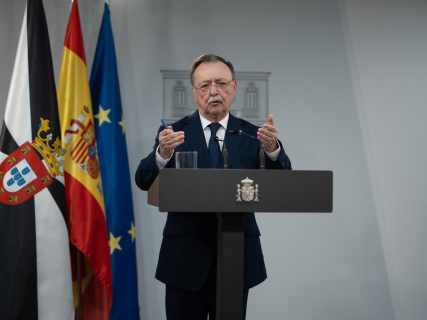

The president of Ceuta, Juan Jesús Vivas, will travel to Brussels on September 8 to directly convey to the institutions of the European Union the situation that the autonomous city is going through after the migratory crisis that began at the end of July. The visit is confirmed, although his meeting agenda is still being finalized, according to sources from the Ceuta Government.
The City Executive is working to ensure that Vivas can hold high-level meetings both at the European Commission and at the European Parliament. The specific interlocutors and the schedules for the meetings will be determined in the coming days.
The trip will take place more than a month after the massive entry recorded from Morocco and at a time when the European response to the crisis has already begun to take shape.
Ceuta seeks to directly involve Brussels
The visit will allow Vivas to personally present to the community institutions the needs of Ceuta and demand the involvement of the EU in a crisis that affects one of its external borders.
This will not be the first contact of the Ceuta president with European institutions since the crisis began. Vivas already intervened by videoconference before the Committee on Civil Liberties, Justice and Home Affairs (LIBE) of the European Parliament, where he advocated for a coordinated and urgent action by Spain and the European Union.
The trip on September 8 will now take those efforts directly to Brussels.
Spain has already requested emergency European funds
The trip will take place after the Spanish Government has formally requested from the European Commission emergency assistance funds to address the consequences of the migratory crisis in Ceuta.
Brussels confirmed last Monday that it had received the Spanish request and that it is working with national authorities to assess the existing needs. Among the areas likely to receive support are the strengthening of border protection and reception capacity, including that intended for unaccompanied minors.
The Commission has also offered in recent weeks the possibility of reinforcing the intervention of the competent European agencies, including Frontex, Europol, and the European Union Agency for Asylum (EUAA).
The amount of potential European aid is still not finalized. The Commission must first assess the needs raised by Spain before determining the support it can mobilize.
Brussels supports the single command, but warns of the pending challenges
The visit of Vivas also comes after the European Commission has supported the creation of the single command established by the Government to coordinate the response to the crisis.
Brussels has positively assessed the strengthening of coordination among the administrations and considers that the situation has evolved since the early days of the crisis, although it maintains that “important challenges” persist due to the thousands of people who continue in Ceuta.
The Commission has particularly insisted on the need to accelerate the procedures for the return of those who remain irregularly and can be returned in accordance with the applicable legislation.
The community Executive has also valued the cooperation between Spain and Morocco to prevent new attempts to enter.
From the single command in Ceuta to the European institutions
The trip will take place during the full implementation of the new device created by the Spanish Government. The Executive has declared the situation of interest for National Security and has appointed the Minister of Territorial Policy and Democratic Memory, Ángel Víctor Torres, as the functional authority in charge of coordinating the actions.
The single command will initially remain active until December 31, 2026, although the decree contemplates both its possible extension and an early termination depending on how the situation evolves.
Vivas participates in that coordination scheme and has held this week his first meeting with Torres since the implementation of the device. His trip to Brussels will now open another institutional front: to directly seek political, operational, and financial support for Ceuta in the EU.