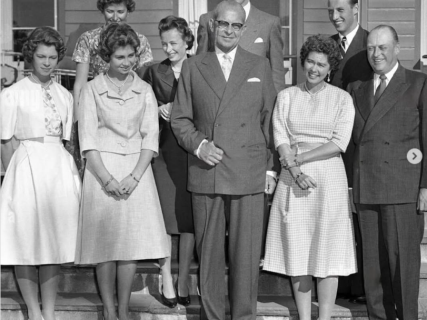
Harald of Norway, the king who could marry Sofia and ended up choosing a commoner

The monarch, admitted in Oslo after suffering an infection, was related in his youth to the then Princess Sofia of Greece, who would end up becoming queen of Spain.

5 minutes

Captura de pantalla 2026 08 24 182644

Captura de pantalla 2026 08 24 182644

Add DEMÓCRATA to Google

Ask FREN

Published

Last updated

5 minutes

Most read

The health status of King Harald V of Norway has once again raised concerns for the Norwegian Royal House. The monarch, 89 years old, remains hospitalized at the Oslo University Hospital after a bacterial infection was detected in his bloodstream during his hospitalization. The Palace has reported that he has responded to antibiotic treatment and that his condition is stable, although he will continue to be hospitalized and away from his official agenda until further notice.

The king's health situation has also revived a youth story that has been part of the chronicles of European royal houses for decades: the relationship attributed to then-Prince Harald with Princess Sofia of Greece, the young woman who years later would become Queen of Spain.

The story dates back to the 1950s, when European royal houses still played an important role in seeking marriages among their members. Queen Federica of Greece, mother of then-Princess Sofia, organized meetings and trips where young people from different European royal families would meet. In that context, the closeness between Sofia and Harald occurred.

Sofia and Harald: a story that did not lead to marriage

The possibility that Harald and Sofia could marry has been reported for years by publications specializing in royalty. ¡Hola! revived this story and explained how Federica favored these types of meetings among young people from royal houses with a view to possible marital links.

Some chronicles maintain that Sofia was attracted to Harald and that the relationship did not prosper because the Norwegian heir ultimately did not choose her. However, there is not enough primary documentation to present as a proven fact that Harald rejected Sofia for economic reasons or due to the size of her dowry.

The alleged issue of the dowry has been part of the versions subsequently spread about that episode, but there is no solid evidence to establish it as the reason why the Norwegian prince dismissed a potential marriage with Sofia. Therefore, references to this aspect should be understood within the context of society chronicles and not as an accredited historical fact.

What did happen is that Harald ended up making a decision that, at that time, was also not easy for a royal house: he chose a woman who did not belong to any reigning family.

Sonja Haraldsen, the woman he waited nine years for

Harald met Sonja Haraldsen in 1959. She was born in Oslo in 1937 and was the daughter of a fabric merchant. The relationship between them lasted for nine years before they could marry.

The Norwegian Royal House itself confirms that the wedding took place on August 29, 1968, after King Olav V, Harald's father, finally gave his consent. Sonja became the crown princess and, when Harald ascended to the throne in 1991, she became queen of Norway.

The obstacle to that relationship was not, therefore, Sonja's economic position compared to a possible royal candidate. It was precisely her status as a woman outside the aristocracy and the European royal houses.

The relationship was maintained for years while Harald awaited his father's authorization. According to the reconstruction published by various media, the heir even suggested that he would remain single if he could not marry Sonja. The decision also had an institutional dimension: Harald was the only male child of Olav and the direct heir to the Crown.

Finally, the consent arrived and the couple married in Oslo Cathedral. Sonja became crown princess and, decades later, queen.

The princess who ended up being queen of Spain

Meanwhile, Sofia's destiny was very different. The princess of Greece ended up marrying then Prince Juan Carlos of Bourbon in Athens in 1962. When Juan Carlos ascended to the throne in 1975, Sofia became queen of Spain.

In this way, two young women belonging to royal families who had coincided in those years followed completely different paths. Sofia ended up being queen of Spain and Sonja ended up being queen of Norway, while Harald ascended to the throne alongside the woman he had waited for nearly a decade.

The comparison is particularly striking because Harald's story did not end up following the usual pattern of dynastic marriages of the time. Instead of choosing a European princess, the Norwegian heir maintained his relationship with a woman without title or royal lineage for years until he obtained permission to marry her.

Harald, hospitalized in Oslo

The story of that youth returns now to the current news due to the health status of the monarch. Harald has been hospitalized since August 17 at the University Hospital of Oslo. The admission initially occurred due to complications related to hemolytic anemia and, subsequently, doctors detected a bacterial infection in the blood.

The Palace has informed that the king is receiving antibiotics and has responded to the treatment. His son, Crown Prince Haakon, is meanwhile acting as regent and assumes the official duties of his father.

Harald, who turned 89 in February, has suffered various health problems in recent years. In 2024, he received a permanent pacemaker after being hospitalized in Malaysia for an infection and, at the beginning of 2026, he was readmitted during a vacation in Tenerife for another infection.

The Royal House has not provided a date for his return to official activity. While he continues to be hospitalized, Harald's life is once again linked to a story that began more than six decades ago: that of the heir who could have formed a couple with the future queen of Spain and who ultimately made queen the woman he chose despite not belonging to any royal house.

Harald of Norway, a lovestruck king

Harald V of Norway was born on February 21, 1937, in Skaugum, near Oslo, in a Europe that just two years later would enter into war. Son of the future Olav V and Princess Märtha of Sweden, and grandson of Haakon VII, he was the first prince born in Norway in more than five centuries.

He was only three years old when Nazi Germany invaded Norway, in April 1940. Harald left the country with his mother and his sisters, Ragnhild and Astrid. After passing through Sweden, the four settled in the United States, while his father and grandfather remained in Europe linked to the Norwegian government in exile. He did not return to Oslo until June 1945, after the war ended.

His education combined preparation for the Crown with a life relatively close to that of other young Norwegians. He studied in Oslo, received military training, and later attended Balliol College, Oxford, where he studied Social Sciences, History, and Economics. In 1957, the death of his grandfather and the proclamation of Olav V made him, at 20 years old, the crown prince.

Outside of his official duties, Harald found in sailing one of his great passions. He reached the highest level of competition and represented Norway in three Olympic Games, in 1964, 1968, and 1972. In Tokyo 1964, he was also in charge of carrying the Norwegian flag during the opening ceremony.

By then, he had already met Sonja Haraldsen. They first met in 1959, but there was an obstacle: she did not belong to any royal or aristocratic family. Their relationship lasted for nine years before Olav V authorized the marriage, after consulting the matter with the Government. Harald and Sonja finally married on August 29, 1968, at Oslo Cathedral. After that, their two children were born, Märtha Louise, in 1971, and Haakon, in 1973.

Harald spent 34 years as crown prince before ascending to the throne. The death of Olav V, on January 17, 1991, made him Harald V of Norway, with Sonja as queen. He adopted the motto used by his father and grandfather: "Alt for Norge", "Everything for Norway".

Since then, Harald has served as king and head of state of a constitutional monarchy, with fundamentally institutional and representative functions. His reign has already surpassed 35 years and, at 89 years old, he continues at the head of the Norwegian Crown.

More key points, information and questions with FREN

AI-GENERATED CONTENT

What procedures are necessary for Crown Prince Haakon to officially assume the regency in Norway?

The assumption of the regency by Crown Prince Haakon in Norway is regulated by the Norwegian Constitution and the constitutional practice developed in the Norwegian parliamentary monarchy. It is not a purely “willful” act of the King or the heir, but a formal procedure involving the Government (Council of State) and, for the most serious or prolonged situations, also the Storting (Parliament). Broadly speaking, the steps differ depending on whether it is a temporary and voluntary regency, or a regency due to the King's incapacity or impossibility.

1. Case of temporary and voluntary regency

In Norwegian political practice in recent decades, the most common case is that the King partially delegates functions to the Crown Prince when he is ill, needs rest, or is traveling, without permanent incapacity. In this context, the procedures are essentially the following:

  • King's decision to delegate functions: The King, as head of State, may arrange for the Crown Prince to act as Regent (or “Regent of the Realm”) on his behalf for a determined period or while a specific circumstance lasts (for example, illness or prolonged absence).
  • Formal agreement in the Council of State: This decision is formalized through an act adopted in the Council of State (the body where the King meets with the Government). The agreement states that the Crown Prince will assume the regency and specifies, at least, the start date and the general framework (for example, “until further notice” or “while the King's temporary incapacity lasts”).
  • Counter-signature by the Government: As in any parliamentary monarchy, the King's acts require the counter-signature of the Prime Minister or another responsible minister. The decision to appoint the Crown Prince as Regent is thus subject to the Government's political responsibility before Parliament.
  • Official publication and communication: The agreement is made public through statements from the Government and the Royal House, and is registered in the official Norwegian records (equivalent to the official gazette). This formally notifies all authorities and institutions that Haakon acts as Regent.
  • Effective exercise of the regency: From that moment, the Crown Prince presides over the Council of State, signs laws and formal Government decisions, and performs the functions of head of State within the limits reserved to the Crown by the Constitution.

In this type of “ordinary” regency, a parliamentary vote or a ruling on the King's incapacity is not essential; the formal act of the monarch himself, articulated through the Council of State, suffices.

2. Case of King's incapacity or impossibility

If the situation is more serious — for example, a physical or mental incapacity that prevents the King from exercising his functions continuously — stricter constitutional rules come into play, with these key elements:

  • Formal determination of incapacity or impossibility: It is the Council of State's responsibility to declare that the King cannot exercise his functions. This is usually supported by medical reports and a careful political and legal assessment, since it directly affects the Head of State.
  • Constitutional appointment of the Regent: Once the impossibility is declared, the Constitution provides that the heir to the throne assumes the regency. Haakon would become Regent of the Kingdom of Norway, not only by political decision but by direct application of the constitutional rule on succession and regency.
  • Participation of the Storting: In these cases, Parliament has a guarantee role. It may be called upon to confirm the situation, oversee the Government's actions, and, if necessary, rule on more significant issues (for example, a possible abdication or definitive succession).
  • Oath and solemn formalization: According to Norwegian constitutional tradition, the Regent must swear to respect the Constitution and laws before the Storting. This oath is a symbolic and legal requirement for the full exercise of the head of State function in place of the King.
  • International communication and State continuity: Norwegian authorities officially inform other States and international organizations of the change in the exercise of the Head of State, ensuring that the Regent is recognized as such diplomatically.

3. Difference between regency and succession

It is important to distinguish between regency and succession to the throne. Regency means that Haakon exercises the King's functions while the King remains formally the monarch. Succession only occurs if the King abdicates or dies, at which point the heir ceases to be Regent and becomes King in full right, with a new oath before the Storting and other specific formalities.

In summary, for Crown Prince Haakon to officially assume the regency, at minimum a formal act by the King and the Council of State designating him Regent is required; and, in cases of more serious or prolonged incapacity, the constitutional determination of that situation, parliamentary oversight, and Haakon's solemn oath as Regent of the Kingdom of Norway.

What differences are there between the functions of the King of Norway and those of Prince Haakon when he acts as regent? At what other historical moments have there been regencies in Norway and how were they politically managed? What role does the Storting have in the political control of the Regent and the Government during a prolonged regency?

What are the powers and attributions of the King of Norway according to the Norwegian Constitution?

The Constitution of the Kingdom of Norway (Grunnloven, 1814, heavily reformed afterwards) establishes a parliamentary monarchy in which the King is head of State and formal holder of the Executive Power, but where real political responsibility lies with the Government, which depends on Parliament (Storting). The monarch's powers are largely formal and are always exercised through the Council of State (the Government assembled before the King) and under the responsibility of the ministers.

Constitutional position of the King

  • Head of State and Executive Power: the Constitution attributes executive power to the King, but in practice this power is exercised by the cabinet responsible to the Storting. The King personifies the continuity of the State and national unity.
  • Hereditary monarchy: the headship of State is transmitted by succession, with detailed rules on the order of succession and the possibility of regencies when the King is underage or incapacitated.
  • Political irresponsibility: the King is not politically responsible for his acts; responsibility lies with the ministers who advise and countersign them. The principle is similar to other European monarchies: “the King reigns, but does not govern” in a partisan sense.

Relationship with the Government (Council of State)

  • Appointment of the prime minister and ministers: formally, the King appoints the prime minister and other Government members. In practice, he does so following election results and parliamentary negotiations: he appoints as prime minister the leader who has a majority or sufficient support in the Storting.
  • Council of State: the King presides over Council of State meetings, where the most relevant government decisions are formally adopted (law sanctioning, certain appointments, foreign policy decisions, etc.). However, the content of these decisions is prepared and politically decided by the Government.
  • Regency: when the King is absent or ill, the Crown Prince (or another person provided by the Constitution) may exercise royal functions as regent, with the same limits and under the same ministerial responsibility scheme.

Role in legislation and Parliament

  • Sanction and promulgation of laws: the Storting approves laws and the King sanctions and promulgates them. The monarch thus participates in the legislative process but does not define its content. The Norwegian system provides a royal veto of mainly suspensive and very exceptional character; politically, the King does not block the clear will of Parliament.
  • Calling elections and opening legislature: the King formally intervenes in calling and opening parliamentary sessions, according to constitutional deadlines. However, he does not have discretionary power to dissolve the Storting at will: the legislature's duration is constitutionally fixed.
  • Information and institutional dialogue: the King periodically receives the prime minister and other Government members to be informed of State affairs. It is a channel of dialogue and institutional continuity, but not an autonomous decision-making body.

Functions in foreign policy and defense

  • International representation: the King represents Norway abroad, receives heads of State, and accredits ambassadors. Formally, he can conclude treaties, which in practice are negotiated by the Government and usually require Storting approval.
  • Commander-in-chief: the Constitution attributes supreme command of the Armed Forces to the King. However, effective command and defense decisions are the Government's responsibility and fall under Parliament's democratic control.

Symbolic prerogatives and residual powers

  • Appointments and honors: the King participates in the formal appointment of senior civil and military officials and in granting orders and decorations, always according to law and on the Government's proposal.
  • Integrative function: beyond constitutional texts, political practice has led the monarch to play a role of social cohesion: presiding over State acts, commemorating historical events, supporting cultural and social initiatives, and acting as a symbol of continuity and stability.
  • Absence of direct political power: although the 1814 text originally attributed a broader margin of power to the King, parliamentary evolution, constitutional reforms, and political practice have consolidated a very restrictive interpretation of those prerogatives: the King does not direct government policy nor intervene in parliamentary majorities.

In summary, according to the Norwegian Constitution the King retains important formal powers — appointing the Government, sanctioning laws, presiding over the Council of State, representing the State and Armed Forces — but all are exercised under the cabinet's and Parliament's responsibility. The core of political power resides in the Government and the Storting; the monarch is above all a guarantor of constitutional continuity and a national symbol, not an autonomous executive actor.

Could you compare the powers of the King of Norway with those of the King of Spain according to their respective constitutions? What constitutional reforms have practically reduced the political power of the King of Norway since 1814? How does the Norwegian Parliament intervene in the appointment of the prime minister and what real margin does the King have in that process?

What has been the political career and academic background of Queen Sofía of Spain, Queen Emerita?

The information available in the consulted sources about Queen Sofía of Spain, Queen Emerita, focuses less on the strictly academic details of her youth and more on her long institutional service career, her role in the parliamentary monarchy, and the public recognition of that work. From these sources, a clear profile can be drawn: a figure conceived as essential support to Juan Carlos I during the Transition and as a reference of continuity, stability, and quiet work in social, cultural, and humanitarian fields.

Family origin and biographical context

Recent pieces place Sofía within the Greek royal house. Her close relationship with her siblings, especially Princess Irene of Greece, who passed away in 2026 at the Zarzuela Palace, is emphasized. Various chronicles from Demócrata about Irene's death and funerals recall that both shared residence at Zarzuela for years and maintained a very close bond, which helps understand the family and transnational dimension of the Queen Emerita, straddling Greek tradition and her roots in Spain.

In the same context, it is recalled that Sofía's family environment was linked to the last stage of the Hellenic monarchy, which provided a relevant political and historical background to her later role in Spain: she witnessed firsthand the fragility of European crowns and democratic transitions, an element that appears in the analysis of political changes in Greece and Portugal in the seventies covered by the newspaper.

Education and preparation for institutional life

The analyzed sources do not detail the specific institutions where Sofía of Greece studied, nor specify formal university degrees. However, they allow fitting her profile into the general evolution of European royal houses described by Demócrata: a transition from markedly political and military training, heavily conditioned by authoritarian contexts, towards itineraries more oriented to diplomacy, languages, and institutional representation.

In parallel, articles about the education of Princess Leonor and other European heirs emphasize that the preparation of royal family members always combines academic training with specific training for representative functions. In Sofía's case, this “professional” dimension of the Crown is reflected in her ability to sustain complex agendas, preside over events in different languages, and maintain a continuous international presence over decades, although the sources do not specify diplomas or degrees.

Political and institutional career in the parliamentary monarchy

The central axis of Queen Sofía's career is her role as consort of Juan Carlos I during the monarchy's restoration and the democratic Transition, and later as Queen Emerita during Felipe VI's reign. On the 50th anniversary of Juan Carlos I's proclamation, Felipe VI presented his mother with the Collar of the Distinguished Order of the Golden Fleece at the Royal Palace. In that ceremony, according to Demócrata, the King highlighted her “a lifetime of exemplary service and loyalty to Spain and the Crown,” expressly emphasizing that Sofía supported “with conviction” Juan Carlos's commitment to democratic openness.

In the same event and in the expanded coverage of the monarchy's 50th anniversary, various political and regional leaders describe the Queen Emerita as a figure “part of the affective memory of democratic Spain,” whose constant presence at key events has helped reinforce the institution's stability and image. Her serenity, empathy, and discreet but continuous dedication are stressed, very much aligned with the parliamentary monarchy model that is claimed as an element of continuity above partisan cycles.

Public activity: social, cultural, and humanitarian dimension

Although retired from the front line of the Head of State, Sofía maintains her own institutional agenda. Chronicles from 2025 and 2026 show her presiding over or inaugurating cultural events (such as the major Zurbarán exhibition at the National Gallery in London), scientific and academic events (for example, the Atapuerca Foundation ceremony in Burgos, where she is presented as a “travel companion and friend” of the project), and social and health events (support for biodiversity conservation or initiatives related to disability and medical research).

Internationally, her leadership in the Queen Sofía Spanish Institute in the United States, reflected in events such as the Sophia Awards for Excellence in Miami or the America&Spain250 initiative, reinforces her role as a cultural bridge between Spain and the Hispanic world in America. Local authorities have even proclaimed a “Queen Sofía Spanish Institute Day” in recognition of this cultural diplomacy work.

Regional presidents such as those of Cantabria or the Balearic Islands, according to various Demócrata reports, insist that Sofía's career is perceived as an example of long-term service, with a strong social and cultural component, and point to her as one of the figures who have helped anchor the monarchy in the daily life of several generations of citizens.

Summary

In summary, although the consulted sources do not exhaustively detail the formal studies of Queen Sofía of Spain, Queen Emerita, they do allow tracing her political and institutional profile: a Greek princess integrated into the Spanish Crown, a key support to Juan Carlos I during the Transition, a reference of continuity during fifty years of parliamentary monarchy, and today, an emerita figure whose agenda focuses on international projection, culture, science, and social and humanitarian causes. Her career is interpreted, from the Royal Palace itself and regional governments, as a “life of service” that has contributed to giving stability and civic content to the monarchical institution.

Play

Test your knowledge with FREN!

How much do you know about this topic? Answer the following 3 questions.

Why did the relationship between Harald of Norway and Sonja Haraldsen take nine years to formalize?

Question 1 of 3

What treatment is King Harald V of Norway receiving during his hospitalization in 2024?

Question 2 of 3

In what year did Harald V ascend to the throne of Norway?

Question 3 of 3

Hola, soy Fren. ¿Cómo te ayudo?