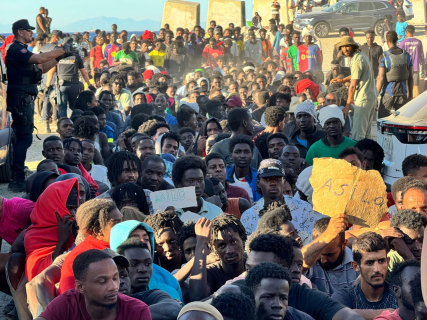
The Police points to a planned operation behind the massive entry in Ceuta and indicates Moroccan agents.

A report from the CENIF sent to the National Court states that uniformed gendarmes guided the migrants and that plainclothes agents gave instructions during the operation.

4 minutes

fotonoticia 20260901190344 1920

fotonoticia 20260901190344 1920

Add DEMÓCRATA to Google

Ask FREN

Published

Last updated

4 minutes

Most read

A report from the National Center for Immigration and Borders (CENIF) sent to the judge of the National Court María Tardón states that the entry of about 72,000 people in Ceuta on July 30 and 31 responded to a planned process in which members of the Moroccan security forces participated.

According to El Español, the document rules out that it was an spontaneous movement caused exclusively by the mafias or by a call spread on social media. The hypothesis outlined in the report is that the migratory purpose would have served as a cover for an operation directed from the Moroccan side of the border.

The document has been sent to the National Court after Judge María Tardón requested information from the National Police and the Civil Guard to determine if the events could present indications of a crime against the independence of the State, a matter that this court is responsible for investigating.

The Police describes an organized process

The CENIF, an intelligence unit integrated into the General Commissariat of Immigration and Borders, had already issued an alert on July 29 about the risk of an entry in Ceuta and Melilla planned for the following day.

The communication sent to the border posts classified the possibility of coordinated illegal accesses both by swimming and by jumping the fence as "extreme risk".

The police report, according to the published information, analyzes the circumstances that later surrounded the mass entry and concludes that there are elements that point to a prior planning.

Among them is the behavior of the people who arrived in the city and, especially, the fact that around 90% returned to Morocco a few hours after entering Spanish territory.

The Police considers that this behavior is hardly compatible with a conventional migratory operation in which the main objective was to remain in Spain.

Moroccan gendarmes would have guided the migrants

One of the main conclusions outlined in the report is the existence of an active guidance by Moroccan agents.

According to the information published by El Español, Moroccan gendarmes would have given instructions to the groups concentrated in the area of Castillejos and directed the flow of people towards certain points from which they would later access Ceuta.

The document also notes the presence of plainclothes individuals who would have supervised the movement on the ground and given instructions to uniformed agents.

Among the points noted is the spigot of El Tarajal, one of the areas where the massive arrival to the autonomous city occurred.

The existence of images in which those individuals appear giving instructions to Moroccan agents is part of, according to the published information, the elements analyzed by the CENIF.

Three waves with different profiles

The report also uses the profile of the people who arrived in Ceuta to support the hypothesis that there was an organized strategy.

The Police distinguishes three phases during the two days of the mass entry.

The first began before 11:00 hours on July 30. In it, mainly young men, aged between 15 and 25 years, many of them equipped with wetsuits, fins, and different types of floats, arrived. Most were Moroccan citizens.

From 11:00 hours until 22:00 hours, a second wave occurred, largely made up of families, women, and children. In this case, the groups did not present the same equipment for sea travel. People from sub-Saharan Africa also began to join.

From 22:00 hours on the 30th and during July 31, the profile resembled that of the first phase again, with a predominance of young men prepared to make the journey by swimming.

According to the interpretation in the report, the sequence allowed for initially saturating the response capacity in the area of El Tarajal and subsequently complicating the containment of other groups.

The CENIF also focuses on the CNI

The police report also considers that what happened may have had a component of counterintelligence, having subsequently generated a questioning of the capacity of Spanish intelligence services to anticipate the operation.

This conclusion is particularly relevant due to the alerts issued before the mass entry.

The CENIF had warned on July 29 of an extreme risk of coordinated entry the following day. The investigation must now determine what information reached the Spanish authorities, when they received it, and what measures were taken based on those warnings.

The issue is related to the appearance of the Minister of Defense, Margarita Robles, before Congress, in which she explained that the CNI had conveyed information about the existing risk on the eve of the massive entry.

The second call of August

The report also establishes a comparison with a second call that was scheduled for August 15.

According to the CENIF, that mobilization was subject to much greater control by the Moroccan authorities, which allowed for the avoidance of a repeat of the scenario from late July.

The difference between both episodes constitutes another of the elements that the Police use to defend that the entry on July 30 and 31 was not a spontaneous phenomenon, but a process whose organization and execution must be investigated.

The report must now be evaluated by the National Court and the Prosecutor's Office, which will have to determine whether the described facts present criminal relevance and, if applicable, what responsibilities could arise.

For the moment, the conclusions disseminated come from the police report to which El Español has had access and it will be up to the judicial investigation to determine the scope and responsibility of the facts it records.

More key points, information and questions with FREN

AI-GENERATED CONTENT

What is the status of the judicial investigation into the mass entry in Ceuta and what are the next steps in the National Court?

As of September 1, 2026, the judicial investigation in the National Court regarding the mass entry of people into Ceuta is in an initial phase of preliminary proceedings, with no firm decision yet on the court's jurisdiction nor the specific indictment of particular individuals. The investigating judge is focused on gathering police and intelligence information to clarify whether the events were the result of a concerted action and if there could have been a criminal organization or an operation directed from state structures behind it.

The case originates from a complaint filed on July 30 by the party Iustitia Europa, following the massive irregular entry of tens of thousands of people from Morocco on July 30 and 31 in Ceuta. According to Demócrata, the Instruction Section No. 3 of the Central Court of the National Court agreed to open preliminary proceedings (Preliminary Proceedings 64/2026) considering that the facts present features that could constitute a crime. The complaint refers, among others, to possible crimes against the peace and independence of the State, against State security, facilitation of illegal immigration, human trafficking, criminal organization, and omission of the duty to prosecute crimes.

Judge María Tardón has already requested several key reports. On one hand, she has asked the General Immigration and Borders Police Station (UCRIF) for a detailed report on the “mass irregular entry” of people, with the express mandate to specify whether the episode could have been due to a “concerted action” and to provide all possible identification elements of those who may have participated in those actions, as reported by another article from Demócrata. On the other hand, she has requested information from the Civil Guard to clarify whether any of its units received prior alerts about the mass entry, thus opening an investigation line on whether there was advance warning and how it was managed.

Procedurally, the process is still in the preliminary investigation phase. The judge herself emphasizes that the issue of the National Court's criminal jurisdiction over the facts remains pending, which means the court is still analyzing whether, due to the nature and scope of what happened, this central body should take on the case. So far, there are no decisions to dismiss the case nor to transform it into a summary procedure with a trial date, nor resolutions specifying a closed list of suspects. Therefore, this is an open and ongoing investigation.

In parallel, the case has acquired significant political dimension. The president of the Popular Party, Alberto Núñez Feijóo, has announced that his party will appear in the National Court proceedings “so that those responsible for the abandonment of Ceuta answer to justice,” in words recorded in a PP note about this announcement, accessible at this link. Other Popular leaders, such as Miguel Tellado, have publicly stressed that if the investigation confirms that the Government knew the risk of the mass entry and did not act, criminal liabilities could arise, reminding that it will be the National Court who must determine this.

Based on the available information, the foreseeable next steps in the National Court are, in general terms, the usual ones in a preliminary proceedings phase of this nature:

  • Receipt and analysis of the reports requested from the National Police (UCRIF) and the Civil Guard, as well as any other documentation that the Public Prosecutor's Office or other bodies may submit.
  • Decision on jurisdiction: the judge will have to decide whether the National Court is indeed the competent body to continue the investigation, in view of the possible impact on State security and territorial integrity.
  • Depending on the evidence found, carrying out new proceedings: witness statements, possible summons of authorities or operational managers as suspects, expansion of information requests, possible rogatory commissions, etc.
  • As the investigation progresses, the judge must choose between dismissing the facts totally or partially due to lack of sufficient criminal evidence, or transforming the case into a summary procedure and, if applicable, proposing the opening of oral trial before the Criminal Chamber against the specific individuals under investigation.

It is important to differentiate this case from others derived from the migration crisis of May 2021, which have also been subject to legal and political debate. The current investigation by the National Court focuses specifically on the mass entry at the end of July 2026 and its possible criminal and national security implications, although in public discourse it is compared and related to the 2021 precedent. In the absence of new judicial resolutions, the scenario remains that of an open investigation, in which the court is still delimiting facts, responsibilities, and its own jurisdiction.

What are the powers and functions of the Minister of Defense, Margarita Robles, regarding border security according to Spanish legislation?

Spanish legislation does not refer to “Margarita Robles” as a person, but to the holder of the Ministry of Defense. On that basis, the key regulations (especially the Organic Law 5/2005, on National Defense, the Law 36/2015, on National Security, Royal Decree 1438/2010 on military missions of the Civil Guard, and Royal Decree 521/2020 on the basic organization of the Armed Forces) allow delimiting her powers regarding border security.

1. General framework: defense of territorial integrity and borders

Organic Law 5/2005 establishes that defense policy aims, among other objectives, at the guarantee of Spain's independence and territorial integrity and the defense of the territory against any aggression. In development of Article 8 of the Constitution, the law assigns the Armed Forces the mission to “guarantee the sovereignty and independence of Spain, defend its territorial integrity and the constitutional order.”

Although public security and ordinary border control mainly fall under the Ministry of the Interior and the Civil Guard (as a police force of military nature), the Defense Minister is the political responsible for ensuring that the Armed Forces are organized, prepared, and employed to:

  • The military defense of borders and national territory against threats or aggressions.
  • Permanent surveillance and security operations in the land, maritime, and air domains, in coordination with other authorities.
2. Direct powers of the Minister of Defense

Organic Law 5/2005 specifies that it corresponds to the Minister of Defense:

  • Develop and execute defense policy (including the border security dimension when military means are required).
  • Direct the actions of the Armed Forces under the authority of the Prime Minister.
  • Determine and execute military policy, proposing and defining capabilities and deployments necessary to protect territorial integrity.
  • Direct the military administration and issue regulatory norms within her scope.

Royal Decree 521/2020 reinforces this role by providing that the Chief of the Defense Staff (JEMAD) exercises command of the operational structure of the Armed Forces under the dependence of the holder of the Ministry of Defense, advising and assisting her in the strategic direction of military operations. This includes surveillance and protection operations of the land, maritime, air, and aerospace spaces that directly affect border security.

3. Civil Guard and cooperation with Interior and other actors

Royal Decree 1438/2010 regulates the military missions that can be entrusted to the Civil Guard. It states that:

  • The military missions of the Civil Guard are entrusted by the Minister of Defense, after consultation with the Minister of the Interior.
  • In their execution, the Civil Guard depends, for those missions, on the Ministry of Defense, and in operational missions, on the JEMAD.
  • In armed conflict or state of siege, the Civil Guard's missions are ordered by the Minister of Defense according to Organic Law 4/1981 and Organic Law 5/2005, coordinated by the National Defense Council.

This means that when border security requires military missions of the Civil Guard (for example, integrated into Armed Forces operations or international missions), it is the Minister of Defense who assumes the competence to order and frame those missions within the military device, in coordination with Interior.

Additionally, regulations such as Order PCI/842/2018 (creation of the Coordination Authority against irregular immigration in the Strait and Alboran Sea) show how Defense participates, through the Navy and military means, in integrated maritime border control devices, alongside Interior, Development, Treasury, and other departments, as well as in cooperation with Frontex. The political decision to involve Defense means is adopted collegially in the Government, but its execution corresponds to the Minister of Defense within her powers.

4. National Security and crisis management

Law 36/2015, on National Security, configures national security as State action to protect citizens' rights and welfare and guarantee the defense of Spain. The Prime Minister directs National Security policy, but the ministers must develop and execute that policy in their departments.

The National Security Council (where the Minister of Defense is a permanent member) assists the Prime Minister in directing the National Security System, issues planning and coordination guidelines, and directs crisis management. When a situation of interest to National Security or a crisis affects border security, the Defense Minister:

  • Participates in the definition of the State's response in the National Security Council and other collegiate bodies.
  • Orders and coordinates the use of the Armed Forces made available for that crisis, including their presence at land, maritime, or air borders.
  • In extreme scenarios of state of exception or siege, intervenes in defining and executing military missions for territorial defense and reinforced border control, according to Organic Law 4/1981 and Organic Law 5/2005.

In summary, the Minister of Defense has a central role in the military dimension of border security: she directs and employs the Armed Forces for the defense of territorial integrity, can assume command of military missions of the Civil Guard, participates in interministerial coordination and national crisis management affecting borders, always under the general political direction of the Prime Minister and the Council of Ministers.

What legal requirements must be met for the National Court to investigate possible crimes against the independence of the State?

The jurisdiction of the National Court to investigate possible crimes against the independence of the State or against the form of Government is not automatically activated by the mere political gravity of the act, but by the legal fit of the conduct within certain criminal types and by the jurisdiction rules established, especially, in the Organic Law of the Judiciary (LOPJ) and in the Criminal Procedure Law (LECrim).

1. Basic normative framework

According to the Organic Law 6/1985, of July 1, on the Judiciary, the National Court:

  • Has jurisdiction throughout Spain and is based in Madrid, and is composed of several Chambers, including the Criminal Chamber, which handles criminal cases.
  • Its Criminal Chamber hears, “in cases established by procedural laws”, cases for certain crimes especially assigned by the LOPJ itself and by the LECrim.

The LECrim, for its part, provides that, in criminal proceedings, the trial will correspond, depending on the type of crime and its penalty, to the Criminal Courts, the Provincial Courts, or, in certain cases, to the Criminal Chamber of the National Court, when so provided by law.

2. What is understood by crimes against the independence of the State or the form of Government

This expression broadly groups conduct that directly attacks:

  • The sovereignty and unity of the State.
  • The basic constitutional structure (for example, the political form of the State, the system of powers, etc.).
  • The essential functioning of constitutional institutions.

These are crimes that the Penal Code places within the titles dedicated to crimes against the Constitution, public order, and State security. For jurisdiction purposes, what matters is not so much the political label of the act but that the conduct, described in a complaint or indictment, could prima facie fit into one of those serious criminal types provided by law.

3. Jurisdiction rules of the National Court

The LOPJ assigns the Criminal Chamber of the National Court the knowledge of cases for a series of crimes that the legislator considers of special national importance. Among them are included, very prominently, those related to:

  • State security and those conducts that affect the entire territory or general interests of the State, and not only a specific province or autonomous community.
  • Supra-provincial or international criminal phenomena (for example, terrorism, certain forms of organized crime, mutual recognition of criminal rulings in the EU, etc.), whose unified investigation is more effective if concentrated in a state-level body.

In practice, for the National Court to be competent in possible crimes against the independence of the State or the form of Government, the following must concur cumulatively:

  • An apparently criminal act that could fit, at least provisionally, into criminal types that the legislator relates to the protection of the State, its constitutional organization, or its security.
  • A material or territorial dimension that exceeds a province or that directly affects general interests of the State, so that it makes sense to concentrate the case before a national-level body.
  • That, according to the jurisdiction rules of the LOPJ and the LECrim, that type of crimes is among those assigned to the National Court and not to ordinary courts or provincial courts.
4. Procedural requirements for the National Court to open an investigation

Besides the concurrence of those material jurisdiction elements, certain minimum procedural prerequisites, common to any criminal process, are required for a case to be initiated in the National Court:

  • Notice of the crime: usually arrives through a complaint, indictment, or report, describing facts that could reasonably constitute a crime and are presented before the central bodies with criminal jurisdiction (Central Investigative Courts or the Public Prosecutor's Office of the National Court).
  • Provisional legal qualification: the receiving body performs an initial analysis to verify if the facts, as described, could be subsumed under criminal types that, if confirmed, would justify the National Court's jurisdiction.
  • Decision on jurisdiction: if it is found that the facts do not fit within its jurisdiction, the National Court must abstain in favor of the territorially and materially competent body (usually an investigative court or a provincial court). If, on the contrary, the above elements concur, it declares itself competent.
  • Formal initiation of proceedings: when the complaint or indictment is admitted and the National Court's jurisdiction is established, a resolution (order) is issued to initiate investigative proceedings, with the first decisions on investigation and possible precautionary measures.
5. Summary

In short, the National Court can only investigate possible crimes against the independence of the State or the form of Government when the facts fit into serious criminal types linked to the protection of the State and its constitutional order, and when, according to the LOPJ and the LECrim, these crimes are expressly reserved to its Criminal Chamber due to their gravity, supra-provincial dimension, or impact on general interests of the State. Additionally, there must be a minimally founded notice of crime and a decision of admission and jurisdiction that leads to the formal opening of the investigation.

Play

Test your knowledge with FREN!

How much do you know about this topic? Answer the following 3 questions.

Which organization prepared the report sent to the National Court about the mass entry in Ceuta?

Question 1 of 3

What was one of the main conclusions of the police report on the mass entry in Ceuta?

Question 2 of 3

What difference did the report point out between the mass entry in July and the call in August?

Question 3 of 3

Hola, soy Fren. ¿Cómo te ayudo?