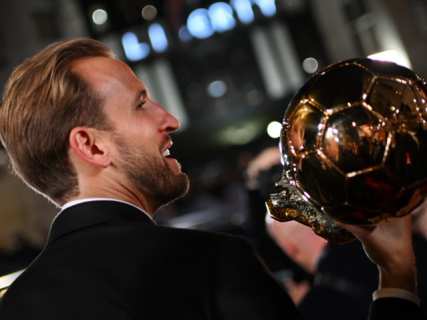

Harry Kane has starred in the big absence from FIFPRO’s ideal eleven of 2026, announced this Monday, November 9. The English forward for Bayern Munich, winner of this year’s Ballon d’Or, has not managed to get into the eleven most voted by their own professional peers, a decision that is especially striking because the award from France Football had recently recognized him as the best player in the world.
The vote, organized by the international players’ union FIFPRO, brought together 19,806 professional players from 73 countries. Unlike the Ballon d’Or, whose winner is chosen by specialized journalists, this recognition depends exclusively on votes from active players.
Kane was among the 26 finalists, but has been left out of an attack made up of Erling Haaland, Kylian Mbappé, Lamine Yamal, and Lionel Messi. The presence of four forwards responds to the selection system, which reserves a final spot for the most voted outfield player among those who have not initially managed to make the team.
The FIFPRO 2026 ideal eleven, with four Spanish players
The team announced by FIFPRO includes four Spanish footballers: David Raya, Pau Cubarsí, Rodri, and Lamine Yamal. The Spanish representation is linked to the 2025-2026 season, which includes the World Cup won by the Spanish national team.
This is the male ideal eleven of FIFPRO 2026:
-
Goalkeeper: David Raya (Arsenal)
-
Defenders: Achraf Hakimi (Paris Saint-Germain), Pau Cubarsí (Barcelona), and Nuno Mendes (Paris Saint-Germain)
-
Midfielders: Jude Bellingham (Real Madrid), Rodri (Manchester City/Barcelona), and Vitinha (Paris Saint-Germain)
-
Forwards: Erling Haaland (Manchester City), Kylian Mbappé (Real Madrid), Lionel Messi (Inter Miami), and Lamine Yamal (Barcelona)
Among the standout names is Messi, who returns to the eleven after three years of absence and extends his historical record to 18 appearances. The Argentine was chosen for the first time in 2007 and continues to be the player who has received this recognition the most times.
Lamine Yamal has also achieved a milestone. The Barcelona forward is the first player to enter the FIFPRO eleven twice before turning 20, after having been selected in the previous edition.
Spain, moreover, reaches 53 total appearances by national players in the men’s ideal eleven since the creation of the award.
How the FIFPRO ideal eleven is voted
The ideal XI of FIFPRO is chosen through a procedure different from that of the main individual awards. Since 2005, the international union has invited professional footballers from around the world to select the teammates they consider most outstanding for their performance during the evaluated period.
Participants access a secure digital platform enabled by FIFPRO and its affiliated unions. Each player selects three goalkeepers, three defenders, three midfielders and three forwards, without their choice depending on the nationality or club of the candidates.
The system then sets a distribution by positions. The most-voted goalkeeper and the three players with the greatest backing in defense, the middle of the field and the forward line enter directly. The eleventh place corresponds to the outfield player who has received the most votes among those who have not yet been selected.
This last rule explains why the 2026 team has four forwards and only three midfielders, instead of being obligated to fit a traditional tactical formation.
For this edition, performances between August 4, 2025, and July 19, 2026—the date of the World Cup final—have been assessed. In addition, candidates had to have played at least 30 official matches during that period.
The number of participants initially announced, higher than 26,000, included the votes from the men’s and women’s categories. The final figure communicated for the men’s XI is 19,806 footballers from 73 countries.
Winning the Ballon d'Or and ending up out of the XI
Kane’s absence is the result of two independent votes, organized by different entities and with selection criteria that are not identical. The Ballon d'Or of France Football is awarded based on votes from specialized journalists, while FIFPRO’s XI reflects the preferences of the professional players themselves. In addition, the union’s award requires that the spots be distributed by position, so a forward can receive many votes and miss out if other attackers get more support.
In this edition, Kane was competing for a spot with Haaland, Mbappé, Messi, Lamine Yamal and other names included in the list of finalists, including Cristiano Ronaldo, Michael Olise and Khvicha Kvaratskhelia.
The fact that voters must choose several footballers by position makes it possible to recognize different careers within the same season. However, FIFPRO has not published in its statement the complete breakdown of votes for each candidate, so it is not possible to specify how many votes Kane received or how far he was from the last selected striker.
A precedent that is difficult to find
The exclusion of the reigning Ballon d'Or proves especially unusual when reviewing the award’s previous editions. According to the historical review published by Sports Illustrated, Kane is the first Ballon d'Or winner who does not make the men’s ideal XI of FIFPRO corresponding to that year since it began being awarded in 2005.
In recent seasons, differences have occurred between the individual awards and the selection of the footballers, although not to the same extent.
In 2025, for example, Ousmane Dembélé, the Ballon d'Or winner, was included in FIFPRO’s XI, along with other standout footballers from Paris Saint-Germain. The Frenchman, however, has not even made it into the 26 finalists for the 2026 edition, a sign of the changes that can occur between one season and another.
There are also differences between the lists of candidates. Cristiano Ronaldo, absent from the 30 candidates for the Ballon d'Or of 2026, was selected among the 26 finalists for the FIFPRO award, although he ultimately also failed to secure a place in the XI.
These cases show that both awards do not always coincide, but the absence of the Ballon d'Or winner from the final team is much less common than discrepancies between their respective lists of nominees.
Messi and Lamine Yamal, protagonists of the voting
The decision regarding Kane has shared the spotlight with Messi’s return. At 39 years old, the Inter Miami forward is again receiving recognition from his teammates after having been left out of the previous two editions.
His selection expands a career that began in 2007 and allows him to reach the 18 appearances in the ideal XI, a number without precedent in the history of the award.
Lamine Yamal, for his part, confirms his continuity among the most-voted footballers. The Barcelona player, who has not yet turned 20, has managed to enter for the second consecutive year, something no other footballer had achieved at that age.
The vote also recognizes footballers from the Spanish national team, world champions, and from Paris Saint-Germain, winners of the Champions League.
For Kane, the result leaves a rare paradox: the footballer who has received the Ballon d'Or of 2026 does not appear in the ideal team of the same year chosen by his teammates, a discrepancy that highlights the differences between journalists' individual recognition and the collective assessment of professionals.