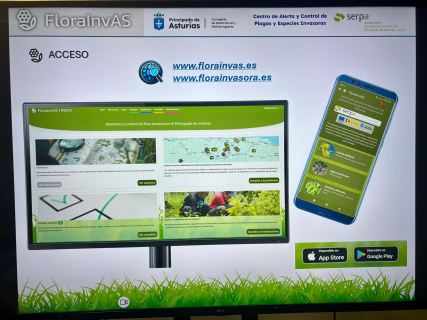

The Department of Rural Environment and Agricultural Policy announced this Wednesday "FloraInvAS", a new platform designed to strengthen knowledge, monitoring, and management of invasive exotic flora species present in Asturias, through the systematic collection of data on their location and distribution in the territory.
The General Director of Agricultural Planning, Marcos da Rocha, and the Director of the Pest and Invasive Species Alert and Control Center, Eloy Álvarez, have been responsible for presenting this digital tool, promoted by the Department with the support of the public company Society of Services of the Principality (Serpa).
The platform will allow centralizing information about specimens and populations of the species included in the Spanish Catalogue of Invasive Exotic Species. The involvement of citizens will be key in the development of the project, as anyone will be able to report the detection of a species through the FloraInvAS website or its mobile app, available for Android and iOS devices.
To complete a report, it will be essential to indicate the exact location and attach one or several photographs that facilitate the correct identification of the observed species.
In addition, FloraInvAS will make available to the public fact sheets with detailed information on each species included in the system and will allow the Principality to have an updated repository on their presence and distribution. This database will serve to better plan actions and determine when it is necessary to apply control or eradication measures.
EIGHTEEN PRIORITY SPECIES
In this first phase, the tool incorporates 18 species of invasive flora for which priority information is sought. Among them are the tree of heaven (Ailanthus altissima), azolla (Azolla filiculoides), butterfly bush (Buddleja davidii), cat's claw (Carpobrotus acinaciformis and C. edulis), Japanese knotweed (Fallopia japonica), wandering Jew (Tradescantia fluminensis), and pampas grass (Cortaderia selloana).
Regarding pampas grass, the work is particularly focused on locating isolated specimens or small clusters situated in areas where the species is not yet widely spread, in order to enable early intervention that helps contain its spread.
With this objective, FloraInvAS defines an exclusion zone that encompasses a large part of the north and center of Asturias. In these areas, new notifications of Cortaderia selloana will not be accepted through the platform, as these are areas where its presence is well established and its control is addressed through specific actions.