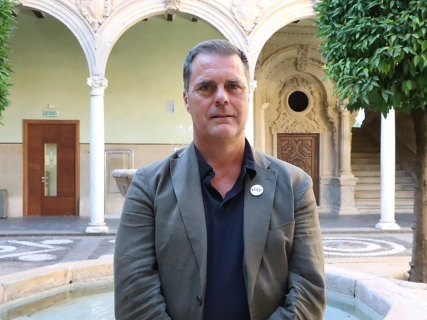

The director of the Jaén Agritech Venture Foundation, Agustín Andreu, has emphasized that the digitalization of traditional olive groves "opens a historic opportunity for youth employment in Jaén" and that the incorporation of new technologies will be the "definitive engine" to rejuvenate the countryside and ensure the economic viability of the olive oil sector.
Andreu made these statements this Monday at the Antonio Machado Headquarters of the International University of Andalusia (UNIA), in Baeza (Jaén), where he is participating as a speaker in the summer course "Digitalization and artificial intelligence in the value chain of the olive oil sector: from the field to the table."
As he explained, technological innovation "is not a trend, but competitiveness," as noted by UNIA in a statement. In his opinion, "the current competitive landscape indicates, especially in the case of traditional olive groves, the absolute need to optimize costs and increase revenues. And that clearly involves technology and innovation. There is no other way."
He also pointed out that the priority must be placed on the primary exploitation itself, where systems of exploitation from 40 or 50 years ago are still "adopted" and it is necessary to "change the mindset quickly." In this context, he recalled that the aging of olive growers and the absence of generational change "makes it difficult for them to take on these tasks themselves."
To close this gap, the expert has proposed promoting technological adoption through 'startups' and specialized service firms. "It is not necessary for the more senior farmers to directly adapt to these technologies, but they should hire service companies with young people already trained to internalize that digitalization and become more competitive," he pointed out.
In his view, the emergence of technology has become the "definitive tool" to attract new generations to the Andalusian rural environment. "Young people will join agriculture to the extent that it provides them with profitability and an interesting field of work," Andreu added.
Summer courses on digitalization and artificial intelligence
The summer course "Digitalization and artificial intelligence in the value chain of olive oils: from the field to the table" is directed by the professor of Marketing and Market Research at the University of JAÉN (UJA), Manuel Parras, and runs until September 2.
The training proposal aims to introduce tools such as digitalization and artificial intelligence (AI) that contribute to making the sector more competitive, breaking down the barriers that are still perceived, largely due to the lack of specialized knowledge.
Among the participating faculty are Luis Martínez, professor in the Department of Computer Science at UJA and international reference in Computational Intelligence; Carlos Parra, agronomist and researcher at the Ifapa Camino de Purchil center; Pedro López, professional drone pilot and director of TecnoAgro360, and Mateo Andrades, pilot and head of Jaedron.
The program also includes the participation of Rosa Gallardo, professor in the Department of Agricultural Economics at the University of CórdobaCO and director of the Chair of Artificial Intelligence and Agriculture; Cristina Martínez, professor in the Department of Electronic Engineering and Computers at UCO; Carlos Pérez, engineer in Computer Science and director of ADJ Online, and Pedro Martínez, managing director of IMS Control Industrial.
The lineup of speakers is completed by Dolores C. Pérez, president of Icnirs (International Society for Near Infrared Spectroscopy) and professor at the Higher Technical School of Agricultural Engineering and Forestry at UCO; Cristóbal J. Carmona del Jesús, professor of Computer Science and Artificial Intelligence at UJA; Isabel Fernández Martínez, from Servimpacto, and Antonio Berlanga, from Agroleum.