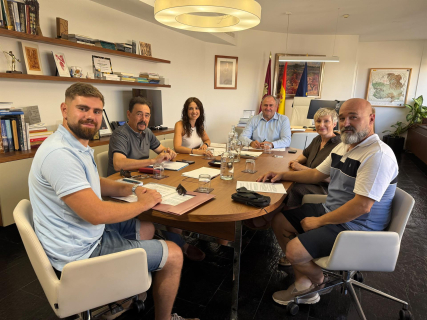

The counselor of Agriculture, Livestock, and Rural Development, Julián Martínez Lizán, has held a working meeting with representatives of the regional truffle sector to analyze different actions that promote the expansion of this crop, strengthen its competitiveness, and open new future avenues for those dedicated to it.
In the meeting, recently held in Toledo, participated the president of the Federation of Truffle Growers Associations of Castilla-La Mancha (FATCLM), Cristóbal López, and the secretary of the Federation, Delia Tarancón; the president of the Association of Truffle Growers of Castilla-La Mancha (ATCLM), Agustín Valencia, along with Manuel Bueno, a member of this entity; as well as the general director of Agricultural Regulation, Lydia Benítez.
According to the regional Government, the sector raised the convenience of adapting various administrative procedures to the current situation of truffle cultivation when developed on agricultural farms.
Among the demands conveyed is that truffle cultivation on agricultural land be fully recognized as another agricultural crop, so that it can be included both in the programs for incorporating young people into the countryside and in the lines for improving farms.
This aims to more accurately reflect the real working conditions and the profitability generated by this use, as well as facilitate its integration into CAP aids, in the support for the incorporation of young farmers, and in investments aimed at modernizing farms.
In this line, the counselor has indicated that his department will analyze together with the sector possible regulatory or technical modifications that allow adapting the current criteria to the particularities of truffle plantations established in agricultural soils.
During the meeting, one of the most unique characteristics of this crop was also addressed: truffle plantations use species that, despite being intended for agricultural activity, may be classified as forest in the regulations, which in practice complicates access in some cases to certain aids from the Common Agricultural Policy (CAP).
"We will see the possibilities by consulting and coordinating with the Department of Sustainable Development to determine if it is possible to carry out some type of management or consideration, since it is a very atypical and novel crop" that presents growth potential in the region.
In the field of promotion, the sector was informed of the available ways to enhance the consumption and marketing of truffles, both through the actions of the Ministry itself —such as the presence at fairs under the regional quality brand Campo y Alma— and through other bodies of the regional government, including the Institute of Foreign Promotion.
Finally, the options for supporting research on truffles from the centers dependent on the Ministry were reviewed. These initiatives would be articulated through the Regional Institute of Agricultural and Forestry Research and Development of Castilla-La Mancha (IRIAF), with the aim of continuing to deepen knowledge and improvement of this crop.