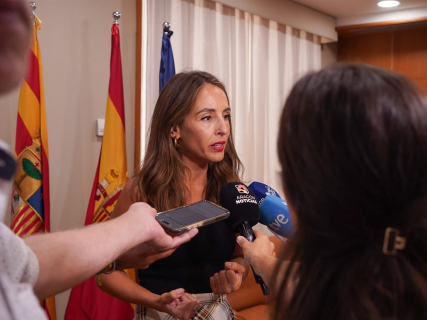

The president of the Cortes of Aragón, María Navarro, has shown her support for the Autonomous City of Ceuta in light of the current migration crisis and has advanced her intention for the Aragonese Parliament to join the working group on migrations of the Conference of Regional Legislative Assemblies of Europe (CALRE).
Navarro has recalled that "On July 30, there was a massive entry --in Ceuta-- and, therefore, this must make us reflect on what role Europe has to face the control of that border, such as the one in Southern Europe, through which so many migratory flows enter, and the problem we have in extraordinary situations," emphasizing the need for a coordinated response from the European Union.
In this framework, the Cortes of Aragón will focus their participation on analyzing issues such as the protection of external borders, the EU's reaction to exceptional episodes, the fight against irregular immigration and criminal networks, as well as the streamlining of identification, asylum, and return procedures. Cooperation with countries of origin and transit, legal and orderly immigration, investment linked to these flows, and the protection of minors and vulnerable groups will also be addressed.
The Presidency of the Chamber aims, from this space of interparliamentary collaboration, to promote initiatives that allow the challenges associated with migration to be part of the European political debate and not be limited to the state or regional level.
Round of spokespersons to open the political course
This Monday, August 31, Navarro has gathered the spokespersons of the parliamentary groups and associations of the Cortes to prepare for the start of the new session period.
The objective of these meetings is to share diagnoses and face the new course from institutional normality, reinforcing the role of the Cortes of Aragón as a forum where the different political sensitivities of the Community are expressed.
With this round, the president wanted to "see the legislative strategy, know firsthand what their concerns are, and share what this upcoming session period will be about."
She reiterated that "Since I have been president of the Cortes, I have always said that this house must be the house of respect, the house of dialogue, the house where we can dialogue from ideological and political differences, but always thinking of the general interest of the Aragonese."
An intense agenda focused on citizen issues
Navarro has emphasized that plurality is inherent to democracy and parliamentary work, but has highlighted the importance of maintaining "respect among all, institutional cordiality, and the ability to dialogue."
In this line, he has recalled the commitment made upon taking office that the Cortes of Aragón be "the common house of all Aragonese, the house of dialogue and the house of agreement."
The next session period will be characterized by a high workload and debates on issues that directly affect citizens, such as housing, the economic situation, employment, or immigration.
The president has stressed that the work of the Chamber must maintain a close link with the real concerns of the population and be oriented towards offering concrete solutions.
Budgets, the central challenge of the period
Among the most relevant challenges of the coming months, Navarro has placed the progress in the processing of the General Budgets of the Autonomous Community, considering that having approved accounts is key for the stability and the capacity for action of the institutions.
He has recalled that the Presidency of the Cortes does not intervene in the political negotiation of the accounts, but must ensure the proper functioning of Parliament and an institutional framework that facilitates dialogue among the groups.
He has pointed out that "The most important law" that will be addressed in the next session period will be that of the budgets for 2027, which includes areas such as health, education, social services, and forest fires. "It is the tool that budgetarily solves the real problems of Aragón," he has stated.
Likewise, he has mentioned the future processing of the housing law, registered in the Chamber months ago, and has expressed his confidence that Parliament can approve it.
To conclude, the president of the Cortes of Aragón has emphasized that, although political discrepancies are inherent to democracy, so is the obligation to seek agreements when it comes to the general interests of the Community.
"We have ahead of us a session period with a lot of work and important challenges. The best way to face them is from institutional responsibility, respect, and the willingness to dialogue," the president has stated.