The weather in Catalonia during the Diada: what the weather will be like in Barcelona during the demonstration and the events

Meteocat does not forecast rain in Barcelona during September 11 and places the temperatures around 26 degrees during the demonstration at 17:14 hours and the institutional event at 20:00.

3 minutes

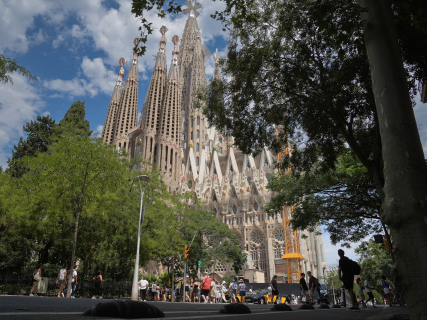
EuropaPress 7704047 varios turistas caminan inmediaciones sagrada familia agosto 2026 barcelona

EuropaPress 7704047 varios turistas caminan inmediaciones sagrada familia agosto 2026 barcelona

Add DEMÓCRATA to Google

Ask FREN

Published

Last updated

3 minutes

Most read

The Catalonia Day 2026 will be celebrated this Friday with stable weather in Barcelona if the latest weather forecast holds. Meteocat does not foresee precipitation during any of the hours of September 11 in the Catalan capital, a favorable forecast for the main outdoor events scheduled.

The morning will start with more cloudiness and temperatures around 22 and 24 degrees, but the sky will tend to clear as the day progresses. During the afternoon, coinciding with the Diada demonstration, the thermometer will hover around 26 degrees.

What will the weather be like during the tribute to Rafael Casanova

One of the first major events of the day will be the traditional floral tribute at the monument to Rafael Casanova, scheduled to start at 9:00 AM.

The Meteocat prediction for that hour places the temperature in Barcelona around 23 degrees, with cloudy intervals and no accumulated precipitation.

At 10:00 AM, around 24 degrees is expected and there is also no rain in the currently available automatic forecast.

The weather during the 5:14 PM demonstration

The largest concentration of people on the street is expected in the afternoon.

The independence demonstration will start at 5:14 PM with two columns that will converge in Plaza de Catalunya.

Meteocat forecasts around 26 degrees at 5:00 PM, clear sky and 0 millimeters of precipitation.

The wind will be moderate, around 18 kilometers per hour according to the municipal automatic forecast available this Thursday.

At 6:00 PM, when the mobilization is expected to continue, the temperature will remain around 26 degrees, with no rain.

Will it rain during the Diada demonstration?

With the forecast available this Thursday afternoon, no.

Meteocat maintains 0 millimeters of precipitation during all time slots on Friday in Barcelona.

This does not mean that the forecast cannot be modified before the events. Weather models are updated and any changes in the coming hours should be taken into account before attending the gatherings.

What will the weather be like during the institutional event

The institutional event of the Generalitat will begin at 8:00 PM at the National Theatre of Catalonia.

For that hour, Meteocat forecasts around 26 degrees, clear sky and absence of precipitation.

From 9:00 PM, the temperature will drop slightly to approximately 25 degrees, while during the last hours of the day some high clouds will appear.

Hourly forecast for the main events of the Diada

Event Time Expected temperature Rain
Offering to Rafael Casanova 9.00 23 ºC 0 mm
Open doors 11.00 24 ºC 0 mm
Diada demonstration 17.14 26 ºC 0 mm
End of the afternoon 19.00 26 ºC 0 mm
Institutional event 20.00 26 ºC 0 mm
Concerts and night activities 21.00 25 ºC 0 mm

The values correspond to the automatic prediction from Meteocat available this September 10 and may be updated before the start of the events.

No warnings on the Catalan coast

The maritime forecast from AEMET also does not anticipate warning conditions on the coast of Catalonia between the night of this Thursday and 8:00 PM on Friday.

The State Meteorological Agency expressly states that no warning conditions are expected in any Catalan coastal area during that period.

A Diada without rain in Barcelona, according to the current forecast

The meteorological scenario is, therefore, favorable for the central events of the Diada in Barcelona.

The morning will be somewhat cloudier, but the clouds will lose prominence during the day. The demonstration at 5:14 PM would take place with about 26 degrees and no rain, while the institutional event at 8:00 PM would maintain similar conditions.

Those who will spend several hours outdoors should also take into account solar exposure. Meteocat places for Friday a predicted ultraviolet index of 5 in Barcelonès, within a scale whose maximum expected for the day in the region is 6.

More key points, information and questions with FREN

AI-GENERATED CONTENT

What are the legal procedures to organize demonstrations in public spaces in Barcelona?

To organize a demonstration in public spaces in Barcelona, you must follow the general regime of the right of assembly provided in the Constitution and Organic Law 9/1983, of July 15, regulating the right of assembly, complemented by Organic Law 4/2015, on the protection of citizen security, and by Catalan regulations on public security and the Generalitat Police – Mossos d’Esquadra (Llei 10/1994). From this framework, quite standardized procedures are configured.

1. Applicable basic regulations
  • Spanish Constitution, article 21: recognizes the right to peaceful and unarmed assembly, and requires that meetings and demonstrations in public transit places be previously communicated to the authority, which can only prohibit them when there are well-founded reasons of public order disturbance with danger to people or property.
  • Organic Law 9/1983, of July 15, regulating the right of assembly (text in BOE): establishes the general regime of prior communication, deadlines, minimum content, powers of the governmental authority, causes for prohibition, and responsibilities of organizers and participants. It was amended by LO 9/1999.
  • Organic Law 4/2015, of March 30, on the protection of citizen security (text in BOE): regulates the powers of the Security Forces and Corps to protect the exercise of the right of assembly and typifies administrative infractions linked to public order disturbances, disobedience, etc.
  • Catalan scope: the Llei 10/1994, of the Generalitat Police – Mossos d’Esquadra (text in Portal Jurídic) configures the autonomous police that acts, together with the Catalan governmental authority, in the protection of the right of assembly.

For the purposes of LO 9/1983, the governmental authority also includes those of autonomous communities that have powers in the protection of people and property and maintenance of citizen security. In Catalonia, this places the Generalitat (Department of Interior / Mossos) as a key authority, without prejudice to the presence of the General State Administration in its own scope.

2. Prior communication: to whom, when, and how

Demonstrations and gatherings in public transit places in Barcelona are subject to written prior communication, never authorization:

  • Competent authority: the communication is addressed to the competent governmental authority in Catalonia (Generalitat, exercising its citizen security powers), which must in turn notify the Barcelona City Council of the essential data of the demonstration so that it can report on the route and material conditions.
  • Ordinary deadline: according to LO 9/1983, the communication must be submitted at least 10 calendar days and at most 30 days in advance of the planned date.
  • Urgency deadline: when there are extraordinary and serious causes justifying urgency, the communication can be made at least 24 hours in advance.
  • Form and channels: the law requires it to be in writing. In practice, the general registry (in person or electronic) of the competent administration is used, and it can also be submitted in other administrative registries that forward the communication to the governmental authority.
3. Minimum content of the communication

Article 9 of LO 9/1983 requires that the communication letter include, at least:

  • Identification of the organizing persons: name, surname, address, and official identification document. If the organizer is a legal entity, also its name, nature, and address, and the identification of its representative.
  • Place, date, start time, and expected duration of the demonstration or gathering.
  • Purpose or objective of the call (reason for the protest or claim).
  • Projected itinerary, if it is planned to circulate through public roads.
  • Security measures planned by the organization and, if applicable, those requested from the authority (police presence, traffic cuts, etc.).

The governmental authority must communicate the data to the affected City Council so that it reports (within 24 hours) on technical aspects of the route. That municipal report is reasoned but not binding.

4. Prohibition, modification, and control
  • The authority can only prohibit or modify the date, place, duration, or itinerary when there are well-founded reasons that the demonstration may cause public order disturbances with danger to people or property.
  • The decision must be adopted in a reasoned manner and notified within a maximum period of 72 hours from the communication.
  • If the organization does not accept the prohibition or modifications, it can file an urgent contentious-administrative appeal before the competent Court, with the specific regime of protection of fundamental rights.
5. Obligations and responsibilities of the organizing persons
  • The organizing persons are responsible for the good order of the demonstration and must adopt the necessary measures for its proper development (order service, instructions to participants, respect for schedules and route, etc.).
  • Those who participate and cause damage to third parties are directly liable for them; the organizing or promoting persons are secondarily liable, unless they prove having taken all reasonable means to avoid them.
  • The governmental authority can suspend or dissolve the demonstration when it becomes unlawful, serious public order disturbances with danger to people or property occur, or other cases provided by law arise.
  • Additionally, according to LO 4/2015, failure to comply with legal obligations or police orders may lead to administrative sanctions (fines) for infractions related to citizen security.

In summary, in Barcelona the procedure always involves communicating the demonstration in writing and with sufficient advance notice to the competent governmental authority, with all essential data and a defined itinerary, and cooperating with Mossos d’Esquadra and the City Council to ensure a peaceful and safe protest. Failure to comply with these steps can not only lead to the prohibition of the event but also to civil and sanctioning responsibilities.

What powers does the Generalitat of Catalonia have in civil protection and meteorology?

The Generalitat of Catalonia has a very broad block of powers in civil protection and meteorology, mainly articulated through the 2006 Statute of Autonomy and two basic Catalan laws: the Llei 4/1997, de protecció civil de Catalunya, and the Ley 15/2001, de Meteorología. These powers are exercised in coordination with both the State and local entities.

1. Civil protection: exclusive competence of the Generalitat

The Statute of Autonomy (Organic Law 6/2006) recognizes the Generalitat an exclusive competence in civil protection. The statutory text itself establishes that this competence includes:

  • The regulation, planning, and execution of measures related to emergencies and civil security in Catalonia.
  • The direction and coordination of civil protection services, including fire prevention and extinction services.
  • The exercise of these functions without prejudice to the powers of local governments and respecting the State's powers in public security.

The reference regulation in Catalonia is the Llei 4/1997, of May 20, on civil protection of Catalonia, which designs a comprehensive civil protection system for the entire Catalan territory. Among its key ideas, according to its preamble:

  • It integrates civil protection within the scope of public security, connecting it with the Generalitat's powers over the Mossos d’Esquadra and the coordination of local police.
  • It regulates the different civil protection plans (such as the Catalonia civil protection plan, PROCICAT) and guarantees their compatibility with State plans.
  • It recognizes a concurrence of powers with local entities, especially in prevention and first response, and provides coordination mechanisms.
  • It excludes from its scope emergencies declared of “national interest,” which correspond to the State, according to State civil protection legislation and Constitutional Court doctrine.

The Statute adds that, in emergencies exceeding the Catalan territory, the Generalitat must promote collaboration mechanisms with other autonomous communities and the State, linking to its participation in the National Civil Protection System and the homologation of plans in the National Civil Protection Commission.

2. Meteorology: own service and statutory competence

In meteorology, the Statute recognizes the Generalitat the competence to:

  • Establish an own meteorological service.
  • Provide meteorological and climatic information, including forecasting, control, and monitoring of meteorological risk situations.
  • Develop research in these areas and prepare climatic cartography.

These provisions are deployed in Ley 15/2001, of November 14, on Meteorology, which creates the Meteorological Service of Catalonia as a public law entity of the Generalitat. According to its preamble and first articles, its functions include:

  • Managing the network of meteorological equipment of the Generalitat (Xemec) and the Meteorological Database of Catalonia.
  • Processing, exploiting, and disseminating meteorological and climatic data, and preparing specific forecasts for the Catalan territory.
  • Forecasting, monitoring, and following meteorological risk situations, in coordination with the Catalonia Emergency Center (CECAT), and issuing warnings to affected users.
  • Providing official meteorological advice to competent administrations and institutions in civil protection, and collaborating, when appropriate, with the State meteorological authority.
  • Promoting research, training, and dissemination in meteorology and climatology, as well as studies on climate change and atmospheric pollution in Catalonia.

The Constitutional Court has recalled in several rulings that, although Catalonia has its own meteorological service, the State maintains relevant executive functions associated with its competence over air navigation and the State Meteorological Agency (AEMET). Hence the need to emphasize collaboration and avoid duplications.

3. Coordination with State and local administration

In civil protection, the Generalitat:

  • Exercises exclusive competence in planning and ordinary management of emergencies in Catalonia, integrating municipalities and supramunicipal entities through local plans and coordination committees.
  • Coordinates with the State in emergencies of national interest and in areas connected with public security and nuclear safety, through homologated plans and cooperation bodies.

In meteorology, coordination is articulated:

  • Through agreements and collaborations with the State meteorological authority to share data and products and ensure coherence between observation networks.
  • Through the participation of local entity representatives in the governing bodies of the Meteorological Service of Catalonia, ensuring the service adapts to municipal needs and its integration with local civil protection.

Overall, the Generalitat has a very broad margin of normative, organizational, and operational action in both civil protection and meteorology, based on a cooperative model with the State and local entities, especially visible in the management of emergencies and meteorological risks.

What were the results of the latest elections to the Parliament of Catalonia and which parties currently form the regional government?

The latest elections to the Parliament of Catalonia were held on May 12, 2024. They resulted in a clear victory for the Partit dels Socialistes de Catalunya (PSC), but without an absolute majority, and the current regional Government is presided over by Salvador Illa, leader of the PSC, supported by agreements with Esquerra Republicana de Catalunya (ERC) and the Comuns–Sumar coalition.

Results of the May 12 elections to the Parliament

According to the official note from the Generalitat on the results of the May 12 elections to the Parliament of Catalonia, with 98.86 % counted and a turnout of 57.97 %, the distribution of votes and seats was as follows:

  • PSC (Partit dels Socialistes de Catalunya) – 42 seats, 27.94 % of the votes (867,228 votes). It is the first time that the socialists win votes and seats in Catalan regional elections so clearly.
  • Junts + Puigdemont per Catalunya (Junts+) – 35 seats, 21.64 % of the votes (671,780). Consolidates as the second force, but without capacity to form an alternative majority.
  • Esquerra Republicana de Catalunya (ERC) – 20 seats, 13.68 % of the votes (424,887). Moves from being a governing force to the third parliamentary force, with a significant drop compared to the previous legislature.
  • Partido Popular de Cataluña (PP) – 15 seats, 10.97 % of the votes (340,629). Records a strong rise and becomes the fourth force in the Chamber.
  • Vox – 11 seats, 7.95 % of the votes (246,976). Maintains a relevant presence in the right-wing bloc.
  • Comuns – Sumar – 6 seats, 5.81 % of the votes (180,528). Positions as a potential partner for a left-wing bloc.
  • CUP–DT – 4 seats, 4.09 % of the votes (127,108). Reduces its representation but retains a group in the Parliament.
  • Aliança Catalana (AC) – 2 seats, 3.79 % of the votes (117,877). Debuts in the Parliament with a small but very influential representation in the identity debate.

These results depict a fragmented Parliament, without an absolute majority of either the pro-independence bloc or the strictly constitutionalist bloc, which forced complex negotiations for the investiture.

Political composition of the current Generalitat Government

After several weeks of negotiations, Salvador Illa was invested president of the Generalitat in August 2024. Various political reports, such as the analysis by Gaceta Médica on the health priorities of Illa as new president, detail that:

  • Illa assumes office supported by two investiture pacts: one with ERC and another with the Comuns–Sumar coalition.
  • The Government formed thereafter is led by the PSC, which provides the presidency and most of the ministries, along with independent profiles of close sensitivity.
  • ERC and Comuns–Sumar act as preferred partners of the investiture and legislative majority, negotiating the main agreements (budgets, social agenda, financing) and guaranteeing the parliamentary stability of the Executive.

The Catalan Government itself and the Parliament have reflected this majority in subsequent institutional activity. For example, the Parliament's information on the president's appearance to explain the composition of the new Executive and the distribution of committees, available on its official website (note of September 3, 2024), shows that the arithmetic of the committees reproduces that balance: PSC as the first force, followed by Junts, ERC, PP, Vox, Comuns, CUP, and the Mixed Group.

In summary, as of today:

  • The regional Government is headed by the PSC, with Salvador Illa as president and an Executive Council mostly socialist and independent in profile.
  • The political base supporting the Government in the Parliament rests on investiture and legislative agreements with ERC and Comuns–Sumar, which allow forming a left-wing majority against the rest of the forces (Junts, PP, Vox, CUP, and AC).

This scheme configures an unprecedented scenario in recent Catalan politics: for the first time since 1980, the Parliament does not have a majority of nationalist or pro-independence seats, and the Generalitat is presided over by a socialist supported by a left-wing majority essentially non-independentist.

Play

Test your knowledge with FREN!

How much do you know about this topic? Answer the following 3 questions.

What temperature does Meteocat forecast for Barcelona during the Diada demonstration at 17:14 hours?

Question 1 of 3

What does the rain forecast indicate for Barcelona during the main hours of the Diada according to Meteocat?

Question 2 of 3

What ultraviolet index value does Meteocat forecast for Barcelonès on the day of the Diada?

Question 3 of 3

Hola, soy Fren. ¿Cómo te ayudo?