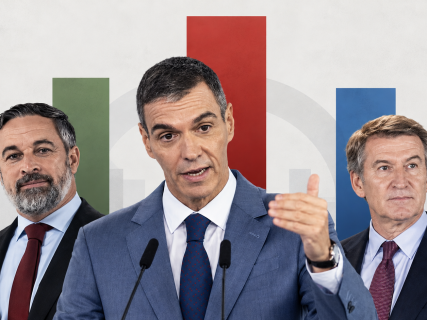
General elections survey: the PSOE is 2.6 points behind the PP, but Vox holds the majority of the right, according to GESOP

The survey for Prensa Ibérica places the PP at 28.7%, 3.5 points below the average of six recent surveys. The socialists decline compared to July and maintain their range of deputies, while Vox improves to 68-72 seats.

5 minutes

Montaje editorial de políticos europeos

Montaje editorial de políticos europeos

Add DEMÓCRATA to Google

Ask FREN

Published

Last updated

5 minutes

Most read

The PSOE appears closer to the PP in GESOP than in a good part of the last polls. However, this lesser distance does not describe a socialist recovery. The poll published this October 12 for Prensa Ibérica places the Popular Party at 28.7% and the socialists at 26.1%: both lose support compared to the previous study in July.

The difference is 2.6 points, three tenths less than then. But the movement that reinforces the alternative majority occurs to the right of the PP. Vox reaches 18.9% and between 68 and 72 deputies, compared to the 64-68 of the previous GESOP.

The PP retreats and the PSOE retains its seats

The previous reference located is the GESOP from July, not a poll immediately prior to the advance. Then, the PP obtained 29.4% and between 123 and 127 deputies. Now it loses seven tenths and its range drops to 121-125.

The PSOE goes from 26.5% to 26.1%, although it retains the 108-112 seats. Sánchez narrows the gap because the PP retreats more, not because it increases its vote estimate. Vox makes the opposite journey: it gains 1.1 points.

Frente Amplio obtains 8% and between 14 and 17 deputies, compared to the 7.7% and the 14-16 that GESOP attributed to Sumar in July. Podemos drops from 4% to 2.6% and from four representatives to two. The comparison of the labels of the alternative left must be read with caution as the configuration of the candidacies changes.

The difference with other polls is in Feijóo, not in Sánchez

To contextualize the result, Demócrata has calculated a simple average of six recent polls: 40dB., Target Point, Hamalgama, Sigma Dos, SocioMétrica, and GAD3. A delivery by firm, published between October 9 and 12, is used with identical weight.

This selection places the PP at 32.2%, the PSOE at 26.2%, and Vox at 18.9%. It is not a comprehensive average of all available polls.

GESOP leaves the PP 3.5 points below that reference. The PSOE barely separates by a tenth and Vox coincides when rounding. That is why the popular advantage is much smaller: 2.6 points in GESOP compared to six in the selected average.

The difference also does not just appear. The previous GESOP already placed the PP below 30%. It would not be correct to interpret the contrast between pollsters as a sudden drop in popular vote.

A right below 50% of the vote, but above the absolute majority

PP and Vox gather 47.6%, compared to 51.1% of the comparative average. Still, the ranges of GESOP allow for a sum of between 189 and 197 deputies: above the 176 necessary for an absolute majority.

This interval is the sum of the extremes published for both parties, not a statistical confidence interval. It also does not guarantee an electoral result or a government agreement.

PSOE, Frente Amplio, and Podemos sum up to 36.7%, not including the territorial left. The distance with PP and Vox is 10.9 points. Therefore, talking about continuity between blocks does not mean they are tied.

The GESOP balance combines a PP weaker than in other studies, a PSOE without recovery compared to July, and a stronger Vox. The smaller distance between the two major parties does not translate, for now, into an alternative majority for Sánchez.

What changes compared to the previous GESOP

Vote estimation · Comparison with July 2026

Swipe to consult all columns →

Candidacy July October 12 Change in points Seats July Seats October
PP 29.4%28.7% −0.7 123–127121–125
PSOE 26.5%26.1% −0.4 108–112108–112
Vox 17.8%18.9% +1.1 64–6868–72
Sumar / Frente Amplio 7.7%8.0% +0.3 14–1614–17
Podemos 4.0%2.6% −1.4 42
PP + Vox 47.2%47.6%+0.4187–195189–197
Source: GESOP for Prensa Ibérica. Previous reference: July survey. Current publication: October 12. July includes Sumar and October Frente Amplio: the name change does not guarantee an identical composition. The variations are differences between estimates, not statistically significant changes accredited. PP + Vox adds the extremes of the individual ranges; it does not constitute a joint confidence interval.

Where GESOP separates from other polls

Vote percentage · Simple average of six recent surveys

Swipe to consult all columns →

Reference Publication PP PSOE Vox PP + Vox
40dB. · EL PAÍS / SER Oct 931.9%28.1%18.9%50.8%
Target Point · El Debate Oct 1132.0%25.9%18.7%50.7%
Hamalgama · Vozpópuli Oct 1133.4%25.3%19.6%53.0%
Sigma Dos · EL MUNDO Oct 1131.9%25.3%19.1%51.0%
SocioMétrica · EL ESPAÑOL Oct 1132.6%26.2%18.8%51.4%
GAD3 · ABC Oct 1231.4%26.4%18.2%49.6%
Average of the six Oct 9–1232.2%26.2%18.9%51.1%
GESOP · Prensa Ibérica Oct 1228.7%26.1%18.9%47.6%
GESOP minus the average Points−3.5−0.10.0−3.5
Calculation by Demócrata with the six deliveries identified in the table. One survey per firm and the same weight for all. GESOP is excluded from the average to compare it with the other six. It is a comparative selection, not a comprehensive average of all published surveys. Calculations made before rounding to one decimal. In 40dB. the scenario with Sumar and Podemos separated is used. The percentages of GAD3 incorporate the variations published regarding its September barometer. The average is not a new survey nor does it allow for a direct allocation of seats.

The comparison with the polls of 23J

Deputies · Absolute majority: 176

Swipe to consult all columns →

Party or sum Result 2023 GESOP October Difference
PP 137121–125 Between 12 and 16 less
PSOE 121108–112 Between 9 and 13 less
Vox 3368–72 Between 35 and 39 more
PP + Vox 170189–197Between 19 and 27 more
Sources: GESOP for Prensa Ibérica and definitive results of 23J published by the Central Electoral Board. Electoral results are compared with estimates. The ranges do not guarantee the result of future elections.

Check here the complete survey and the technical sheet

More key points, information and questions with FREN

AI-GENERATED CONTENT

What are the parliamentary procedures required to call general elections in Spain?

In Spain, the calling of general elections is a formal act of the King, but the way to reach that point is strictly regulated by the Constitution and, to a lesser extent, by parliamentary Regulations. There is no prior parliamentary “agreement” of the Chambers to dissolve them: the initiative is always governmental or automatic due to the investiture process.

1. Basic constitutional framework

  • Article 68.4 CE: sets the duration of the Congress's term at four years from its election, except in case of early dissolution.
  • Article 99 CE: regulates the investiture of the President of the Government and provides for automatic dissolution if investiture is not achieved within two months from the first vote.
  • Article 115 CE: regulates early dissolution at the initiative of the President of the Government.

The legal act that calls the elections is always a Royal Decree of dissolution and call, signed by the King and countersigned by the President of the Government, and published in the Official State Gazette (BOE). With its publication, the Cortes are dissolved and the electoral process begins.

2. Early dissolution at the initiative of the President of the Government

This is the most frequent case. The essential steps are:

  • Political decision of the president: the President of the Government decides to propose dissolution. The Constitution recognizes this initiative, which is not shared with the Chambers.
  • Consultation with the President of the Congress: article 115 CE requires that, before proposing dissolution, the president hear the President of the Congress. It is a mandatory but non-binding consultation, without a vote or agreement of the Chamber.
  • Deliberation of the Council of Ministers: the Council of Ministers must deliberate on the proposal of dissolution and call for elections. From that deliberation will come the agreement to propose dissolution to the King.
  • Formal proposal to the King: the president submits to the King the proposal to dissolve the Congress and Senate or only the Congress (in practice, both Chambers are dissolved) and to call elections.
  • Royal Decree of dissolution and call: the King issues the Royal Decree, which specifies:
    • Dissolution of the affected Chambers.
    • Date of the elections (within the deadlines of the Organic Law of the General Electoral Regime).
    • Date of constitution of the new Chambers.
  • Publication in the BOE: the decree comes into force upon its publication. From that moment:
    • The Government goes into caretaker mode from the day of the elections until the new Executive takes office.
    • The Chambers are dissolved and the Permanent Deputation comes into play, assuming limited powers (validation of decree-laws, states of alarm, exception, and siege).

In this scenario, there is no procedure of debate or vote in the Plenary of the Congress or the Senate on the dissolution: the parliamentary role is very limited and is channeled mainly through the Presidency of the Congress (consultation) and, once the Chambers are dissolved, through the Permanent Deputation.

3. Automatic dissolution due to investiture failure

The Constitution provides for an “automatic” dissolution when a president cannot be invested:

  • After elections, the King proposes a candidate and the Congress holds the investiture debate.
  • If the candidate does not obtain an absolute majority in the first vote nor a simple majority in the second, successive candidacies may be attempted, always within the framework of article 99 CE.
  • If two months elapse from the first investiture vote without any candidate being invested, the King dissolves both Chambers and calls new elections, with the countersignature of the President of the Congress.

Here the decisive “parliamentary procedure” is the very succession of failed investiture debates and votes. There is no room for additional political decision: once the two-month period without investiture is fulfilled, dissolution is mandatory.

4. Ordinary end of the legislature

If there is no early dissolution, the legislature ends when the four-year term from the election of the Congress expires. The procedure is:

  • The natural expiration date of the mandate approaches.
  • The Government and the Royal Household coordinate the date of the elections within the time limits set by the electoral law.
  • The King, at the proposal of the Government, issues a Royal Decree declaring the mandate expired and calling elections, with publication in the BOE.

Here too there is no express parliamentary agreement on the call: the role of the Chambers is mainly passive, limited to completing the legislature and, once dissolved, operating through the Permanent Deputation.

5. Role of the Boards and the Permanent Deputation

During the legislature, the Boards of the Congress and the Senate organize parliamentary activity, but they do not intervene in the decision to dissolve nor in setting the election date. Their relevance appears afterwards:

  • After dissolution, the Permanent Deputation meets, a body that represents each Chamber and which, according to the Constitution, assumes certain limited powers while they are dissolved, especially regarding:
    • Validation or repeal of royal decree-laws.
    • States of alarm, exception, and siege, if they occur during that interval.
  • Once the new Chambers are constituted, the Permanent Deputation reports in Plenary on the decisions adopted during the electoral period.

In summary, the parliamentary procedures leading to general elections are actually very few: the key lies in the decisions of the President of the Government (early dissolution) or in the result of the investiture debates (automatic dissolution), while the formal role of the Chambers focuses on the investiture, the consultation with the President of the Congress, and the limited exercise of functions by the Permanent Deputation once dissolved.

Can you explain in more detail how an investiture debate in the Congress is carried out step by step? What differences are there in the Government's capacity to act before and after entering caretaker mode following the election call? What exactly is the role of the Permanent Deputation during the electoral period and what limits does it have?

What powers does the President of the Government have in relation to the election call?

The President of the Government is the political protagonist of the call for general elections, but his powers are framed within a quite precise constitutional framework. He does not "directly call" the elections: what he does is propose to the King the dissolution of the Cortes Generales and the calling of elections, within the limits set by the Constitution and electoral legislation.

1. Initiative to dissolve the Cortes and propose elections

The key power of the president is the authority to propose the dissolution of the Congress, the Senate, or both Chambers. Once the president makes that political decision, he submits it to the King, who formally dissolves the Chambers by means of a royal decree that also sets the date of the general elections.

In practice, the King acts according to the proposal of the President of the Government, so the initiative and political responsibility to bring forward or not the elections correspond to the president. That decision must be accompanied by:

  • The indication of whether only one Chamber or both are dissolved (in practice, almost always both).
  • The proposal of a specific date for holding the elections.
  • Respect for the legal deadlines between dissolution and voting (campaign period, etc.).

2. Constitutional limits to that authority

The president's power is not absolute. The Constitution establishes several material and temporal limits to that initiative:

  • He cannot propose dissolution while a motion of censure is in process. This prevents the president from "escaping" imminent parliamentary control by bringing forward elections.
  • He cannot dissolve early during the first year of the legislature if there has already been a previous dissolution by that means. The aim is to prevent abusive or repeated use of early elections to seek majorities by repeating polls.
  • He must previously consult the President of the Congress. It is not an authorization, but a formal consultation obligation that reinforces the institutional dimension of the decision.
  • He cannot dissolve in situations of constitutional exception (for example, during a state of siege in certain cases), where specific rules apply.

3. Ordinary call and automatic dissolution

Apart from early elections, the president also plays a role in the ordinary call of elections when the Cortes' term ends. The legislature has a maximum duration (except for early dissolution), and upon its end, dissolution and calling of elections must proceed. The formal decision is again articulated through the president's proposal and the King's decree, but here it is not a "discretionary" power, but the fulfillment of a constitutional term.

Additionally, there is the so-called automatic dissolution due to investiture failure. If after a certain period from the first investiture vote no candidate obtains the confidence of the Congress, the Chambers are dissolved and new elections are called without the need for a political decision by the outgoing president. In that case:

  • It is not a power that the president can use or not: dissolution is imposed by the Constitution.
  • The caretaker Government is limited to complying with that mandate and processing the formal aspects of the call.

4. Role of the president during the campaign and the caretaker Government

Once the Cortes are dissolved and elections called, the Government (and with it the president) goes into caretaker mode from the elections until the new president takes office. During that period:

  • He continues to hold the headship of the Government and the ordinary representation of the State in the political sphere.
  • He must respect reinforced limits on making major decisions, so as not to unduly condition the future Parliament and Government arising from the polls.
  • He no longer has room to decide on new dissolutions (the Cortes are dissolved) nor on investitures, which will correspond to the new parliamentary majority.

5. Powers over regional and local elections

It is important to distinguish levels: the President of the Government only has this role regarding the Cortes Generales. Regional and local elections are governed by their own statutes and laws:

  • In general, regional presidents are those who can dissolve their parliaments and bring forward elections in their community, with similar limits.
  • Local elections follow much more rigid calendars and there is practically no equivalent political power of early dissolution of municipal councils.

Therefore, the President of the Government's competence in electoral calls focuses on the state level and is exercised mainly through the proposal of dissolution of the Cortes and setting the date of the general elections, within the constitutional conditions and guarantees indicated.

What were the exact results of the last general elections in Spain by party?

The last general elections held in Spain were on July 23, 2023, for the election of the Congress of Deputies. According to the official data of the electoral process (collected, among others, in the Official State Gazette), the national result by party —in votes, percentage of valid votes, and seats— was as follows.

Official results by party (Congress, 23J 2023)
Party / Candidacy Votes % of valid votes Seats
People's Party (PP) 8,091,840 33.05 % 137
Spanish Socialist Workers' Party (PSOE) 7,760,970 31.70 % 121
Vox 3,033,744 12.39 % 33
Sumar 3,014,006 12.31 % 31
Republican Left of Catalonia (ERC) 462,883 1.89 % 7
Junts per Catalunya 392,634 1.60 % 7
Basque Country Gather (EH Bildu) 333,362 1.36 % 6
Basque Nationalist Party (EAJ‑PNV) 275,782 1.12 % 5
Galician Nationalist Bloc (BNG) 152,327 0.62 % 1
Canarian Coalition (CCa) 114,718 0.46 % 1
Navarrese People's Union (UPN) 51,764 0.21 % 1

In total, the Congress was composed of 350 seats. The percentages indicated are calculated over the total valid votes (including candidacies that did not obtain representation) and may vary by a hundredth depending on the rounding criteria used by each source or statistical table.

Main parties without representation

Besides the candidacies that did obtain seats, several formations received a significant volume of votes but were left out of Congress due to the effect of the electoral system (provincial constituency and allocation by the D’Hondt method). Among them are:

  • PACMA: 165,768 votes (approx. 0.67 % of valid votes), no seats.
  • CUP‑PR: 98,794 votes (0.40 %), no seats.
  • Workers' Front: 46,605 votes (0.19 %), no seats.
  • New Canary Islands‑Canarist Bloc: 45,557 votes (0.18 %), no seats.

The existence of parties with tens or hundreds of thousands of votes but without representation is one of the recurring features of Spanish general elections: what matters to enter the seat allocation is not only the national percentage, but the territorial concentration of the vote in each province.

Political reading of the result

Based on these data, the PP was the force with the most votes and seats (137), and the PSOE came in second with 121. The sum of the traditional state right-wing parties (PP and Vox) reached 170 seats, to which the seat of UPN is added, while the reference government bloc was articulated around PSOE and Sumar, with the parliamentary support of nationalist and independentist parties that obtained between 1 and 7 deputies.

Overall, the chamber resulting from 23J 2023 was very fragmented: eleven different candidacies obtained representation and the Government needed to build an investiture and legislative majority with several partners, since no simple combination of two parties alone reached the absolute majority of 176 seats.

Play

Test your knowledge with FREN!

How much do you know about this topic? Answer the following 3 questions.

What is the percentage difference in voting intention between the PP and PSOE according to the GESOP survey published on October 12?

Question 1 of 3

What percentage of voting intention does Vox reach in the GESOP survey published on October 12?

Question 2 of 3

What is the maximum total number of seats that PP and Vox could reach together according to the GESOP range?

Question 3 of 3