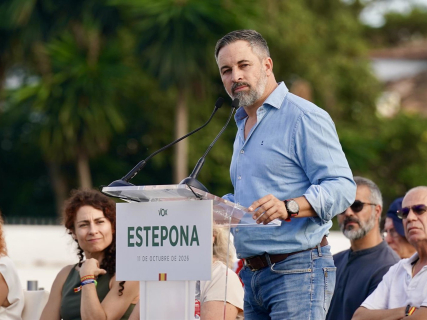
General elections survey: Vox gains five seats, the PP loses five and the PSOE stagnates at 103, according to Sigma Dos

The right maintains its 203 deputies, but changes the internal balance: the PP drops to 135 and Vox reaches 68, more than double than on the 23J. Sumar recovers one point of vote without improving its nine seats.

fotonoticia 20261011195906 1920

fotonoticia 20261011195906 1920

Add DEMÓCRATA to Google

Ask FREN

Published

Last updated

7 minutes

Most read

Elecciones 29N · Encuestas

La media de las encuestas

Media a 18 de noviembre de 2026 · 17 institutos

  • PP31,4 %
  • PSOE27,4 %
  • Vox19,0 %
  • Frente Amplio6,1 %
  • ERC2,4 %
  • SALF2,0 %
01020304050ene 2024jul 2024ene 2025jul 2025ene 2026jul 2026

Media del último estudio de cada instituto en 30 días y su evolución semanal desde el 23J. Partidos con al menos un 2 %.

Todas las encuestas

Elecciones generales del 29 de noviembre · Demócrata

The most important movement of the last Sigma Dos does not change the majority, but the distribution of power within it. The survey for El Mundo places the PP at 135 deputies, five less than in the previous release, and Vox at 68, five more. Together they maintain the 203 seats they already had in the previous survey: 27 above the absolute majority.

The PSOE remains at 103 representatives and Sumar at nine. The socialists drop three tenths, down to 25.3%, while their coalition partner improves from 6.6% to 7.6%, without that increase translating into more deputies.

The survey, published on the night of October 11, thus maintains a wide parliamentary advantage for the right ahead of the 29N. But it does not reflect a growth in their total seats: what changes is the weight of each party.

Compared to the previous Sigma Dos: Vox advances and the PP retreats

The previous study, collected by Sigma Dos on its website on October 5, granted the PP 32.6% of the vote and 140 deputies; the PSOE, 25.6% and 103; Vox, 18.3% and 63; and Sumar, 6.6% and nine.

Now the PP drops seven tenths, down to 31.9%, while Vox gains eight and reaches 19.1%. The sum of both barely changes: it goes from 50.9% to 51%.

The distance between the two major parties also narrows. The PP led the PSOE by seven points and now does so by 6.6. In seats, the difference drops from 37 to 32. This cut does not come from a socialist improvement, but from a popular retreat.

Podemos goes from 3.3% to 3.1% and maintains two deputies. PSOE, Sumar, and Podemos gather 114 representatives, exactly the same as in the previous study.

Compared to the 23J: Vox gains 35 deputies and the PSOE loses 18

The comparison with the elections of July 2023 shows a much deeper transformation. The PP would lose two deputies compared to its 137 at that time. Vox, on the other hand, would go from 33 to 68: gaining 35 and exceeding double its representation.

PP and Vox would jointly advance from 170 to 203 seats. That’s 33 more, despite the fact that the popular party would be slightly below its result from the 23J. The growth of the potential majority is concentrated in Santiago Abascal's party.

The PSOE would drop from 121 to 103 deputies, a loss of 18. In votes, it would go from 31.7% to 25.3%, a decline of 6.4 points.

Sumar and Podemos would obtain eleven representatives between them, compared to the 31 that the joint candidacy achieved in 2023. The difference would be twenty deputies. Comparing the whole avoids treating as identical lists that then ran united and now appear separated.

Sumar gains a point, but not a seat

One of the most striking results of the survey is to the left of the PSOE. Sumar improves a full point in vote estimation and, still, retains its nine deputies.

There is no automatic relationship between national percentage and representation. The distribution depends on where the votes are concentrated and which candidacy secures the last seats in each constituency. Without the provincial breakdown, it cannot be specified where that improvement is halted.

The sum of PSOE, Sumar, and Podemos reaches 36% of the vote, compared to the previous 35.5%. Their distance from the 51% of PP and Vox is fifteen points. The 18.1 points that separate the right from PSOE and Sumar correspond to another comparison, which excludes Podemos.

The majority does not change; the negotiation between PP and Vox does

With 203 deputies, PP and Vox could gather a sufficient majority for an investiture if they agreed to support it. The survey does not turn that pact or the electoral result into accomplished facts.

What it does reflect is a Vox with greater weight against the PP. The published estimation of transfers indicates a net balance of around 1.15 million votes favorable to Vox in its exchanges with the populars regarding the electorate of 2023. That calculation should not be confused with movements produced exclusively during the last week.

The balance is concrete: the right retains its majority, the PP loses ground to Vox, and the improvement of Sumar in votes does not modify the representation of the state left.

Democrat · Polls · Sigma Dos / El Mundo

Vox gains five seats and the PP loses five

The sum of the right remains at 203 deputies. PSOE and Sumar do not change.

Swipe to see all columns →
Party or space 23J of 2023 Previous Sigma Dos October 11, 2026 Since the previous Against the 23J
PP 137140135 −5 −2
PSOE 121103103 0 −18
Vox 336368 +5 +35
Sumar 31Included Podemos 99 0 See joint space
Podemos Integrated in Sumar 22 0 See joint space
Sumar + Podemos 311111 0 −20
PP + Vox 170203203 0 +33
PSOE + Sumar + Podemos 152114114 0 −38

Absolute majority: 176 deputies. Sources: Sigma Dos / El Mundo and definitive results of the 23J. The previous reference is the barometer collected by Sigma Dos on its website on October 5, with fieldwork from September 22 to October 1.

Podemos ran integrated in Sumar in 2023. The grouped rows are subtotals and should not be summed again. This table does not show all the candidacies of the Congress.

Democrat · Evolution of the vote

Sumar gains one point and Vox rises eight tenths

The PP drops seven tenths and the PSOE, three. The right goes from 50.9% to 51%.

Swipe to see all columns →
Party or grouping Previous Sigma Dos October 11, 2026 Change in points
PP 32.6%31.9%−0.7
PSOE 25.6%25.3%−0.3
Vox 18.3%19.1%+0.8
Sumar 6.6%7.6%+1.0
Podemos 3.3%3.1%−0.2
PP + Vox 50.9%51.0% +0.1
PSOE + Sumar + Podemos 35.5%36.0% +0.5

Source: Sigma Dos / El Mundo. Differences calculated with the published percentages. The groupings are subtotals and do not include all the forces that could intervene in an investiture.

The variations between estimates do not alone demonstrate statistically significant changes nor allow attributing them to a specific event.

Democrat · The 350 deputies

This is how Congress would look according to Sigma Dos

Complete distribution of seats published in the new survey.

Candidacy Estimated vote Seats
PP31.9%135
PSOE25.3%103
Vox19.1%68
Sumar7.6%9
ERC2.6%9
Junts1.2%7
EH Bildu1.1%6
PNV0.9%5
Podemos3.1%2
BNG0.9%2
Adelante Andalucía0.8%2
Coalición Canaria0.5%1
UPN0.2%1
Total seats —350

Source: graph of Sigma Dos for El Mundo published on October 11, 2026. The seats total 350. The percentages shown sum to 95.2%: the graph does not break down the remaining 4.8% and does not assign an unpublished composition here.

Original information from El Mundo · Previous barometer and its technical sheet

Check the original information from El Mundo and the previous barometer published by Sigma Dos, with its technical sheet.

More key points, information and questions with FREN

AI-GENERATED CONTENT

What is the legislative process for the investiture of a Prime Minister in Spain after a general election?

In Spain, the investiture of the Prime Minister after a general election follows a procedure mainly regulated by Article 99 of the Constitution and the Rules of the Congress of Deputies (arts. 170‑172). Below is an orderly explanation of the entire process, from the elections to the possible repeat election if no candidate is invested.

1. From the elections to the candidate proposal

After the general elections are held, the Congress meets in constitutive session on the date set in the Royal Decree of convocation. In that session, the Board of the Congress is elected and the Chamber is declared constituted, which communicates its constitution to the King.

From there, the King holds a round of consultations with the representatives designated by the political groups with parliamentary representation. After these consultations, the King, under his political responsibility but following the logic of parliamentary majorities, makes a proposal of candidate for the Presidency of the Government and sends it to the Congress.

2. Convocation of the investiture Plenary

According to Article 170 of the Rules of the Congress, upon receiving the candidate proposal, the Presidency of the Chamber calls the investiture Plenary. There is no fixed deadline in days to call it, but it must be done respecting reasonable times for organization and political negotiation.

3. Development of the investiture debate

Article 171 of the Rules details the format of the debate:

  • Opening: the session begins with the reading, by one of the Secretaries, of the candidate proposal sent by the King.
  • Candidate's presentation: the candidate presents their Government program and requests the confidence of the Chamber. There is no time limit for this initial intervention.
  • Intervention of the groups: after a pause agreed by the Presidency, a deputy from each Parliamentary Group that requests it intervenes, for a time of 30 minutes each.
  • Reply and counter-reply: the candidate may intervene as many times as desired. If responding separately to each group, that group has a right of reply of 10 minutes. If responding globally, each group may make a final reply of 10 minutes.
4. Required majorities: first and second vote

At the end of the debate, the Presidency sets the time for the vote:

  • First vote: for the candidate to be invested, they need the absolute majority of the members of Congress (today, 176 votes or more out of 350).
  • Second vote: if that majority is not reached, a new vote is held 48 hours later. In this vote, a simple majority suffices (more votes in favor than against, excluding abstentions).
  • Before this second vote, the candidate may intervene up to 10 minutes and the groups up to 5 minutes each to set their position.

If confidence is granted, the Presidency of the Congress communicates it to the King, who formally appoints the person invested as Prime Minister.

5. Successive candidates and the two-month deadline count

If in the two initial votes the candidacy does not obtain confidence:

  • Article 172 foresees that successive candidate proposals may be processed, with the same debate and voting procedure.
  • The two-month deadline is counted from the date of the first investiture vote (the first time a candidate is put to a vote, whether successful or not).
  • If those two months pass without any candidacy obtaining the confidence of Congress, the Presidency of the Chamber submits to the King the Decree of dissolution of the Cortes Generales and call for new elections, which will be published and open a new electoral cycle.
6. Congress and Government "in office" after the elections

After the call for elections, the Cortes are dissolved and the outgoing Congress cannot hold an investiture. The Government remains acting (limited in its powers) until the new Prime Minister is appointed or, if there is no investiture, until after the new elections.

The investiture is always held with the new Congress already constituted, which acts with full powers, not "acting". The outgoing Government is the one that remains acting throughout the investiture process (unless it is an immediate re-election without early dissolution).

In summary, the system combines the King's arbitral role (candidate proposal), the centrality of Congress (which grants or denies confidence), and a two-month deadline that acts as an unlocking mechanism, leading to new elections if a Government cannot be formed.

What competencies and functions does the president of Vox, Santiago Abascal, have within the party and in the Congress of Deputies?

Santiago Abascal holds a dual position of power: he is the highest organic leader of Vox and, at the same time, a national deputy and member of the Permanent Deputation of the Congress. This grants him very clear formal competencies within the party and a relevant role, although not as spokesperson, in the Lower House.

1. Competencies and functions within Vox

According to his biographical profile and the party's public information, Abascal has been national president of Vox since 2014 and has been repeatedly re-elected in internal assemblies, most recently in 2024, with over 90% support. From this position:

  • He presides over the National Executive Committee (CEN), the body that exercises the executive direction of Vox at the state level.
  • He sets the political and ideological line of the party: discourse, programmatic priorities, and campaign frameworks.
  • He directs the electoral strategy, influencing the selection of candidacies and lead candidates in regional, municipal, European, and general elections.
  • He shapes and reshapes the leadership: proposes and replaces general secretaries, vice presidencies, and executive members, within statutory procedures.
  • He arbitrates internal conflicts and provides political coverage to disciplinary proceedings and reorganization of positions.
  • He exercises external representation of Vox before other parties, regional governments, European partners, and civic platforms.

The episodes regarding the crisis with Javier Ortega Smith illustrate these competencies well. At several points, the leadership "headed by Abascal" decided to successively remove him from the general secretary, the vice presidency of Vox, and his main parliamentary responsibilities. Abascal himself explains in an interview that decisions are made by him "together with the team he has appointed" and that the Assembly elects a leadership and "that leadership is the one that commands and will continue to command." In other words, the presidency concentrates the political leadership of the party and effective command over the Executive.

Additionally, Abascal insists that all members must submit to the statutes and the guarantee bodies, and supports the opening of proceedings when he considers that some leader challenges the leadership's decisions. This internal discipline control is a substantive part of his function.

2. Abascal's role in the Congress of Deputies

Institutionally, Abascal has been, since 2019, a deputy for Madrid integrated in the Vox Parliamentary Group (legislatures XIII, XIV, and XV). Parliamentary and stakeholder information identifies him, in the current legislature, with two main traits:

  • Deputy for Madrid of the Vox Group in the Congress Plenary.
  • Member of the Permanent Deputation of the Congress since November 21, 2023.

The Permanent Deputation is the body that maintains certain functions of the Congress when the Chamber is not in ordinary session or is dissolved due to the call for elections. As a member, Abascal participates in its meetings, may intervene in the debates of that body, and votes on decisions adopted (for example, ratifications of decree-laws or requests for urgent appearances).

In the Plenary, his role is that of deputy and main political reference of Vox: he intervenes in high-profile debates (government control sessions, motions of censure, major political debates) and defends the party's general position on strategic issues such as migration policy, the unity of Spain, or criticism of the Prime Minister.

3. Is he a spokesperson? Does he lead the group in Congress?

The consulted documentation is clear on an important point: Abascal is not the spokesperson of the Vox Parliamentary Group in this legislature. The spokesperson role falls to another deputy (Pepa Millán), who performs the regulatory functions of daily group leadership:

  • Organizing the group's daily activity in Congress.
  • Distributing spokesperson roles in committees and speaking turns.
  • Formally representing the group before the Board and the Spokespersons' Board.

Therefore, Abascal does not hold the formal competencies of spokesperson nor presides over the parliamentary group. However, his status as party president and national leader gives him a very high political influence over the group's leadership:

  • He defines the master lines that the group must convey in the form of initiatives and speeches.
  • He signals priorities and "red lines" in investitures, budgets, or major negotiations.
  • He publicly supports or corrects parliamentary leadership moves, which conditions their room for maneuver.
  • He supports changes in cadres and spokespersons (as shown by the replacements of Ortega Smith) that the group formalizes before the Chamber.
4. General assessment

In summary, within Vox Abascal exercises the political and organic leadership of the party: he presides over the Executive, sets the strategy, and largely controls the composition of the leadership and candidate lists. In Congress, he is a deputy for Madrid and member of the Permanent Deputation, without being the formal spokesperson of the Vox Group, but acting as its most visible face and main political decision-maker. His broader power lies within the party; in the Chamber, his weight rests both on his institutional positions and on that prior organic authority.

Can you detail exactly what the Permanent Deputation of the Congress is and what competencies it has, with recent examples? What are the organic and practical power differences between the president of Vox and its general secretary within the party? How has Abascal used his internal authority in Vox in recent crises with leaders like Ortega Smith or other critics?

What were the exact results of the July 2023 general elections for PSOE, PP, and Vox and how many seats did each obtain?

In the general elections held on July 23, 2023 for the Congress of Deputies, the official results for PSOE, PP, and Vox were as follows: the PP was the most voted force and obtained 137 seats, the PSOE obtained 121 seats, and Vox achieved 33 seats. Below I detail the exact votes and percentages for each.

Numerical results of 23J 2023 (Congress)

According to the official data of the final count of 23J 2023 for the Congress of Deputies (collected in summaries from media such as RTVE or Europa Press), the exact figures for the three parties you are interested in were these:

Party Votes % vote Seats
People's Party (PP) 8,091,840 33.05 % 137
Spanish Socialist Workers' Party (PSOE) 7,760,970 31.70 % 121
Vox 3,033,744 12.39 % 33

These figures correspond to the final count for the Congress. The PP positioned itself as the first force in votes and seats, followed by a PSOE very close in vote percentage, while Vox came in third place at a considerable distance in support, but with a relevant presence in the Chamber.

Basic interpretation of these results

Although you asked for the specific data, it is useful to interpret what they mean in parliamentary terms:

  • PP (137 seats, 33.05 %): significantly improves its results compared to the 2019 general elections and becomes the group with the most deputies. However, it remains far from the absolute majority (176) and from a comfortable sum with Vox that would allow it to govern without further support.
  • PSOE (121 seats, 31.70 %): despite being behind the PP in votes and deputies, it maintains a very high result and does so at a relatively short distance: around 1.3 percentage points and 16 seats fewer. That relatively narrow margin was key for Pedro Sánchez to attempt to articulate an alternative majority in the Congress with other parties.
  • Vox (33 seats, 12.39 %): although it maintains notable weight, it suffers a significant loss of representation compared to the previous legislature. It remains a relevant actor of the right-wing bloc, but with less arithmetic capacity to single-handedly facilitate a majority for the PP candidacy.

The combination of these results – PP as the first force, PSOE close in second place, and Vox as the third more distant force – resulted in a highly fragmented Congress. No ideological bloc obtained an absolute majority on its own, which forced intense negotiation for the investiture and subsequent governability.

Why the 23J is so talked about

The July 23, 2023 elections are considered a reference election for several reasons:

  • They confirmed the consolidation of a strong but incomplete bipartisanship: PP and PSOE concentrate more than 64 % of the vote, but need other parties to govern.
  • They reconfigured the weight of the right-wing bloc: although PP and Vox add up a significant number of seats, that sum was not enough for a stable investiture without additional support.
  • They left a scenario of mandatory negotiation for any investiture: both the attempt to form a Government from the right and the subsequent investiture from the left depended on pacts with multiple formations.

In summary, for the general elections of 23J 2023 to the Congress, the data you sought are: PSOE, 7,760,970 votes (31.70 %) and 121 seats; PP, 8,091,840 votes (33.05 %) and 137 seats; Vox, 3,033,744 votes (12.39 %) and 33 seats. These numbers remain the basis of the balance of power in the legislature started after those elections.

Play

Test your knowledge with FREN!

How much do you know about this topic? Answer the following 3 questions.

How many seats would Vox obtain according to the Sigma Dos survey of October 11, 2026?

Question 1 of 3

How many seats do PP and Vox jointly add up to in the latest Sigma Dos estimate?

Question 2 of 3

Which party among PP, PSOE, Vox, and Sumar gains the most seats compared to the July 2023 general elections according to the survey?

Question 3 of 3