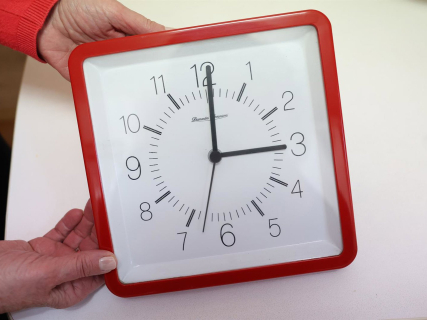

The next time change in Spain already has a date: it will be during the early morning of Sunday, October 25, 2026, the last Sunday of the month. At 3:00 AM in mainland Spain and the Balearic Islands, clocks will need to be set back to 2:00, while in the Canary Islands the change will occur when it is 2:00, at which point it will again be 1:00. In this way, the summer time period officially ends and the so-called winter time begins.
The most immediate consequence is that Sunday the 25th will officially have 25 hours, one more than usual. That night, an additional hour can be slept, and from then on, the Spanish time difference with universal time will again be UTC+1 in the Peninsula and the Balearic Islands and UTC+0 in the Canary Islands. The perception of sunrise and sunset will also be advanced by one hour: there will be more light early in the morning, but it will get dark earlier in the evening.
When does the time change in October 2026
The official date is recorded in the calendar published by the Government and responds to the rule that Spain has applied for years: summer time always ends on the last Sunday of October. In 2026 that day will be October 25. Royal Decree 236/2002 establishes that, when that moment arrives, the official time must be set back 60 minutes.
Therefore, the formula to remember it is simple: in the early morning from the 24th to the 25th of October, at 3:00 it will again be 2:00. Those in the Canary Islands will need to make the same adjustment one hour earlier: when the clock shows 2:00, it will again show 1:00.
The change is made in the early morning to minimize disruptions to economic activity, transportation, and public services, although certain sectors that work during the night have to adjust their schedules to a day in which the same time slot appears twice.
Which clocks need to be set back
The majority of citizens will not have to do anything with their mobile phone, computer, tablet, smartwatch, or internet-connected devices, as long as they have the automatic date and time adjustment activated. These devices usually change the time by themselves during the early morning.
It is advisable to review the devices that are not connected to a network or that operate manually, such as wall clocks, traditional alarm clocks, analog clocks, some appliances, ovens, microwaves, or clocks from certain vehicles. In all of them, the time must be set back one hour: if they show 3:00, they should change to 2:00.
It is also recommended to check on Sunday morning that electronic devices have updated the time correctly, especially if they are used for alarms, travel, or appointments. Devices set manually or with an incorrect time zone may not make the change automatically.
Do you sleep one hour more or one hour less?
In October, you sleep one hour more. By setting the clock back from 3:00 to 2:00, that time frame repeats itself and the day has 25 hours. It is the exact opposite of what happens in March, when daylight saving time begins and clocks are set forward one hour, making that Sunday only have 23 hours.
The winter schedule will remain in effect until the last Sunday of March 2027. At that time, the reverse process will occur: clocks will be set forward 60 minutes to enter again into the daylight saving time period.
What happens with sunrise and sunset
The change does not alter the actual duration of the day, but it does change the official time at which we see sunrise and sunset. Starting from October 25, the Sun will rise approximately one hour earlier according to the clock and will also set one hour earlier. This means more light during the early hours of the morning, in exchange for earlier darkness in the evenings.
The effect adds to the natural progression of autumn, when days are already shortening rapidly. The National Geographic Institute reminds that during this time, the duration of sunlight decreases each day due to the movement of the Earth and the approach to the winter solstice.
Is this the last time change in Spain?
No. For years, the possibility of eliminating seasonal time changes has been debated in the European Union, but that reform has not been definitively approved. The BOE itself noted when publishing the calendar until 2026 that the European proposal to end this practice was still not adopted.
In fact, the European Commission published in March 2026 a new calendar with the start and end dates of daylight saving time between 2027 and 2031, which confirms that the system is still planned for the coming years as long as the regulations are not modified. For 2027, for example, daylight saving time will begin on March 28 and end on October 31.
Thus, although the Spanish calendar published in 2022 formally ended in 2026, that does not mean that the October change will be the last. The Spanish regulation maintains the system indefinitely and the EU has already set the dates for the following years.
The date to remember: October 25
For those who want to avoid doubts, you just have to remember three pieces of information: Sunday, October 25, 2026, one hour back and at 3:00 it will be 2:00. In the Canary Islands, at 2:00 it will be 1:00 again. Most mobile phones and computers will change automatically, while manual clocks will need to be adjusted.
The result will be a night with an additional hour and the return to standard time, which will bring earlier sunrises and sunsets according to the clock. And, despite the ongoing debate in Europe for years, it will not yet be the last scheduled time change.