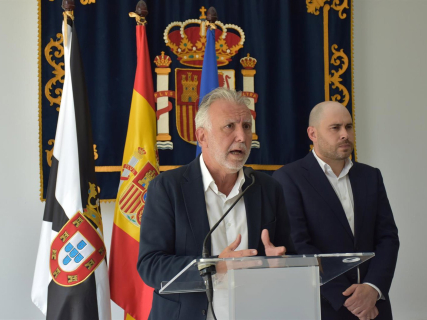

The version defended by Margarita Robles regarding the information that the Government had before the migratory crisis in Ceuta has run out of public support within the Executive. The Minister of Territorial Policy and responsible for the single command, Ángel Víctor Torres, has backed Fernando Grande-Marlaska and has denied that there was any communication that anticipated the arrival of tens of thousands of people.
Torres thus joins the position expressed by the Interior, the Government Delegation in Ceuta, and sources from Moncloa. In contrast, the Minister of Defense maintains that the CNI communicated on July 29 the existence of a call to attempt to swim into the autonomous city the following day.
The controversy affects two different issues: whether there was any prior warning about that call and whether the available information allowed anticipating the dimensions that the entry on July 30 would ultimately reach.
Torres backs Marlaska: "There was no communication"
Ángel Víctor Torres has stated that Marlaska was "clear" when he denied that the intelligence services had anticipated an entry like the one that ultimately occurred.
"There was no communication that we were going to have an arrival of tens of thousands of people," he assured during an interview on Cadena SER.
The minister has acknowledged that during the previous days the situation in Ceuta was reported daily and that there had been an increase of about a thousand entries in a week. However, he maintains that those communications did not warn of the arrival of tens of thousands of people.
"If we had received it, the action would have been different," Torres has stated.
Robles maintains that the CNI warned on July 29
The version of Margarita Robles is different. During her appearance before the Defense Commission, the minister assured that the 25 CNI agents assigned to Ceuta had carried out the work that corresponded to them and shared their analyses with the Security Forces and the Government Delegation.
Robles specified that on July 29 the members of the intelligence service "reported to the Government Delegation" a call to attempt to swim in the following day, taking advantage of a holiday in Morocco.
The Minister of Defense also emphasized that communications from the intelligence services do not necessarily have to take the form of a written report.
Your statement does not equate to asserting that the CNI had calculated that tens of thousands of people would cross the border. It does imply, however, that there was prior communication about a specific call.
Moncloa even denies that there was an oral warning
The extent of the clash increased after sources from Moncloa cited by elDiario.es denied both the existence of written reports and oral warnings from the CNI to the Delegation or to any member of the Executive.
From the Presidency, they attributed Robles' words to a possible poor explanation and assured that there is no record of any call from the CNI to the Government in the terms described by the minister. This denial does directly affect the communication that Robles places on July 29.
The Government Delegation in Ceuta also stated that it had not received any report warning of what would happen. It acknowledged that it transmitted daily data on the increase of entries by sea, but maintained that none allowed anticipating what occurred.
The different versions had already opened a clash within the Government over the CNI's warnings. Torres' support for Marlaska now expands the political isolation of Defense.
Warning of a call is not anticipating the magnitude
The apparent contradiction requires distinguishing two levels. It is possible that the intelligence services detected a call on social networks without being able to calculate that it would lead to an entry of exceptional dimensions.
For this reason, Torres' statement about the absence of a warning that anticipated tens of thousands of arrivals does not alone disprove that a lesser communication could exist. The direct conflict arises when Moncloa also denies that the oral warning described by Robles is recorded.
It remains unclear, therefore, whether that communication on July 29 occurred, who received it, what its exact content was, and what assessment was made by the authorities in charge of the security of Ceuta.
Torres reduces the "we arrived late" to an assessment by Robles
The confrontation is not limited to the CNI. Robles also apologized to the people of Ceuta and acknowledged that the Government had arrived late because the population continued to suffer.
Torres has framed those words in a "personal reflection" of the minister. Although he admits that actions can always be improved, he defends the effort made by the Executive in the face of a crisis of extraordinary complexity.
El País reports a strong discomfort among several ministers due to Robles' statements and places the discrepancy in the closest circle to Pedro Sánchez. However, it is not recorded that the president has demanded a rectification nor that the clash will produce immediate consequences.
The next determining explanation will come with Marlaska's appearance in Congress. The minister must clarify whether he only denies that the magnitude of the entry could have been anticipated or also that Interior was aware of the call mentioned by Robles.