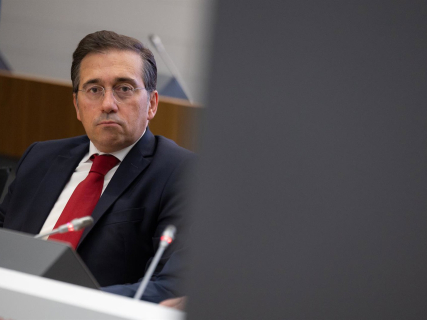

The Supreme Court has issued an ultimatum to the Government just over a month before the general elections on November 29. The Administrative Litigation Chamber has given a deadline of five days to the ministers Félix Bolaños, head of the Presidency, Justice and Relations with the Cortes, and José Manuel Albares, head of Foreign Affairs, to deliver the nominal list of 163,020 citizens naturalized under the so-called grandchildren's law who could be affected by the precautionary suspension of their right to vote.
According to El Mundo, the requirement is included in two rulings from the High Court, with a report by the magistrate Antonio Narváez, in which the Executive is reproached for not having yet provided the identity of those affected despite knowing the exact number of people registered in the Census of Resident Absentee Voters (CERA). The documentation must be sent both to the Supreme Court and to the Central Electoral Board and the Electoral Census Office before 3:00 PM on Wednesday, October 28.
The court warns that if the Government again fails to comply with the order, it could impose coercive fines of 1,000 euros on the responsible ministers, repeatable until the information is provided, and initiate the necessary actions to determine if there is any criminal responsibility. This last possibility does not imply an automatic charge, but would require the corresponding judicial processing.
Only 91 certificates issued from the 31,390 files reviewed
The controversy is related to the application of the Law 20/2022 of Democratic Memory, which allows certain descendants of Spanish citizens who left the country for political, ideological, or persecution reasons to access Spanish nationality.
The Supreme Court agreed in September on precautionary measures that condition the exercise of the vote of a group of beneficiaries of this naturalization route on the accreditation of certain requirements linked to the exile of their ancestors.
However, the verification process is progressing slowly. According to the documentation provided to the court, by October 21, 31,390 files had been reviewed, but the consular records had only issued 91 certificates that accredited compliance with the required conditions. The figure represents approximately 0.3% of the examined files, a percentage that reflects the verification difficulties when there are only five weeks left until the elections.
The Chamber considers it particularly concerning that the complete list of affected individuals has not yet been delivered, as this information is necessary to ensure the correct preparation of the electoral roll and to inform citizens of their situation.
The Supreme Court questions the Government's delay before the 29N
The judges express their displeasure at the lack of progress after more than a month of requests. According to El Mundo, the court finds it incomprehensible that the Administration has not yet identified the 163,020 affected individuals, especially since their data has already been used to process the corresponding nationality files.
The Chamber recalls that it has been the State Attorney's Office itself that has provided the exact number of citizens included in this case. Therefore, it questions how the Executive has the overall figure but has not conveyed the individual identification of the voters.
Furthermore, the Supreme Court has ordered the Electoral Census Office to expressly inform the Spaniards residing abroad who are affected that their registration in the CERA does not guarantee by itself that they can vote on November 29.
In these cases, citizens must have the consular certification that proves they meet the requirements established by the precautionary measures. The situation introduces an element of uncertainty for thousands of people who acquired Spanish nationality through the Democratic Memory Law.
Bolaños and Albares defend that they are working to comply with the order
From the Government, they maintain that the collection of the requested data is a complex task, due to the high number of files and the need to coordinate information from civil registries and Spanish consulates abroad.
After the new requirement became known, Félix Bolaños assured that his department had already transferred on October 15 to the Electoral Census Office all the documentation and the names it had, coming from the digitized civil registries.
The minister also defended that the Executive has been making all possible efforts for weeks to address the judicial requests and announced that Foreign Affairs would reiterate the instructions to the consulates to try to complete the information within the new deadline.
For its part, the department of José Manuel Albares claims that both the Ministry and the consular network have been working since the first requirement from the Supreme Court and that they will intensify efforts to respond to the latest ruling. The judicial decision also includes the particular vote of magistrate Alicia Millán, who had already expressed her opposition to the precautionary suspension of the right to vote of these citizens.
With October 28 as the deadline, the Government now faces a new demand from the Supreme Court in the midst of the electoral pre-campaign. The outcome of the efforts will be decisive to clarify the situation of the thousands of nationals by the grandchildren's law whose right to participate in the general elections on November 29 remains conditioned by judicial measures.