
The President of the Canary Islands, Fernando Clavijo, has sent a letter to the European Commissioner for Home Affairs and Migration, Magnus Brunner, in which he requests urgent intervention by the European Union in response to the upturn in the arrival of migrant people via the Atlantic route.
The head of the regional Executive asks that Brussels, in coordination with the Government of Spain, immediately analyze the situation, activate the mechanisms of solidarity and support provided for in Community law, and convene an urgent meeting to agree on specific measures and an action calendar.
According to what the Canary Islands Government has said in a statement, this request is made in a context of growing pressure on the archipelago’s first reception facilities and public services, with particular impact in El Hierro.
In the letter, Clavijo warns of the reactivation of departures from several points on the west coast of Africa, in particular from Senegal and Gambia, and of the risk that new routes will become established. In his view, the European response cannot be limited “to managing the consequences once the boats reach the Canary coasts”.
For this reason, the Canary Islands president proposes five priority lines of action to the European Commission: an immediate assessment of migratory pressure and of the extraordinary needs of the Canary Islands; the urgent review of the instruments of solidarity, assistance, and financing of the European Pact on Migration and Asylum; strengthening cooperation with Morocco, Mauritania, Senegal, and Gambia; the mobilization of resources and specialized European agencies in border management, international protection, and reception; and the direct participation of the Canary Islands Government in monitoring the response, while respecting, at all times, the competences of the State.
Urgent meeting with the Commission and the Spanish Government
The President has requested an “urgent” meeting with representatives of the European Commission and the Spanish authorities to specify this intervention. In his letter, he recalls that the Canary Islands constitute an external border of the European Union and maintains that the situation cannot be “an exclusively regional or state problem”.
"The credibility of the new European Pact on Migration and Asylum is also at stake in the Canary Islands; solidarity cannot be limited to a principle set out in European legislation: it must be made effective when an external border of the Union faces an extraordinary situation," he said in the document.
Clavijo adds that what is happening these days in El Hierro requires "anticipation and coordination," so it is essential that "Europe get involved before the pressure overflows even more the resources of the islands, with effective support to Spain, to the Canary Islands and to the reception facilities.
"We are talking about protecting lives, caring for people with dignity and ensuring that a European responsibility does not fall in a disproportionate way on the territories of first arrival," Clavijo said, who pointed out that the regional Executive has sent to the Ministry of the Interior to adopt immediately urgent and extraordinary measures, especially the reinforcement of security personnel in El Hierro.
RUPs set out their position in Guadeloupe
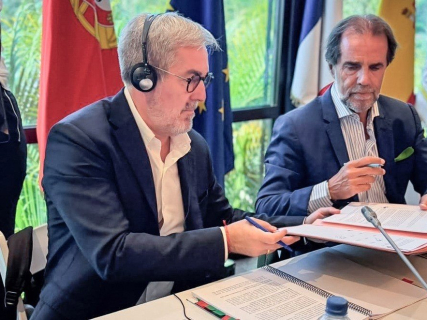
The request by the president coincides with the common position approved by the nine outermost regions (RUP) in the final declaration of the XXX Conference of Presidents, held in Guadeloupe.
The text notes that migration pressure generates significant impacts on public services, infrastructure and social cohesion in several of these territories, and calls for a European response based on solidarity, shared responsibility and respect for fundamental rights.
In particular, the document demands effective coordination with the Commission, the real application of solidarity mechanisms and adequate financing for the reception, protection and integration of migrant people, with special attention to unaccompanied minors.
It also calls for the exceptional situations faced by the RUPs to be included in the future European emergency response mechanism at external borders, guaranteeing a rapid intervention and sufficient resources.
For the Government of the Canary Islands, both initiatives respond to the same priority: that the status of the Atlantic external border and the added difficulties of islandness are translated into European tools adapted to the reality of the archipelago. Clavijo argues that cooperation with West Africa must combine the prevention of dangerous departures and the fight against the networks of illegal migrant trafficking with the protection of human rights and the generation of opportunities in the countries of origin and transit.
Other agreements of the Declaration of Guadeloupe
The "Declaration of Guadeloupe" also addresses the rest of the issues that will shape the relationship between the RUP and the European Union in the coming years. The presidents value the new European Strategy for these regions, but they call for the recognition of their geostrategic weight to be translated into specific regulatory and financial measures. They demand the systematic application of Article 349 of the Treaty on the Functioning of the EU, anticipating the impact of the new rules, adapting them when necessary, and evaluating their results.
In this context, the nine regions consider the first package of legislative simplification insufficient and are calling for a second package to address the proposals still pending. The Canary Islands has reiterated the urgency of having the 29 regulatory adaptations it submitted to the Commission analyzed, which would not have been incorporated into the first initiative.
In the negotiation of the European budget 2028-2034, the Conference of Presidents of the RUP calls for shielding additional cohesion allocations, maintaining the agricultural POSEI as an autonomous and reinforced instrument, recovering a POSEI for Fisheries, and launching a POSEI-Transport. In addition, it proposes a common network of budgetary security that guarantees resources, at least, equivalent to the current ones in constant euros, as well as effective access for the RUP to the European programs for competitiveness, research, and innovation. The presidents also ask that Spain, France, and Portugal maintain a coordinated position throughout the negotiating process.
The statement also defends maintaining the exceptions to the European emissions trading scheme for air and maritime transport, the adoption of measures that prevent the loss of competitiveness of ports, and adjustments to the carbon border adjustment mechanism. With regard to housing, it is requested to study solutions tailored to the pressure on land and to the residential demand of the RUP, with the aim of ensuring access to affordable housing and the right of its population to remain in its territory.