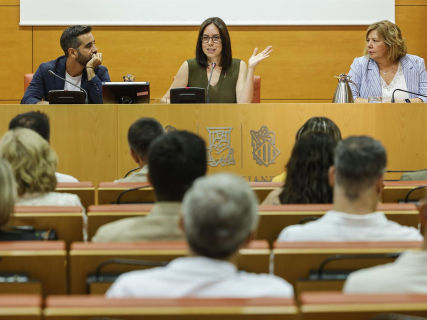

The general secretary of the PSPV and Minister of Science, Innovation and Universities, Diana Morant, has announced that the Government of Spain, the PSPV, and the socialist group in Les Corts will analyze "all the possibilities" to reverse the "censoring police project" in the Valencian classrooms that, as she has denounced, is incorporated into the law of Fiscal Measures, Administrative and Financial Management, and Organization of the Generalitat, known as the accompanying law to the 2026 budgets.
In statements to the media this Monday in Les Corts, she specified that the central Executive will give "a look" at this regulation. At the same time, she lamented that the Comunitat Valenciana has become "the laboratory of the most fascist and extremist policies in all of Spain" and warned that this situation "can spread to other autonomous communities."
Likewise, she pointed out that if the matter "ultimately goes to court," the PSPV "also makes itself available as an instrument to defend through unions or however all those teachers who may be, they indeed, persecuted and censored by this patriotic police that the Consell" of Juanfran Pérez Llorca has implemented. "Let the educational community be clear that we are going to be on their side until the end," she emphasized.
Regarding Compromís's decision to take the regulation to the Ombudsman and refer to a "resource of unconstitutionality," Morant specified that this "can be put by the Government of Spain," so she indicated that she sees it "well" that the coalition joins. She emphasized, in any case, that in Congress the PSOE has 120 deputies: "For this to go through, it will be the votes of the Socialist Party that will be definitive." Despite this, and "beyond those nuances," she valued the "alignment" between Compromís and the PSPV: "We are going for a Botànic III."
She defended that "we have to give certainty to the citizens that, just as the right has managed to come together here for the greatest setbacks and cuts of rights, the left in the Comunitat also presents a clear alternative in which, together, we are going to provoke a government of change to open a new stage, which is what the citizens desire overwhelmingly and has been seen in the streets."
A "decisive" political course for change
On the start of the political course, Morant has stated that it will be "decisive" because, at the end of it, "the citizens will finally have the ability to decide about their future" and has guaranteed "the certainty that they have the Socialist Party to produce the necessary change" in the Generalitat. She has suggested that "from today until election day, citizens must ask themselves a question, and that is whether their life is better today than when this legislature began with the PP and Vox, or in other words, if their life is better today than when Ximo Puig stopped being 'president' of the Generalitat."
The leader of the Valencian socialists has made a "disastrous" assessment of the legislature and the summer. "We are facing the worst government that the Comunitat has ever had," she has reiterated. In contrast, she has defended that next May the future 'president' of the Generalitat will not be "put in place" by either the leader of Vox, Santiago Abascal, or that of the PP, Alberto Núñez Feijóo, but by the Valencian electorate. "I want to give citizens the reassurance that we will indeed manage," she has assured.
Morant has promised that the PSPV will strengthen self-government and will do "politics differently," and has proclaimed: "Let everyone be clear that we are prepared, that we are very eager for this political course, to do the opposition that we have to do, to denounce what we have to denounce."
Health and the "privatizing model"
In reviewing the situation of the Comunitat in the areas of competence of the Consell, she started with Health, where she has criticized the return to the "privatizing model." "This summer has been dramatic," she has pointed out, to subsequently claim: "Neither hospitals nor health centers can stop in August, because diseases do not stop in August nor can we have hospitals working part-time."
In response, she has defended the need to strengthen staffing, "treat our professionals better and utilize our large facilities in our large hospitals." "Because, if not, we will fall into that false discourse that public hospitals do not have the capacity and that is why we have to contract with the private ones," she has warned. "There is an interested model that some are collecting money from people's health," she has criticized.
Education and the "censoring police"
In the educational field, Diana Morant has emphasized that "nothing has changed" regarding the end of last school year and has questioned that the solution from the Generalitat has been to distribute "like 10 fans or something like that" per center: "I laugh to avoid crying, that has been the proposal to fight against the problem of air conditioning."
Furthermore, she has focused on the "censoring police" that, she has denounced, is going to "be watching what each of our teachers does or says in the classrooms." She has reminded that "education is not just teaching mathematics, physics, chemistry to our children, it is also talking to them about that a boy and a girl are equal, that there are people who love differently, that there are people who feel differently from the gender they were born with."
She has also expressed "a lot of fear" at the possibility that "any talk or event that is held against transphobia, in favor of equality between men and women or in the fight against gender violence is considered ideological (...) and that in the end intimidates teachers because they could receive a complaint from any parent and that this makes our education go back to the black and white era."
Emergencies and housing, in the spotlight
Regarding emergencies, she has recalled that in the four most significant wildfires of the summer, the intervention of the Military Emergency Unit (UME) was necessary. "The first message, of course, whenever it is needed and we are required, the Government will be with its forces fighting the fire. But the question I ask myself, no longer as a minister, but as a candidate for the Presidency of the Generalitat, is whether we are exercising our self-government," she has raised.
She has asked: "Is it true that the Generalitat, that the fire brigade consortia no longer have the capacity to tackle fires like that of l'Albufera without having to mobilize the UME? Because the answer is very easy: the Emergency service in the Comunitat Valenciana in this legislature has been dismantled," she has denounced, criticizing that there are fire stations "that do not meet all shifts because they do not have enough personnel."
He also recalled that "we have suffered the dana and, by changing to --former president Carlos-- Mazón, this is not a 'Goodbye, fish'. We do not forget the dana and neither the episodes of fires and the incapacity of the Generalitat due to its cuts in emergency services to deal with these fires that, by the way, will now require a large reconstruction and preparation plan so that it does not happen again."
In terms of housing, Morant has maintained that the example that with Mazón and Llorca the Comunitat is "worse" is the scandal of Les Naus or the rise in the price of public protection housing to "market" levels. "In the end, they are making public protection housing for whom, for ministers with a minister's salary? For deputies with a deputy's salary? For mayors with a mayor's salary?" he has asked.