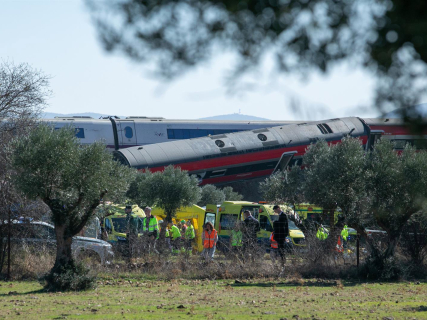

The rail tragedy of Urda (Toledo), which has left at least 68 dead, transformed this Wednesday the Madrid station of Puerta de Atocha Almudena Grandes into a place of uncertainty for the travelers who planned to travel to Andalusia and of anguish for the relatives who were trying to locate the passengers of the trains involved in the accident. The cancellations have forced dozens of people to look for transport alternatives, while the fear of traveling by train again mixed with the difficulties of finding a way to reach their destinations.
From early in the morning, the Renfe counters have concentrated passengers loaded with suitcases and backpacks who were waiting for information about their journeys. At 11:00 a.m., the lines already brought together dozens of affected people, many of whom had learned of the accident through social media before receiving communication from the railway company.
"It is a misfortune, there have been many dead, it even frightens me to see the images," Rafaela told Europa Press. The traveler, whose train had been canceled, explained that she later received a text message notifying her of the suspension of the service. Her concern went beyond the problems of completing the trip. "We are defenseless, we have no security. It is a shame that citizens have to travel this way", she lamented.
"I am not getting on the train for anything anymore"
The distrust toward rail transport was repeated among some of the passengers affected by the cancellations. María Teresa had gone to Atocha together with her husband to travel to Sevilla, where they planned to celebrate their 59 years of marriage, but the accident altered their plans and gave way to concern for safety.
"I am not getting on the train for anything anymore," the woman stated, visibly shaken. Her husband recalled a trip made the previous year to Galicia during which, according to his account, the train had suffered sudden movements. "The tracks are in dreadful shape," he assured.
Jose, a young man from Lérida who planned to continue on to Andalusia, also acknowledged that the accident had changed his perception of rail journeys. "I feel disappointment, that it happens twice in a year and on the same track", he explained, before admitting that he was reconsidering using the train again.
"You are going with the idea of putting your life at risk," added the traveler, who finally chose to look for a rental vehicle to complete the trip.
Two rooms for relatives and a psychological care device
While the passengers affected by the cancellations tried to reorganize their trips, relatives and people close to the occupants of the derailed trains went to Atocha to request information about their situation.
Among them were two Human Resources managers from a company who were looking for news of a colleague who was traveling on the crashed AVE. The worker was heading to Sevilla for professional reasons and, despite attempts to contact him, his colleagues still had not managed to locate him by 11.00 hours.
The station has set up two rooms intended for the relatives of the victims, to which teams of psychologists have moved to provide assistance. The device has also had the presence of railway workers, police officers, Samur personnel, Samur Social and Cruz Roja.
The arrival of relatives in search of information has coincided with the presence of travelers waiting for news about their trains or trying to find other means of transport to leave Madrid.
From 60 to 160 euros for a rental car in a matter of minutes
The interruption of railway connections with Andalucía has caused numerous passengers to resort to rental cars, buses, taxis and vehicles with driver in order to try to reach their destinations.
Jesús, ship captain, had arrived from Barcelona and planned to continue by train to Jerez de la Frontera. Upon learning of the cancellation, he decided to rent a vehicle for 60 euros, although other travelers who looked for the same alternative shortly after found considerably higher prices.
This was the case of Jose, who had traveled from Lérida and ended up paying 160 euros for a rental car. Both ended up sharing a van with Carmen, María and Paqui, three other passengers from Barcelona, with the intention of reaching Jerez during the night.
The difficulties in finding transport also affected Cristian, a resident citizen in the United States who was traveling with his sister and had tickets for an AVE scheduled for 15.30 hours. After the cancellation, both tried to rent a car, but could not do so because of the conditions relating to the driving license.
"Uber is the only alternative we have found so far", explained the traveler, who estimated an approximate cost of 120 euros per person to complete the journey.
Taxis of up to 600 euros to reach Andalusia
The prices of transport alternatives have become another concern for the affected travelers. Fernando, Jose and several friends who were traveling from Lérida to Málaga managed to rent a car for about 250 euros, although they had to wait for the vehicle to become available.
Despite the difficulties, some passengers downplayed the setbacks in light of the seriousness of the accident. "It makes no sense now to complain that they won't give me a car. They will give it when it's my turn. The misfortune is the accident", one of the travelers explained.
Demand has also shifted to the Atocha taxi stand, where a driver said that several colleagues had received requests to make trips to Andalusia. According to his estimates, a taxi ride south can reach 600 euros.
The same professional explained that during the morning he had made numerous trips to the Estación Sur de Autobuses, another of the options used by passengers to try to continue their journeys.
The accident heightens concern about railway safety
Beyond the cancellations, the testimonies collected in Atocha reflect the concern of some regular travelers about the incidents they say they have experienced in recent years.
Jesús, who uses the train frequently, recalled delays and problems recorded on the line over the last three years, especially in recent months. Among the episodes he recounted was an incident in which, according to his testimony, a carriage near his own began to burn.
Personal experiences and the shock from the accident have fueled the distrust of some passengers, although their statements reflect individual perceptions and do not allow conclusions to be drawn about the general state of the infrastructure.
The day thus left two simultaneous realities in Atocha, that of those waiting for news of relatives or companions who were traveling on the trains involved in the accident and that of the passengers who were trying to reorganize their journeys, in a station where cancellations, uncertainty and mourning have conditioned all activity.