The audio recordings of the Urda train accident reveal the order to the AVE to continue with "normal running" and the Iryo warning before the collision

Several media outlets report three key conversations from the Urda train accident. Their content supports a central point of Óscar Puente's explanation, but it does not resolve all the unknowns nor determine on its own the responsibilities

cronologia urda 1200x900 (1)

cronologia urda 1200x900 (1)

Add DEMÓCRATA to Google

Ask FREN

Published

Last updated

4 minutes

Most read

Elecciones 29N · Encuestas

La media de las encuestas

Media a 27 de octubre de 2026 · 15 institutos

  • PP31,0 %
  • PSOE27,3 %
  • Vox18,9 %
  • Sumar6,3 %
  • Podemos2,9 %
  • ERC2,3 %
010203040ene 2024jul 2024ene 2025jul 2025ene 2026jul 2026

Media del último estudio de cada instituto en 30 días y su evolución semanal desde el 23J. Partidos con al menos un 2 %.

Todas las encuestas

Elecciones generales del 29 de noviembre · Demócrata

The communications prior to the Urda railway accident provide new details about the instructions the train drivers received before the collision. According to an exclusive published by EL PAÍS, the Atocha controller authorized the AVE to resume circulation with «normal running». The Iryo driver also received that instruction, but contacted again afterward to warn that she was still stopped and could not get the train moving again.

The sequence includes three conversations: one between the control center and the driver of the AVE that was traveling behind, and two others with the woman driver of the Iryo. The sequence described places a decisive warning five minutes before the tragedy: the train occupying the track was still stopped.

The published content matches the core of the explanation offered during the afternoon by Óscar Puente: the control center allowed the AVE to resume normal running when, according to the minister, the circumstances required keeping it stopped or applying the corresponding restrictions.

The order to the AVE: the driver asks for confirmation

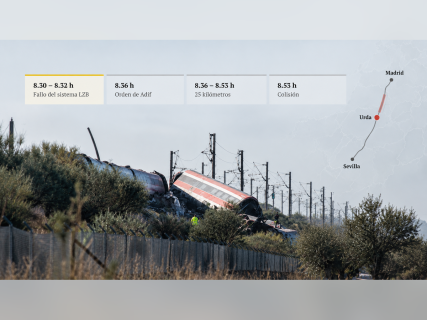
The most relevant passage of the transcript published by EL PAÍS corresponds to the communication with Renfe train 2080. In it, the recipient is identified and the time of 08:36 is recorded.

The controller tells the driver to disconnect and reconnect the LZB system and to resume movement. He then specifies that he must do so under the BSL and with «normal running».

The driver expressly asks whether the instruction is to continue with normal running. The controller's answer is affirmative.

The importance of this exchange lies in the fact that the condition for circulation is expressly confirmed in the transcribed conversation. It is not merely a generic reference to putting the train back in motion: the driver asks for clarification on how he should do it and receives an answer.

According to EL PAÍS's reconstruction, the AVE was about 25 kilometers behind the Iryo. The Government's interpretation is that the authorization violated the procedure applicable to that situation, which required restricted circulation, with a limit of 40 kilometers per hour.

The Iryo receives an order, but cannot get moving

The other two communications provide information about what was happening on the train in front.

According to the exclusive report, the Iryo driver also received authorization to resume normal operation. However, that instruction did not translate into effective movement of the train: seven minutes later she called again because she could not restart the train and remained stopped.

This distinction is fundamental for reconstructing the accident. Authorizing a train to continue does not prove that it has started moving or that the section it occupied has been cleared.

The second call from the Iryo communicated precisely that difference between the order received and the actual situation of the train. According to the published timeline, five minutes remained before the impact.

The alert that places the focus on the final minutes

EL PAÍS maintains that, despite that warning, the AVE was not told to brake. That point concentrates one of the main questions raised by the report: what action followed the communication that the Iryo remained stopped.

The conversations described make it possible to know the instructions and warnings recorded in those exchanges. To fully reconstruct what happened, it will be necessary to compare them with the full set of communications, the traffic records, and the data from the control systems.

The absence of a warning in the published fragments should not be confused, by itself, with an independent verification of all the actions carried out during those minutes. The claim that there was no warning to the AVE is part of the reconstruction offered by the newspaper.

What the audio recordings support in Puente's version

The published communications provide support for a specific claim by the minister: there was an order to resume AVE traffic normally.

Puente had placed that instruction at 08:36 and had pointed out that it was not corrected in time. He also maintained that the Iryo was occupying the track and that traffic should not have been authorized under those conditions.

The exclusive adds detail to that explanation: it describes the confirmation requested by the AVE driver and the subsequent call from the Iryo driver reporting that she could not start moving.

In addition, the published account introduces a relevant element in relation to the previous information that attributed to sources of Iryo the absence of authorization to proceed. According to EL PAÍS’s reconstruction, there was indeed an instruction to resume, although the train was unable to carry it out. The discrepancy will have to be clarified with the complete recordings and the context of each order.

What they do not yet allow us to conclude

The audios described do not by themselves explain the cause of the initial failure of the LZB, all the working conditions of the control center, or the complete functioning of the safety barriers during the incident.

Nor do they automatically turn the minister’s explanation into a definitive conclusion on technical, organizational, or political responsibilities. Supporting the existence of a specific order is different from determining all the causes that made the collision possible.

The novelty of the exclusive lies in documenting two essential moments: the authorization for the AVE to continue at normal speed and the later warning that the Iryo was still stopped. The pending question is to reconstruct what happened between those communications and the impact, and why it was not possible to prevent it.

More key points, information and questions with FREN

AI-GENERATED CONTENT

What is the usual procedure for train circulation when a train occupies the track on the Spanish railway network?

The usual procedure is to keep trains separated through the block system: if a train occupies a protected section, another cannot normally enter that same section until it is free. This does not mean stopping the entire line: other trains can run on different sections, as long as safety conditions are maintained.

The reference for the General Interest Railway Network is the Railway Traffic Regulations, approved by Royal Decree 664/2015. It is important to distinguish between normal occupation — a train moving or stopped before a signal — and immobilization due to a failure requiring assistance.

1. Separation through blocks

The track is organized into block sections, segments in which, under normal conditions, there cannot be more than one train simultaneously. Article 4.1.1.2 establishes two principles: trains traveling in the same direction must maintain a distance that prevents overtaking, and no train should be dispatched in the opposite direction on the same track from the adjacent station.

Therefore, one train can follow another along a line, but normally cannot occupy the same block section. The separation depends on the block system and existing installations, not on a universal time interval.

2. Holding the next train

In automatic block systems, to dispatch or allow a train to proceed, article 4.2.1.2 requires that the block section be free, that the exit route be set, and that the corresponding movement order be given. Additional conditions of the installed block type must also be met.

Until these conditions are met, the next train must obey the indications of signals or the cab signaling system. The presence of a train ahead does not authorize freely approaching it, even if it is visible.

3. Management from stations or centralized control

Traffic management corresponds to the infrastructure administrator, through the competent traffic manager. It can be exercised from stations or from the Centralized Traffic Control, which remotely governs signals, blocks, and other elements.

At stations, interlockings also intervene: systems that link signals and track devices to establish safe routes. They prevent authorizing incompatible routes and changing certain devices while the route remains authorized. Thus, traffic management is not only about ordering a train to wait.

4. Resumption when the section is free

Subsequent circulation can proceed when the applicable block, route, and movement authorization conditions are met. Protection equipment, such as ASFA, ERTMS, or LZB, complement signaling with various functions of information, supervision, or braking.

There is no single reduced speed simply because there is another train ahead. The driver must comply with the corresponding orders and limits. Signal overruns ordering a stop require the applicable regulatory procedure; they do not equate to a general authorization to enter an occupied track.

5. If the train is broken down and requests assistance

Article 3.6.3.1 provides that, upon receiving the request for assistance, the traffic manager will not dispatch trains on the affected track and will inform the corresponding responsible parties. The stopped train cannot resume movement without express authorization.

The control center coordinates the aid. Before sending assistance means, it is verified that the route to the indicated point is free of other trains. Approaching the immobilized train is done under specific instructions: it is an exceptional operation, different from ordinary circulation.

What powers does the Minister of Transport have in managing railway incidents according to current legislation?

The Minister of Transport has powers of political direction, regulation, and coordination of the state railway sector, but does not concentrate all decisions in the event of an incident. Legislation distinguishes between operational traffic management, safety supervision, emergency response, and technical investigation: leading the Ministry does not mean replacing those responsible for each function.

1. Political direction and regulatory authority

Article 4 of the Law 50/1997, of the Government establishes that ministers have "competence and responsibility in the specific sphere of their action." They are responsible for developing governmental action in their department, exercising regulatory authority, and other powers conferred by the rules.

In the face of railway incidents, this framework allows the minister to promote the response of their department and necessary reforms within their competencies. It does not allow altering what is established by law through a ministerial order nor automatically assuming technical functions attributed to another body.

2. Coordination and system monitoring

Article 5 of the Royal Decree 253/2024 assigns the Directorate General of the Railway Sector the coordination between the infrastructure administrator and operators, under supervision of the State Secretariat. It also tasks it with assisting the latter in evaluating effectiveness and technical control of the attached administrators.

Therefore, ministerial coordination is exercised through a structure of senior and managerial bodies, not necessarily through the minister's personal decisions on each incident. The regulation must be read with its subsequent amendments, including Royal Decree 690/2025.

3. Safety: differentiated supervision from operation

The Law 38/2015, of the railway sector, and Royal Decree 929/2020 establish a division of responsibilities. Safety supervision and inspection correspond to the State Railway Safety Agency; administrators and railway companies retain their management responsibilities.

The Ministry also has preventive functions: planning development, maintenance, and renewal of the network and preparing annual safety plans. These powers allow guiding improvements after an incident but do not make the minister the technical authority to authorize each circulation or decide each operational measure.

4. Emergencies and passenger assistance

The Railway Sector Law obliges passenger transport companies to establish properly coordinated emergency plans to provide assistance when there is a serious service disruption. The operational obligation thus falls on the companies, without excluding the Ministry's institutional coordination.

Additionally, Royal Decree 929/2020 expressly differentiates operational safety from civil protection and public safety, which have their own regulations. The direction of the railway sector should not be confused with general command over all emergency services.

5. Independent investigation and accountability

The minister cannot determine the conclusions of the technical investigation. Law 2/2024 creates an independent administrative authority, whose statute is approved by Royal Decree 141/2026, with transitional provisions regarding previous commissions. The purpose is to clarify causes and prevent new accidents, not to establish guilt: this separation is already stated in Royal Decree 623/2014.

Finally, the minister may appear to explain their management and must attend parliamentary control mechanisms. Articles 202 and 203 of the Congress Regulations regulate these appearances. Political responsibility and the obligation to inform do not equate to directing the independent investigation.

What legal requirements must be met to authorize the resumption of a train's movement after a technical incident?

In Spain, to resume movement after a technical incident, two conditions must be met: that the train can circulate safely and that the movement is permitted according to circulation rules. That the failure seems resolved is not enough if a restriction remains in force, the movement order has been invalidated, or assistance has been requested.

The following explanation refers to the General Interest Railway Network. Specific checks and authorizations depend on the failure, the stopping location, and the signaling system used.

1. Applicable regulations

The main operational reference is the Railway Traffic Regulations, approved by Royal Decree 664/2015, with its amendments. It regulates movement orders, failures, assistance, braking, and failures of safety installations.

The framework is completed by the Railway Sector Law and Royal Decree 929/2020, on operational safety and interoperability. Additionally, the royal decree approving the Regulations requires administrators and railway companies to incorporate procedures to apply it into their safety management systems.

2. Check technical conditions

Before restarting movement, the procedure corresponding to the anomaly must be applied. There is no single functional test required for any incident: verifications depend on the affected element and applicable safety procedures.

It is important to distinguish between recovering normal circulation and continuing under special conditions. For example, a signaling failure may require an overrun authorization; a faulty level crossing requires specific protection measures. A circulation authorization alone does not prove that a material failure is repaired.

3. Have a valid authorization
  • Invalidated movement order. According to article 1.5.1.9, if a stopped train cannot depart immediately after receiving it, the order is invalidated. If it has not passed the departure signal or the corresponding block, it must receive a new order; if it has passed them, resumption must be notified or a reversal ordered.
  • Assistance requested. Article 3.6.3.1 states: "the Driver may not resume movement until expressly authorized by one of the Traffic Managers of the adjacent stations or the CTC." This prevents unilateral departure even if the failure disappears.
  • Authorized reversal. If the cause disappears and forward continuation is intended, article 3.6.2.4 requires canceling the reversal and authorizing resumption through the regulatory exchange of telephone calls and the planned checks.
4. Respect restrictions and communications

The driver must comply with notified conditions and signals. According to article 1.5.1.10, if several speed limits apply, the most restrictive must be observed. There is no universal reduced speed for any resumption.

Communications must take the form required for each case, including regulatory telephone calls. An informal conversation should not be confused with the specific required authorization. For example, in the case of a faulty level crossing, article 5.2.6.2 requires stopping before crossing and receiving authorization with crossing conditions.

5. Distribution of responsibilities

The driver executes actions and complies with movement conditions; the traffic manager manages authorizations and traffic protection; and the railway company applies its safety procedures over train operation. The decision requires coordinating technical fitness with operational authorization: neither substitutes the other.

Play

Test your knowledge with FREN!

How much do you know about this topic? Answer the following 3 questions.

What order did the AVE receive before the Urda railway accident?

Question 1 of 3

What did the Iryo driver do after receiving the instruction to resume movement?

Question 2 of 3

According to the Government's interpretation, what procedure should have been applied to the AVE in that situation?

Question 3 of 3