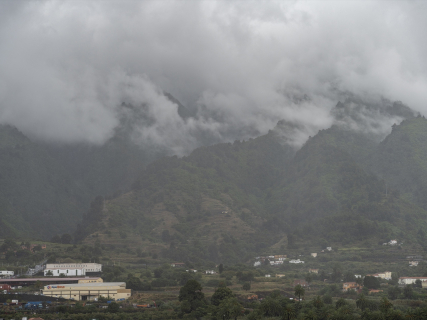
Where there will be clouds and how much they will hinder the observation of today's eclipse

AEMET forecasts cloudy or overcast skies in the Cantabrian area, northern Galicia, the Pyrenees, and northern Canary Islands during the total solar eclipse on this August 12, while conditions will be more favorable in much of the interior of the peninsula.

6 minutes

EuropaPress 5253763 nubes bajas borrasca oscar junio 2023 palma santa cruz tenerife canarias

EuropaPress 5253763 nubes bajas borrasca oscar junio 2023 palma santa cruz tenerife canarias

Add DEMÓCRATA to Google

Ask FREN

Published

Last updated

6 minutes

Most read

The weather will be decisive to contemplate the solar eclipse of today, August 12, 2026. The State Meteorological Agency (AEMET) predicts that by the end of the afternoon, coinciding with the phenomenon, mostly clear or slightly cloudy skies will prevail in much of Spain, although there are several areas where cloud cover may seriously hinder observation.

The most complicated situation will be concentrated in the north of Galicia and the Cantabrian area, precisely territories included in the path of totality. They are joined by the Pyrenees and the northern slopes of the Canary Islands, while during the afternoon clouds may also develop in mountainous areas of the north and the eastern peninsula.

The position of the sun adds an additional difficulty. Spain is at the end of the path of totality and the phenomenon will occur very close to sunset, so it will not be enough to have a large part of the sky clear: it will be essential to have visibility towards the west and for the clouds not to cover precisely that low part of the horizon.

North of Galicia and Cantabrian, the areas with the highest risk from clouds

The AEMET special forecast for the eclipse places one of the main meteorological problems in the north of Galicia and the regions of the Cantabrian area. By the end of the afternoon, cloudy or overcast skies with the presence of low cloud cover are expected, a situation that may directly compromise the possibility of contemplating the phenomenon.

This especially affects areas of Galicia, Asturias, Cantabria, and the Basque Country. The problem is relevant because a part of these territories is within the path of totality of the eclipse, so they have a privileged astronomical position but may encounter much less favorable weather conditions.

Low cloud cover is especially problematic on this occasion because the sun will be near the horizon. A compact layer located to the west may be enough to hide the sun during the moment of totality, even if there are clearings in other parts of the sky.

Pyrenees and mountainous areas, pending the evolving clouds

The Pyrenees constitute another of the areas where the weather forecast requires heightened attention. In addition to the expected cloud cover, there is the possibility that during the afternoon, evolving clouds will grow in mountainous areas, with showers or storms in some sectors.

AEMET contemplates the possibility of convective phenomena in points of the eastern Pyrenees, the Teruel Iberian range, and the east of Castilla-La Mancha. Clouds can also develop in other mountainous systems of the eastern third, so the specific situation may vary appreciably between relatively close localities.

This does not mean that the eclipse will be impossible to observe in all these areas. Evolving clouds and storms have a more localized character than an extensive layer of low cloudiness, but they increase the uncertainty just during the hours prior to the maximum of the eclipse.

Where there will be better conditions to see the eclipse

Outside the most affected areas, AEMET's forecast is considerably more favorable. In much of the territory, mostly clear or slightly cloudy skies will prevail, which will allow for the observation of the eclipse as long as there is a suitable horizon and no local clouds appear during the last hours of the afternoon.

The areas of the interior of the peninsula far from the Cantabrian cloudiness start with better weather conditions. This is especially important in sectors of Castilla y León, the Ebro valley, and other interior areas crossed by the path of totality, where the eclipse can reach its most spectacular phase.

However, a forecast of mostly clear skies does not guarantee perfect observation by itself. The National Geographic Institute (IGN) reminds that Spain is at the end of the path of totality, so the sun will be rapidly descending towards the western horizon when the maximum occurs.

The added problem: the sun will be very low on the horizon

The height of the sun will be one of the keys to the total eclipse of August 12, 2026, in Spain. In A Coruña, for example, the maximum will occur approximately at 20:28 hours and during totality the sun will be about 12 degrees high above the horizon.

Further east it will be even lower. In Burgos, the maximum will occur around 20:29 hours, with the sun at about 8 degrees high. This requires finding a place with a clear view to the west, without mountains, buildings, trees, or other obstacles that may block it.

The extreme case is found in the Balearic Islands. In Palma, the eclipse will begin around 19:38 hours and will reach its maximum around 20:32 hours, when the sun will be just 2 degrees above the horizon. Even with a practically clear sky, any obstacle or bank of low clouds to the west can prevent viewing the most important phase.

Balearic Islands: more important than ever to have a clear horizon

The situation of the Balearic Islands during the eclipse requires precisely differentiating between general cloudiness and real visibility. The islands are at the end of the shadow's path across Spain and the maximum will occur when the sun is practically setting.

This means that a relatively small amount of cloudiness can be decisive if it concentrates near the western horizon. For the same reason, a mountain, building, or wooded area located to the west can be as problematic as the clouds themselves.

Those who want to observe the eclipse from the Balearic Islands should look for a location with the greatest possible opening towards the west. In Palma, the barely 2 degrees of height of the sun during the maximum leaves very little margin to overcome obstacles located in that direction.

Canary Islands: clouds in the north and haze in the eastern islands

In the Canary Islands, the forecast presents important differences depending on the island and the slope. AEMET forecasts the presence of low cloudiness especially in the northern slopes, where the clouds may hinder the observation of the eclipse.

In addition, there is haze expected in Lanzarote and Fuerteventura, which can reduce atmospheric transparency. Haze does not necessarily have the same effect as a compact layer of clouds, but it can worsen visibility and reduce the sharpness with which the phenomenon is viewed.

Therefore, it is also not advisable to apply a single forecast to the entire archipelago. The orientation, the slope, and the local cloudiness will be decisive to know to what extent the eclipse can be observed from each point.

Risk map: where clouds may hinder the eclipse

The weather forecast allows dividing Spain into large areas according to the risk that clouds present for observation. This is not a guarantee that the eclipse will be seen or not seen in each locality, as cloudiness can evolve during the hours prior, but it allows identifying the areas that start with better and worse conditions.

The Cantabrian areas and the north of Galicia concentrate the most unfavorable scenario due to the expected presence of low cloudiness. In the interior, on the contrary, more favorable conditions prevail, although it will be necessary to monitor the evolving clouds in mountainous areas.

TABLE: Where there will be clouds during the eclipse on August 12, 2026

Zone Forecast Difficulty in observing the eclipse
North of Galicia Cloudy or overcast skies, with low cloudiness High
Asturias and Cantabrian area Low cloudiness and cloudy or overcast skies High
Cantabria Cloudiness in the Cantabrian area High
Basque Country Risk of cloudiness, especially on the Cantabrian slope Medium/high
Pyrenees Cloudiness and possibility of evolving clouds Medium/high
Interior of Castilla y León Generally more favorable conditions Low, except for local cloudiness
Ebro Valley Generally favorable conditions, with attention to mountainous areas Low/medium
Turolense Iberian Possible evolving clouds, showers or storms Medium
East of Castilla-La Mancha Possible evolving clouds and storms Medium
Balearic Islands The horizon will be decisive due to the low height of the sun Very dependent on the western horizon
North of the Canary Islands Low cloudiness High in affected areas
Lanzarote and Fuerteventura Presence of haze Medium

The forecast may change until the last hours

Although the AEMET forecast allows delimiting the areas with greater risk of clouds during the eclipse, the exact situation may evolve during the afternoon. This is especially important with evolving clouds and storms, whose distribution can be very irregular.

Therefore, a person located in a province with generally favorable forecasts may find a cloud right on the horizon, while in an initially more complicated area, clearings may open coinciding with totality. The municipal prediction and the observation of the horizon during the previous hours will be the most useful references.

In any case, the weather conditions do not modify the safety recommendations. During the partial phases of the eclipse one should not look directly at the sun without certified eye protection for solar observation, even if there are clouds, because these do not constitute a safe filter for solar radiation.

More key points, information and questions with FREN

AI-GENERATED CONTENT

What legal requirements or permits are needed to organize a public astronomical observation event in Spain?

To organize a public astronomical observation event in Spain (for example, an open meetup announced on social media, with telescopes, in a square or park), municipal permits such as public space occupation are usually required and, if applicable, a license or responsible declaration for recreational activity, in addition to civil liability insurance and, if necessary, a basic safety/self-protection plan. The specific details depend on the autonomous community and the city council, because the competence in shows and recreational activities is regional and local. Additionally, there are state regulations on citizen security, self-protection, and noise. The safest approach is always to treat it as an organized “public event,” even if it is free and non-profit.

Basic state framework

At the state level, the General Regulation of Police of Public Shows and Recreational Activities, approved by Royal Decree 2816/1982 (Show Regulation), remains a reference, although some of its provisions have been repealed or replaced by later regulations and regional laws.

Regarding citizen security and public order, the key regulation is the Organic Law 4/2015, on the protection of citizen security (LO 4/2015). It regulates, among other aspects, the actions of the Security Forces and Corps in meetings and gatherings in public spaces, as well as the control of activities that may affect public tranquility.

For events with certain attendance or specific risks, the Basic Self-Protection Standard, approved by Royal Decree 393/2007 (RD 393/2007), also applies, which requires having a self-protection plan when the activity is included in its annex I or when required by authorities. The decree itself foresees that, for temporary activities in already authorized centers or spaces, the organizer of the temporary activity must prepare a complementary self-protection plan attached to the license.

Regarding noise, the basic framework is set by Law 37/2003, on Noise, and its development regulations, such as Royal Decree 1513/2005 (RD 1513/2005) and Royal Decree 1367/2007 (RD 1367/2007), on acoustic zoning, quality objectives, and acoustic emissions. Although astronomical observation is usually silent, if sound equipment is used or many people gather, the city council may apply these limits.

Regional regulations on shows and noise

The detailed regulation of public shows and recreational activities is regional. Some significant examples of framework laws are:

  • Community of Madrid: Law 17/1997, on Public Shows and Recreational Activities, amended by Law 4/2013 (Law 4/2013 Madrid) and other reforms; and the regional catalog of shows and activities approved by Decree 184/1998, amended by Decree 40/2019 (Madrid catalog).
  • Comunitat Valenciana: Law 14/2010, on public shows, recreational activities, and public establishments, amended by Law 6/2018 (Law 6/2018 CV).
  • Andalusia: Catalog of Public Shows and Recreational Activities and schedule regime approved by Decree 155/2018 (Andalusia catalog).

Regarding acoustic pollution, besides the state framework, there are specific regional laws and regulations, for example:

  • Catalonia: Law 16/2002 on protection against acoustic pollution, amended by Law 4/2025 (Law 4/2025 Catalonia).
  • Community of Madrid: Decree 55/2012 on protection against acoustic pollution (Noise Decree Madrid).
  • Comunitat Valenciana: Law 7/2002 on protection against acoustic pollution (Law 7/2002 CV).
  • Andalusia: Regulation for the preservation of acoustic quality approved by Decree 50/2025 (Decree 50/2025 Andalusia).

These regulations combine with municipal noise and coexistence ordinances, which are very relevant if the event is at night and in an urban area.

Common permits and requirements

Generally, for a public astronomical observation event, the following are required or may be required:

  • Municipal authorization for public space occupation (square, street, urban beach, etc.), indicating date, schedule, expected capacity, setup of telescopes/tents, and person responsible for the activity.
  • Communication or license for recreational activity if the event fits into the regional categories of show or occasional or extraordinary recreational activity. In many communities, this is done via a responsible declaration.
  • Civil liability insurance covering personal and material damages to third parties during the event, especially if heavy equipment is handled or significant attendance is expected.
  • Basic safety/self-protection plan, proportional to the event size: entry and exit points, capacity control, minimum safety lighting, first aid kit, and emergency contact. For larger events or those included in annex I of RD 393/2007, a formal self-protection plan may be required.
  • Respect for the protection of minors: schedule adjustments, alcohol consumption in the space, and, if applicable, application of regional restrictions if it is assimilated to a public show attended by minors.
  • Compliance with noise limits: if speakers or music are used, it must comply with ordinances and acoustic quality objectives derived from the Noise Law and regional regulations.

Natural spaces and public forests

If the observation is carried out in natural parks, public forests, or protected spaces, a specific authorization or communication from the managing body of the space (competent regional ministry or local entity) is usually required, under the regulations of protected natural spaces and, if applicable, the rules for night environment protection (such as those developed by Law 6/2001 of Catalonia, partially amended by Law 3/2023, cited in Law 3/2023 Catalonia).

In summary, although details vary, it should always be foreseen: municipal permit for space occupation, civil liability coverage, respect for noise and schedules, and, in protected spaces, additional environmental authorization. Early contact with the city council and, if applicable, with the administration of the natural space is essential to adjust the event to the specific regulations of each place.

What differences are there between organizing this type of event in a city square and in a protected natural park? What specific obligations would I have if the astronomical observation event were mainly aimed at minors and educational centers? How do city councils usually regulate the schedules and noise of outdoor scientific or cultural nighttime activities?

What are the competencies and functions of the State Meteorological Agency (AEMET) in forecasting astronomical phenomena?

The State Meteorological Agency (AEMET) has legal competencies focused on the observation, prediction, and communication of meteorological and climatic phenomena, not astronomical ones. Therefore, its role in forecasting astronomical phenomena (eclipses, comets, meteor showers, planetary alignments, etc.) is essentially indirect and complementary. AEMET may intervene when these phenomena have relevance to the atmosphere, incident solar radiation, or citizen safety, but it is not the body responsible for calculating or setting astronomical ephemerides. That task falls to specialized astronomical and geographic centers, such as the National Astronomical Observatory (IGN) or other scientific institutes.

General competence framework of AEMET

From a legal and administrative point of view, AEMET is a state agency attached to the General State Administration, whose mission is articulated around several axes:

  • Meteorological monitoring and prediction: continuous monitoring of the atmosphere, preparation of weather forecasts and warnings for adverse meteorological phenomena (heavy rain, wind, snow, storms, heat or cold waves, etc.).
  • Climate services: statistical analysis of the climate, preparation of climate change scenarios, and provision of climate information to administrations and economic sectors.
  • Support for civil protection and security: issuance of official warnings that serve as a basis for civil protection decisions, air and maritime transport, emergency management, among others.
  • Meteorological information to the public: mass dissemination of forecasts, warnings, and meteorological data through websites, apps, and media.

In this competence statute, the reference is always the Earth's atmosphere and its variables (wind, temperature, precipitation, radiation, etc.), not the movement of celestial bodies or the planning of astronomical observations.

Relationship between astronomical phenomena and AEMET functions

Although AEMET does not have the function of announcing or calculating astronomical phenomena, it can intervene in collateral aspects when these intersect with its scope of action:

  • Sky observation conditions: for events like solar eclipses or meteor showers, AEMET's contribution focuses on informing about the forecasted cloudiness, visibility, and atmospheric conditions (fog, haze, pollution, etc.) that may favor or prevent observation.
  • Solar radiation and safety in eclipses: in solar eclipses, the combination of astronomical data (from other bodies) with information on radiation and cloudiness can be relevant to disseminate recommendations on safe sun exposure, approximate duration of the penumbra, rapid changes in brightness and temperature, etc.
  • Associated atmospheric effects: some astronomical phenomena can produce very slight but measurable changes in atmospheric parameters (radiation, temperature, local circulation). In those cases, AEMET could analyze them within its meteorological and climatological research activity.
  • Support for civil protection: in events with large crowds to observe astronomical phenomena (for example, a total eclipse visible in part of Spain), AEMET can provide detailed weather forecasts and warnings of adverse phenomena to facilitate the planning of security and emergency devices.

What AEMET does not do in the astronomical field

It is important to clearly distinguish which functions do not correspond to AEMET in this area, as they help understand the competence limits:

  • It does not calculate orbits or ephemerides of planets, comets, asteroids, or satellites.
  • It does not set the official dates and times of eclipses, conjunctions, oppositions, or other astronomical phenomena; those data come from specialized astronomical and geodetic institutions.
  • It does not issue official astronomical warnings as such (for example, alerts for asteroid passages), since these are not part of the meteorological and civil protection warning system it manages.
  • It does not have the mission of astronomical outreach in the strict sense, although it may occasionally disseminate related contextual information when there is strong social interest and it relates to atmospheric conditions.

Institutional coordination and use of information

In practice, when a major astronomical phenomenon visible from Spain approaches, a combination of roles usually occurs:

  • Astronomical organizations detail schedules, visibility zones, magnitudes, and observation recommendations.
  • AEMET provides the fine meteorological forecast (cloudiness, visibility, possible storms or fog) that will condition the real observation experience and the safety of large crowds.
  • Civil protection and security authorities use both pieces of information to size and organize devices.

In summary, AEMET is a key actor in everything related to the atmosphere and weather, even when these intersect with astronomical events, but its competence stops at the meteorological and climatological boundary. The main responsibility for forecasting and characterizing the astronomical phenomena themselves corresponds to other specialized scientific bodies.

Which Spanish organization is exactly responsible for calculating and disseminating the ephemerides of eclipses and other astronomical phenomena? How do AEMET and civil protection services coordinate when there is a major astronomical event visible from Spain? Has there been any specific meteorological safety protocol in Spain for recent solar eclipse observations?

What differences are there between Spanish regulations and those of other European countries regarding the protection of astronomical observation?

Spain has a relatively unique framework in Europe because it combines general rules on air quality and outdoor lighting with a specific law to protect the astronomical quality of the Canary Islands observatories. In other European countries, the consulted documentation does not provide clear references to equivalent state laws focused on astronomical observation; night sky protection appears rather integrated into biodiversity policies, energy efficiency, or European projects. Additionally, in Spain, the autonomous communities have begun to approve their own light pollution regulations explicitly linked to night sky protection, which reinforces this multi-level approach. At the EU level, the major frameworks are environmental (biodiversity, zero pollution), and not specific to astronomy, although they do include light pollution as an emerging problem.

Spanish state framework

In Spain, the most unique regulation is Law 31/1988, on the Protection of the Astronomical Quality of the Observatories of the Canary Islands Astrophysics Institute, which requires limiting outdoor lighting, radio emissions, and polluting activities in La Palma and Tenerife to preserve the sky quality of the IAC observatories. The law establishes easements on lighting, radio frequency, and atmospheric pollution and grants the Canary Islands Astrophysics Institute a mandatory role in lighting, broadcasting, and activities licenses above 1,500 m altitude, as stated in the legal text published in the BOE (Law 31/1988).

This law is developed through Royal Decree 243/1992, which approves its regulation and defines in detail what is considered outdoor lighting, the territorial scope of protection, and technical requirements such as avoiding light emission above the horizontal plane, limiting radiation below 440 nm, or requiring certain lamp technologies and filters (Regulation of Law 31/1988). In 2017, Royal Decree 580/2017 updates the regulation to incorporate new technologies such as LEDs and strengthens the role of the Technical Office for the Protection of the Sky Quality of the IAC (RD 580/2017).

In parallel, Law 34/2007, on air quality and atmospheric protection sets the basic framework for combating atmospheric pollution in Spain, with a broad approach less focused on astronomy and more on health and environment (Law 34/2007). Complementarily, Royal Decree 1890/2008 approves the Energy Efficiency Regulation in outdoor lighting installations, where light pollution is explicitly recognized as a negative impact and general technical design prescriptions for lighting are set, which can then be tightened in areas with observatories (RD 1890/2008).

More recently, Order TED/388/2023 regulates aid to renew municipal outdoor lighting, incorporating as an objective not only energy efficiency but also the introduction of “lighting systems that protect the night sky against light pollution,” and referring to the future outdoor lighting regulation (Order TED/388/2023).

Spain has also promoted the international debate on “dark and quiet skies” alongside the United Nations, as reflected in the Agreement published in the BOE to organize the DarkSky meeting in La Palma, focused on protecting astronomical sites against light and radio pollution (Agreement on Dark and Quiet Skies).

Role of autonomous communities and local governments

Besides the state level, several communities have developed their own light pollution regulations with direct impacts on astronomical observation. Andalusia has approved a new regulation for protection against light pollution, which declares the Calar Alto and Sierra Nevada observatories as reference points and defines zones of maximum light protection around them, with specific lighting conditions to guarantee astronomical research (Andalusian regulation).

Catalonia, for its part, has protected large areas of the western Pyrenees with “the highest degree of protection against light pollution,” moving towards the largest protected area against this type of pollution in Europe (Western Pyrenees), and promotes Starlight certification in spaces such as Montsec or Aigüestortes (Parc Natural dels Ports). At the municipal level, cities like Zaragoza have incorporated light pollution reduction in major public lighting renewal projects, emphasizing that it threatens both ecosystems and night sky observation (Reluzes project in Zaragoza).

European approach and comparison with other countries

The reviewed documentation does not show direct references to specific state laws on “dark sky” in France, Italy, Portugal, Germany, or the United Kingdom comparable to Spain’s Law 31/1988. What is identified is a European framework where light pollution is mainly addressed as a biodiversity and health problem, not astronomy. The LIFE Natura@Night project, promoted by the European Commission, works in Madeira, Azores, and the Canary Islands to map light pollution, redesign public lighting (for example, with low-blue-content LEDs), and comply with directives such as Habitats, Birds, and the 2030 Biodiversity Strategy (LIFE Natura@Night).

From the socio-economic use perspective, both in Spain and other countries, the rise of astrotourism and sky quality certifications (Starlight, DarkSky) is pushing more demanding private and local standards on lighting. An international example is the DarkSky International program for resorts, which requires responsible outdoor lighting and dark skies as certification criteria (DarkSky certification for resorts). In Spain, places like Teide, La Palma, or Gredos are promoted as some of the best skies in Europe, reinforcing the connection between regulatory protection and tourist appeal (Astrotourism according to Demócrata).

In summary, the main difference is that Spain has approved an explicitly astronomy-oriented regulatory block (the Canary Islands case) and develops, together with the autonomous communities, specific light pollution regulations that mention observatories and night skies. In other European states, based on the consulted texts, the protection of astronomical observation is more diffuse within general environmental regulations, LIFE projects, and certification figures, with less visibility of national laws specifically dedicated to the night sky.

What specific technical obligations does the Regulation of Law 31/1988 impose on outdoor lighting in La Palma and Tenerife? Which Spanish autonomous communities, besides Andalusia and Catalonia, are processing their own regulations against light pollution? How is Spain coordinating with the European Union in initiatives like LIFE Natura@Night and the Zero Pollution Action Plan?

Play

Test your knowledge with FREN!

How much do you know about this topic? Answer the following 3 questions.

What factor makes observing the eclipse especially difficult in the Balearic Islands?

Question 1 of 3

What meteorological phenomenon can reduce the visibility of the eclipse in Lanzarote and Fuerteventura?

Question 2 of 3

What does AEMET recommend for observing the eclipse in areas where the sun will be very low above the horizon?

Question 3 of 3

Hola, soy Fren. ¿Cómo te ayudo?