For many years now, the press, on a global scale, has been dragging the mortgage it signed by succumbing to some technoligarchies that promised practically unlimited access to millions of readers in exchange for handing over control over how, when, and to whom their content reached. 2026 will be remembered as the year when the media lost large volumes of traffic due to the combination of changes in Google’s algorithms, the loss of visibility in Discover, and the emergence of an artificial intelligence that feeds on journalistic content and barely returns readers to those who produce it.
The press, far from going into defensive mode and unceremoniously expelling those who are ruining it, continues to accept the rules imposed on it without even questioning them, with the only compensation, in some cases, being meager payments that must be renegotiated each year in exchange for continuing to feed its content to the same platforms that take away its readers, thus consolidating a model of dependence in which the media bear the costs of producing information while others control its distribution and a good part of the profits it generates.
The latest capitulation has come almost imperceptibly. Google has begun to replace the original addresses of news shared from some of its services with "share.google" links, thereby becoming an intermediary even for recommendations between readers: it records access data and replaces the name of the media with its own. After controlling a good part of the traffic from search engines, conditioning distribution with Discover, and using journalistic content to feed its artificial intelligence, Google is now entering one of the last spaces that escaped its control, that of personal recommendations, and the media, once again, accept it without protest.
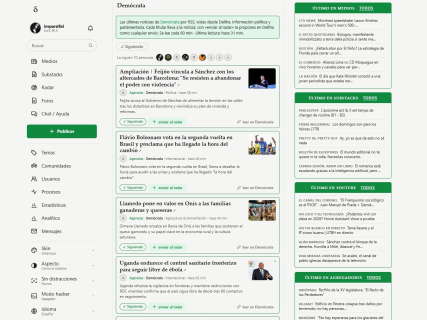
What would happen if a digital space were created that was banned from Google, from artificial intelligences, and from any other parasite of content, a place where press readers shared the links they consider relevant and thus drove traffic to the media? To that question answers deltha.eu, an anti-algorithm aggregator that we have just launched to demonstrate that it is possible to stand up to the big tech platforms without giving up the advantages of the internet —discovering new publications, sharing information, collectively deciding what is worth reading— and to return to the media something they should never have lost: direct contact with their readers.
Deltha is a European platform, created in Spain and launched by Jot Down, whose goal is to connect readers with media, independent publications, newsletters, and creators specialized in different areas, in such a way that it facilitates the discovery of content from different countries and in different languages without replacing the media or turning journalism into answers that eliminate the need to visit them. It offers different interfaces to navigate information and customization options based on the anti-algorithm manifesto, whose postulates demand to return to the reader the ability to decide what information they want to receive. A medium like Demócrata, specialized in parliamentary and legislative information, which lives off readers who know what they are looking for and not from the lottery of an algorithm, is exactly the type of publication for which such a space makes sense, and that is why it is already among those that can be read on the platform.
The figures that justify the urgency are not provided by me. The report Journalism, Media, and Technology Trends and Predictions 2026 from the Reuters Institute at the University of Oxford states that visits to media from organic Google search fell by 33% between November 2024 and November 2025, that traffic from Discover decreased by 21% in the same period, and that, according to the interviewed executives, search engines could cut another 43% in three years. The artificial intelligence does not compensate for any of that: although some assistants include links to the sources they draw from, Google sends media about five hundred times more visits through its search engine than ChatGPT, a gap that reaches one thousand three hundred times if Discover is counted. For those funded by advertising, every lost traffic point is a lost revenue point, and behind every point are entire newsrooms in the air.
The issue is not just economic. While producing quality content is becoming increasingly expensive, its distribution depends on companies whose algorithms decide which media millions of people see and which become almost invisible, turning the issue into a problem of competition and informational pluralism that European authorities have already incorporated into the regulatory debate, including the use of third-party content to feed AI-based services. Deltha does not intend to replace that debate or the own channels of each medium, but rather to complement them and reverse a trend in which the internet has stopped fulfilling one of its essential functions: being the channel that connects those who generate content with those who seek it.