Digital Power launches the verification of profiles: politicians, associations, and economic leaders can now claim their profile and analyze their own activity on social media.

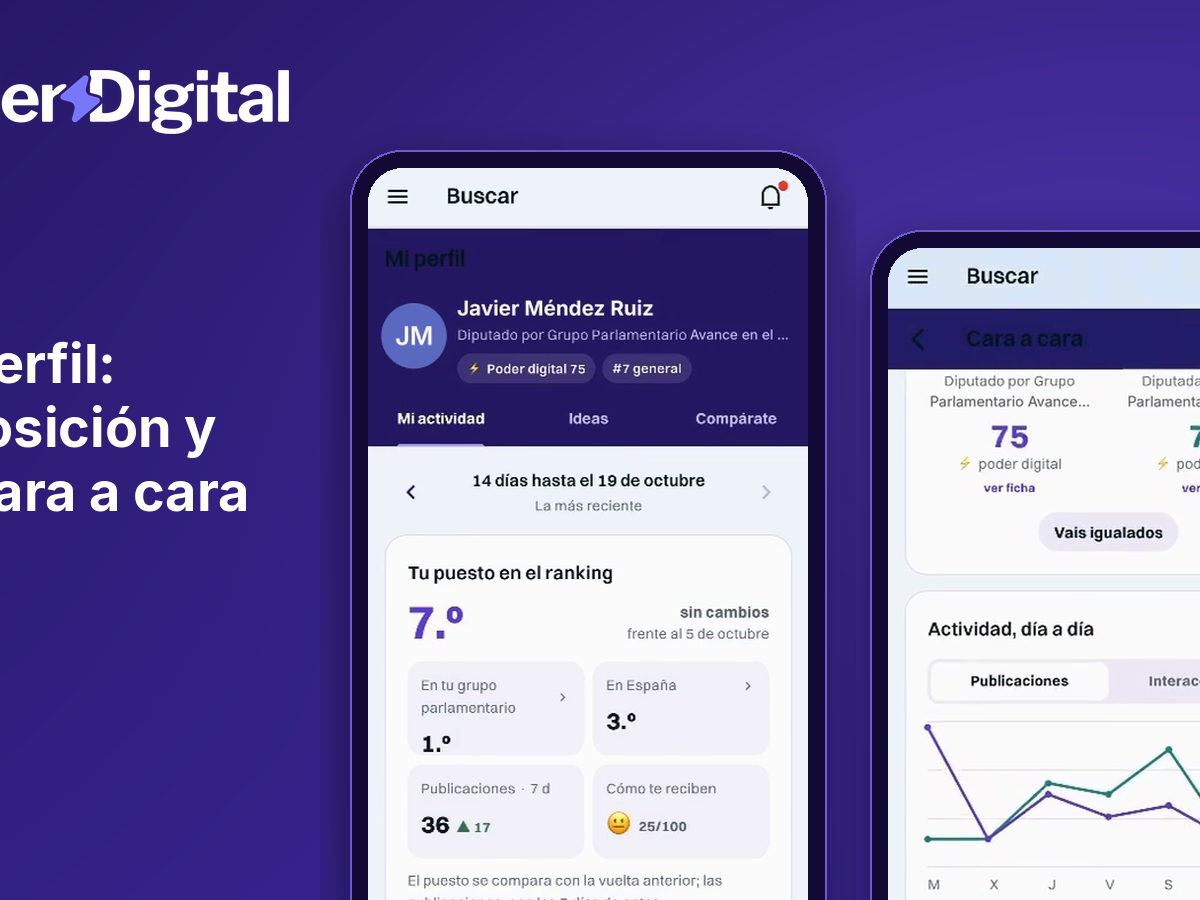
Verified profiles access "My profile," a private area with their position in the ranking, how the audience receives them, which topics work for them, and a face-to-face with any other profile. The update, developed by the public affairs consultancy Vinces, is already available in the app and on Demócrata.

press 1 verifica

press 1 verifica

Add DEMÓCRATA to Google

Ask FREN

Published

Last updated

1 minute

Most read

Elecciones 29N · Encuestas

La media de las encuestas

Media a 21 de octubre de 2026 · 15 institutos

  • PP31,6 %
  • PSOE26,9 %
  • Vox18,7 %
  • Sumar6,3 %
  • Podemos3,1 %
  • ERC2,2 %
010203040ene 2024jul 2024ene 2025jul 2025ene 2026jul 2026

Media del último estudio de cada instituto en 30 días y su evolución semanal desde el 23J. Partidos con al menos un 2 %.

Todas las encuestas

Elecciones generales del 29 de noviembre · Demócrata

A little over a month before the elections on the 29N, the more than 5,000 public officials, associations, and economic and social leaders that appear in Poder Digital stop being just observed. From today, they can be observed. The application incorporates profile verification: any person or organization included in the ranking can claim their profile as their own and, once validated, access a private area with the analysis of their digital presence.

Poder Digital is the application developed by Vinces, a public affairs consultancy specialized in technology and data, which collects and organizes public information about the digital activity of political representatives and displays it through transparent and objective rankings. The application that you can consult in DEMÓCRATA measures the real capacity, the digital power, of a political actor to connect with voters and lead the public conversation on X, Instagram, LinkedIn, and TikTok, expressed on a scale from 0 to 100.

What changes

Until now, each profile only saw its position in the ranking. With verification, it sees what is behind it: how that position evolves, which lever of the RIO formula (regularity, interactions, originality) supports it and which holds it back, how the audience receives its messages, and what topics it talks about. It also receives concrete recommendations to rise in the ranking and can compare itself with any other profile, network by network.
press 2 miperfil

The public profile incorporates a verified badge and its holder can review and update part of the information.

How to verify the profile

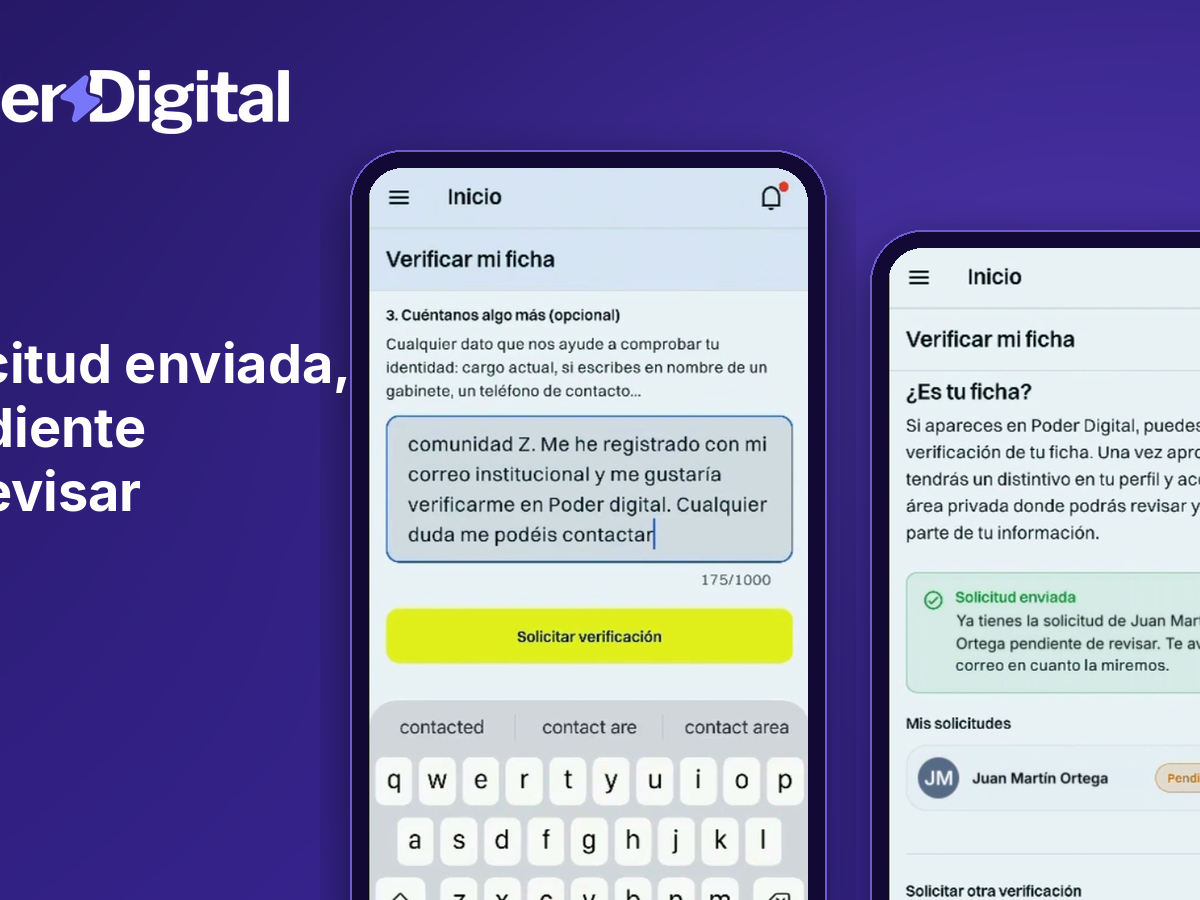
In the app menu or in DEMÓCRATA, the option "Verify my profile" guides the process in six steps: confirm the email (the institutional one speeds up validation), choose the profile, provide data that allows verifying the identity, and send the request. The Poder Digital team notifies by email once validated. The offices that manage multiple profiles can verify them all from the same screen.
press 3 solicitud

The novelty responds to a real demand: since the launch, more than fifty entities have contacted the public affairs consultancy and DEMÓCRATA to correct or complete their profile. The verification turns that interest into a direct channel.

More key points, information and questions with FREN

AI-GENERATED CONTENT

At what parliamentary stage are the regulatory proposals on digital transparency of politicians in Spain?

As of October 21, 2026, the main state proposals on transparency of contacts, agendas, and legislative footprint have expired with the dissolution of the Cortes on October 6; they are no longer pending approval in committee. Furthermore, no autonomous state initiative exclusively dedicated to the transparency of politicians' social media accounts has been located. It is important to distinguish this area from the digital publication of meetings, interests, and contributions to laws.

The two central initiatives: expired
  • Draft Law on transparency and integrity of interest groups' activities. The Government took it to Congress and it was published on February 7, 2025. Its examination corresponded to the Finance and Public Function Committee, and the working group — the group responsible for preparing the text — was constituted on November 19, 2025. It aimed to create a public registry of interest groups, a code of conduct, and a regulatory footprint report to identify external contributions to regulations. Its scope was the General State Administration and its public sector, not the internal regulation of Congress. It expired on October 6, 2026 (published draft; dissolution of the Cortes).
  • Reform of the Congress Regulations on interest groups and infractions of deputies and parliamentary groups. This proposal did regulate relations within the Chamber: contact registry, electronic publicity of meetings, documentation used, and legislative footprint reports. It even had a working group report, published on June 25, 2026, but did not complete its approval and also expired. This official document corrects information that placed the initiative without having reached the working group (working group report).
Other routes: rejected or still preparatory

The Royal Decree-Law 21/2026, of August 25, on transparency and integrity of interest groups, also did not consolidate regulation: Congress rejected maintaining it and its processing concluded in September. This route should not be confused with the previous draft law (publication of rejection).

The Open Administration Law is documented as a draft approved by the Government on October 7, 2025. It included publicity of agendas and trips, information about advisors, and sanctions for transparency breaches. The last located milestone is preparatory: consultative reports before approving a draft and submitting it to the Cortes. No subsequent accredited parliamentary stage is recorded; a draft does not expire due to dissolution (announcement of the draft).

What exists and what remains open

The Code of Conduct of the Cortes already requires publishing institutional agendas and meetings with interest groups; it is not a pending proposal (Code of Conduct). The First Open Parliament Plan, approved in March 2025, is an institutional roadmap, not a law that has automatically implemented all measures (explanation in Demócrata).

At the regional level, there are different situations: Navarra published the approval of its transparency reform in March 2026; Euskadi, in May. The Madrid proposal on legislative footprint reached a single reading in June, with no definitive outcome recorded here. Therefore, there is no single parliamentary stage for all of Spain: the central state reforms expired, while some regional ones have already concluded.

What are the competencies and functions of communication offices in public institutions according to Spanish regulations?

In Spain, the functions of communication offices depend on the organizational regulations of each institution: the work of a press office should not be confused with the general communication competencies of the Government. State regulation allows identifying common functions of information, media relations, advising, and coordination, along with specific limits for institutional campaigns.

1. Public information and media relations

The specific precedent is Royal Decree 3414/1978, on informational advisories and ministerial press offices. Its article 3 assigns these offices three tasks: to provide information about department matters, to collect and systematize news related to it, and to serve as a liaison body with the media.

Article 2 contemplates, for the informational advisor, studies on public opinion, media effects, dissemination techniques, informational campaigns, and public relations. It is a historical reference that should be read alongside later structures, not as a uniform description of all current institutions.

2. Coordination, content, and informational coverage

Royal Decree 676/2025, in its regulation of the State Secretariat of Communication, offers the main consulted state organizational framework. It includes:

  • Coordinating the Government's information policy and promoting the State's institutional communication.
  • Preparing and disseminating Government and president statements, and summarizing the Council of Ministers' activity.
  • Maintaining relations with the media and organizing national, regional, international, and digital informational coverage.
  • Analyzing current events, conducting documentary monitoring, and managing communication during national alert situations.
  • Providing technical and audiovisual support to public activities and supporting institutional advertising planning.

These competencies belong to the bodies identified by the regulation: they are not automatically assigned to any office. It also establishes functional dependence on the State Secretariat of Communication for ministerial and peripheral units responsible for media relations, with the exception provided for the Diplomatic Information Office.

3. Advertising and institutional campaigns

Law 29/2005 regulates campaigns promoted or contracted by the General State Administration and the state public sector. It does not constitute a general attribution of competencies to the offices.

Its article 3 allows campaigns to inform about rights, obligations, public services, relevant regulations, public employment, risk prevention, and social interest actions. It requires public interest, own competencies, truthfulness, transparency, efficiency, and austerity.

Articles 11 and 12 and Royal Decree 947/2006 articulate planning, technical assistance, evaluation, and coordination through the Advertising and Institutional Communication Commission. This prepares the annual plan based on ministerial proposals for approval by the Council of Ministers.

4. Limits and practical application

Article 4 of Law 29/2005 prohibits campaigns aimed at highlighting management achievements, discriminatory messages, and presentations that could be confused with party symbols or expressions. Article 5 requires accessibility, including audiovisual provisions and formats that favor cognitive accessibility.

In digital communication, the Digital Communication Guide and institutional image rules, whose manual was updated in 2026, must be considered. However, managing networks, processing transparency requests, or acting as a spokesperson cannot be presumed solely by the office's denomination.

To determine their specific competencies, the applicable organizational regulation must be identified. The state framework presented does not replace the provisions of autonomous communities, local entities, or other public institutions.

What legal requirements must digital platforms meet to process and verify data of public profiles in Spain?

Digital platforms that process and verify public profiles in Spain must comply with the General Data Protection Regulation (GDPR) and Organic Law 3/2018. That information is visible on the internet does not equate to authorizing any subsequent use: collecting it, relating it, and publishing it requires justifying the purpose and protecting individuals' rights.

1. Justify processing and delimit its purpose

The platform must identify what data it needs, what it uses them for, and what legal basis allows it. Profile publicity does not replace this analysis. The regulation protects each person's ability to know who uses their data, for what purpose, and to oppose certain uses.

Therefore, verifying a public office and creating a commercial history of behaviors should not be treated as equivalent operations. Each purpose requires its own justification and an evaluation of its consequences.

2. Collect only what is necessary and verify diligently

Processing must respect the principles of minimization, accuracy, and purpose limitation. In practice, the platform must establish procedures to verify identity, contrast attributions, update positions, and correct errors, avoiding confusing people with similar names.

As an operational measure, it is advisable to keep the source and date of verification, distinguish facts from inferences, and enable a correction channel. An automated conclusion should not be presented as a confirmed fact without verification proportional to the risk.

3. Inform and allow the exercise of rights

Transparency must explain who is responsible for processing, its purposes, and how to exercise the rights recognized by the regulation. Obtaining information from third parties or open sources does not by itself remove these obligations.

Additionally, platforms that carry out economic activity online must comply with identification and service information obligations provided in Law 34/2002. The legal notice and privacy information serve different functions; one does not replace the other.

4. Apply enhanced safeguards to sensitive data

Political opinions, health, and other specially protected categories require specific analysis. It should not be assumed that any public publication allows building sensitive profiles.

There are also particular rules for infractions and administrative sanctions: article 27 of Organic Law 3/2018 requires, outside legally provided cases, consent or authorization through a law with the rank of law. Mere appearance on the internet does not constitute that authorization.

5. Demonstrate security and assess risks

Article 28 of Organic Law 3/2018 requires appropriate technical and organizational measures to guarantee and demonstrate compliance. Risks of impersonation, discrimination, fraud, reputational damage, and confidentiality loss must be especially assessed.

The platform must determine whether an impact assessment and prior consultation are appropriate. Special attention is deserved by personal profiling, massive processing, sensitive data, vulnerable persons, and certain international transfers. The obligation depends on the characteristics and actual risks of the processing.

6. Verify source conditions

If data come from administrations, the reuse conditions of Law 37/2007 and applicable licenses must be reviewed. Access protected by the Transparency Law does not equate to unlimited authorization for subsequent exploitation.

In short, verification must be integrated into a documented compliance procedure, not limited to checking that the profile is open.

Play

Test your knowledge with FREN!

How much do you know about this topic? Answer the following 3 questions.

What is the main function offered by the private area 'My Profile' in Poder Digital?

Question 1 of 3

What three factors does the RIO formula analyze in the Poder Digital ranking?

Question 2 of 3

What is needed to verify a profile in Poder Digital?

Question 3 of 3