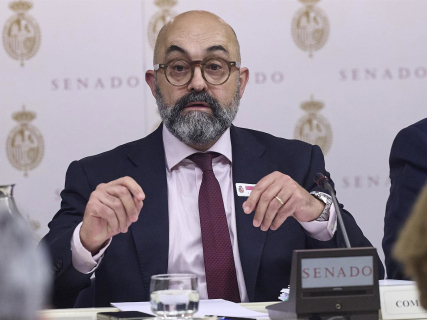

Adif denied this Monday that it refuses to apply the safety recommendations formulated by the Railway Accident Investigation Commission (CIAF) and maintains that its response regarding the signal overrunning incident in Cuenca-Fernando Zóbel is based on technical criteria to determine which proposals can be assumed, which require further study, and which it considers should not be implemented.
At the same time, the railway operator has stressed that its president, Luis Pedro Marco de la Peña, has never decided "never" to increase spending on maintenance.
Through two public notes, the infrastructure manager has defended both its position regarding the CIAF recommendations and the evolution of the items allocated to the upkeep of the network. According to the data provided by the entity itself, the maintenance budget has risen from 703 million euros in 2018 to 1.375 billion in 2026.
In relation to the incident recorded in Cuenca-Fernando Zóbel in June 2024, which Adif has described as "isolated", the company indicates that it has prepared a "highly justified" technical report on the measures suggested by the CIAF. It specifies that some of them are already implemented, while others could generate undesired effects if applied as formulated.
The entity emphasizes that its obligation is to respond through an allegation and recalls that the CIAF recommendations are not automatically applicable.
Arguments on the three questioned measures
Adif details the reasons why it concludes that it is not appropriate to apply three of the proposed measures, although it leaves open the possibility of carrying out specific analyses and requests clarifications on possible additional actions.
The first recommendation refers to studying the removal of ERTMS level 1 in the sections where it operates together with level 2, including the suppression of FF7D, after a risk and capacity analysis. The administrator argues that level 1 provides support in modification phases, in situations of radio unavailability, and during the migration from GSM-R to FRMCS, so it considers it advisable to keep it active. It adds that any modification would require a joint analysis by the sector.
As for the use of automatic route-setting devices in ASFA as a transitional measure on lines equipped with level 2 ERTMS while it is not yet in service, Adif maintains that it is an aid to operation and "in no case" a safety installation.
On this point, it warns that extending its use in a generalized way could reduce the line’s capacity and lead to counterproductive situations. For this reason, it argues that any eventual implementation should be subject to a specific and detailed study, which it does not rule out undertaking.
The third measure proposes ensuring in the particular technical specifications documents of the CMS projects the technical compatibility with adjoining sections. Adif argues that such compatibility is already guaranteed through European regulations, its own engineering rules and ETCS/ESC controls.
In this regard, it cites Regulation (EU) 2023/1695 and instruction "Adif-IT-101-003-015-SC-053". However, it requests clarification in case it would be possible to introduce additional actions that strengthen safety and notes that it remains awaiting a new communication on the matter.
The recommendations stem from an incident that occurred on June 25, 2024, when an AVE that was covering the route between Murcia and Madrid improperly passed a departure signal in Cuenca-Fernando Zóbel. The ERTMS system automatically stopped the train, but subsequently the resumption of travel was authorized without the overrunning having been detected. The episode, without victims, led CIAF to propose technical improvements and a review of circulation procedures.
Defense of the maintenance budget
In parallel, Adif states that its president recorded for 2026 the amount allocated to conservation and maintenance of the infrastructure that the management conveyed to him, assuming that proposal and incorporating it into the budget project.
The entity thus rejects that Marco de la Peña chose not to increase this investment and emphasizes that the maintenance budget has increased in recent years, reaching the 1.375 billion euros planned for 2026, compared with the 703 million of 2018.