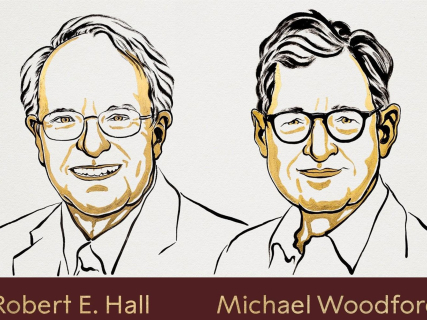

The Royal Swedish Academy of Sciences has awarded this Monday, October 12, the 2026 Nobel Prize in Economics to Michael Woodford and Robert E. Hall, two prominent American researchers whose contributions have helped transform the understanding of how modern economies function. The recognition distinguishes their work on the microeconomic foundations of macroeconomic stabilization, a field of research essential to understanding how markets, firms, and consumers respond to economic policy decisions.
The award, officially named the Sveriges Riksbank Prize in Economic Sciences in Memory of Alfred Nobel, is endowed with 12 million Swedish crowns, which the two researchers will have to share. With this decision, the Academy focuses on the study of the mechanisms that allow governments and central banks to act in response to fluctuations in economic activity, price variations, and labor market issues, issues that are especially relevant in a global scenario marked by economic uncertainties.
Who are Michael Woodford and Robert E. Hall, the 2026 Nobel Prize winners in Economics
Michael Woodford is one of the leading academic figures in the field of modern macroeconomics and monetary policy. His research has contributed to explaining how central bank decisions influence the expectations of consumers, firms, and investors, as well as the behavior of inflation and economic activity. One of his most well-known contributions is related to the importance of communication from monetary authorities and their ability to guide expectations about the future evolution of interest rates.
This approach is especially relevant for understanding the functioning of institutions such as the European Central Bank (ECB) or the Federal Reserve of the United States, whose decisions not only affect the immediate cost of money, but also the economic forecasts of agents. The possibility of anticipating the evolution of interest rates can influence investment, consumption, and financing decisions even before actual changes in monetary policy occur.
For his part, Robert E. Hall has developed a research trajectory focused on the labor market, unemployment, and economic cycles. His works have allowed to deepen the analysis of how hiring and job destruction evolve during the different phases of expansion and contraction of the economy, as well as the factors that explain the persistence of unemployment.
The contributions of both researchers address different but complementary dimensions of macroeconomics. While Woodford has delved into the functioning of monetary policy and the formation of expectations, Hall has contributed to explain the dynamics of employment and economic fluctuations, two areas that are fundamental to design policies aimed at limiting the effects of crises.
A recognition of the tools to face economic crises
The research of Woodford and Hall acquires special importance in the analysis of economic stabilization policies, that is, the measures that authorities can adopt to reduce the oscillations of productive activity, contain inflation, and limit the increase of unemployment. This type of policies seeks to mitigate the effects of recessions and prevent economic imbalances from prolonging over long periods.
One of the main challenges of macroeconomics consists precisely in understanding how the individual decisions of families, workers, and companies end up influencing the whole of the economy. The models developed based on these foundations allow to study, for example, why a rise in interest rates can reduce consumption, how companies react to a drop in demand or what circumstances can cause unemployment to remain high even when a recovery begins.
In this context, the work of the two awardees has contributed to the development of theoretical tools used to analyze the consequences of economic decisions. Their relevance extends to the debate on the balance between price control, employment maintenance, and growth stability, although the concrete results of each measure depend on the conditions of the economy in which it is applied.
From creative destruction to economic stability: the latest Nobel
The recognition of 2026 occurs after that granted in 2025 to Joel Mokyr, Philippe Aghion, and Peter Howitt, distinguished for their research on the relationship between technological innovation and sustained economic growth. Their work helped to understand how the emergence of new technologies and production methods can drive the development of economies and improve long-term welfare levels.
One of the main contributions recognized was the theory of "creative destruction," developed by Aghion and Howitt, which explains how innovations displace previous products, technologies, and business models. This process can generate new economic opportunities and increases in productivity, but it also forces companies and workers to adapt to changes.
In 2024, the Nobel Prize in Economics went to Daron Acemoglu, Simon Johnson, and James A. Robinson, for their research on how institutions are formed and how they condition the prosperity of countries. A year earlier, in 2023, the economist Claudia Goldin was recognized for her contributions to the understanding of the situation of women in the labor market and the historical factors that explain the differences in income and participation between men and women.
These distinctions reflect the diversity of issues addressed by economic research. While some studies attempt to explain the differences in wealth between countries or the causes of long-term growth, others analyze how labor markets function, what causes crises, and what instruments can be used to reduce their consequences.
A Nobel created more than 60 years after the original prizes
The Nobel Prize in Economics has a particularity compared to the rest of the awards: it was not included among the categories established by Alfred Nobel in his will. It was created in 1968 by the Central Bank of Sweden, on the occasion of the 300th anniversary of the institution, and began to be awarded in 1969.
Since then, the Royal Swedish Academy of Sciences has been responsible for selecting the laureates through an academic evaluation procedure. The recognition has consolidated itself as one of the most prestigious in the field of economic research and has distinguished specialists in monetary policy, development, game theory, financial markets, inequality, and behavioral economics.
The official delivery of the Nobel Prize in Economics 2026 will take place on the next December 10 in Stockholm, coinciding with the anniversary of the death of Alfred Nobel. Woodford and Hall will then receive the diploma, the medal, and the corresponding financial endowment, in a ceremony that will bring together the awardees from the different scientific disciplines and Literature.